







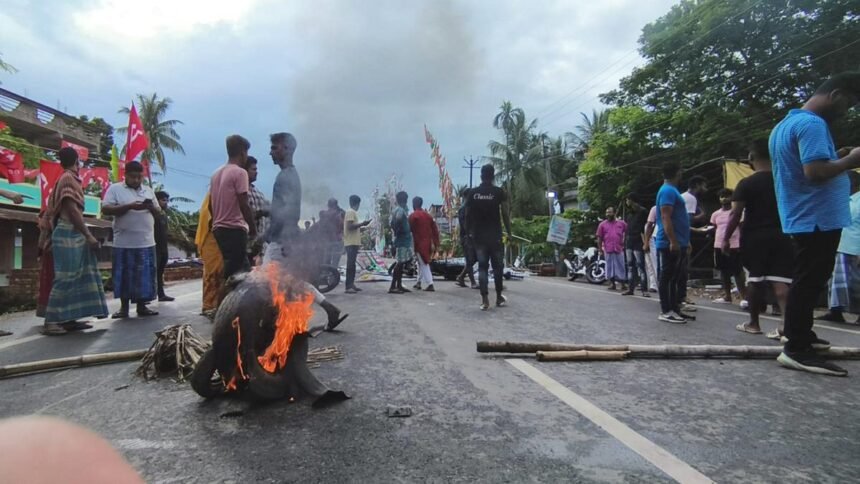
In a rare display of unity cutting across ideological lines, all political parties in West Bengal expressed strong condemnation over the killing of nine people in various parts of the state during the ongoing panchayat elections. The opposition Bharatiya Janata Party (BJP) and Communist Party of India (Marxist) (CPI(M)) accused the State Election Commission (SEC) of failing to deploy central forces as mandated by the orders of the Calcutta High Court.
The ruling Trinamool Congress (TMC), despite losing five of its own supporters to poll violence, raised concerns about the absence of central forces that had been brought in for the elections. This incident has brought to the forefront the contentious issue of maintaining law and order during elections and has triggered a debate on the role of security forces.
The violence occurred against the backdrop of the ongoing panchayat elections in West Bengal. These elections are of immense significance as they serve as a direct representation of local governance and determine the functioning of grassroots democracy. However, the recent spate of violence has marred the democratic process and raised serious concerns about the state’s ability to ensure a safe and fair electoral environment.
Political parties across the spectrum have come forward to condemn the killings, expressing their deep anguish and sorrow over the loss of lives. The BJP and CPI(M) were particularly critical of the SEC, alleging that it had disregarded the orders of the Calcutta High Court, which had explicitly directed the deployment of central forces to maintain law and order during the elections. The absence of these forces was seen as a major contributing factor to the violence that unfolded.
On the other hand, the ruling TMC, despite facing the brunt of the violence with the loss of its own supporters, questioned the reasons behind the non-deployment of central forces. They emphasized the need for a robust security presence during elections to prevent such incidents from occurring. The absence of central forces, which had been brought in specifically for the panchayat elections, raised doubts about the effectiveness of the security arrangements made by the authorities.
The incidents of violence have sparked widespread concern and have drawn attention to the urgent need for reforms in the electoral process. The safety and security of voters and candidates should be of paramount importance, and the state must ensure a conducive environment for free and fair elections. The involvement of central forces is seen as a crucial step towards achieving this goal, as their presence can act as a deterrent to violence and instill confidence among the electorate.
The state government, in coordination with the SEC, must investigate the circumstances leading to the violence and take appropriate action against those responsible. Additionally, efforts should be made to enhance the coordination between the state police and central forces to ensure seamless security arrangements during elections. It is imperative to address the concerns raised by political parties and the public to restore faith in the electoral process and prevent any further loss of life.
The recent incidents of violence in West Bengal have once again brought to the forefront the challenges faced by the state in maintaining law and order during elections. The need for a comprehensive approach that involves the active participation of all stakeholders, including political parties, law enforcement agencies, and election commissions, cannot be overstated. Only through concerted efforts can West Bengal and other states across the country ensure peaceful and fair elections, strengthening the foundations of democracy.

