

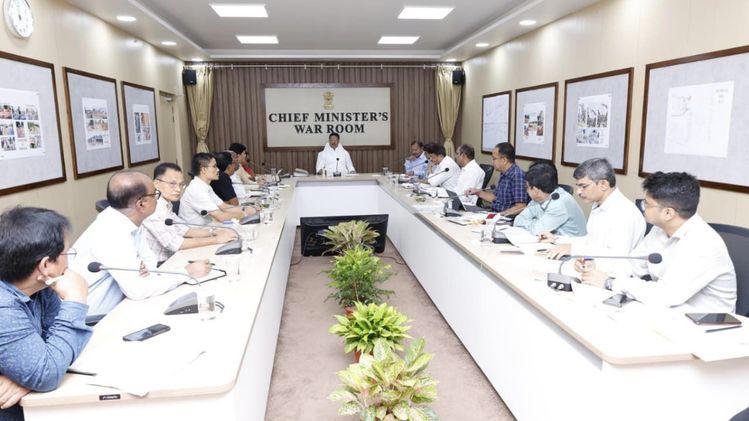
Tripura Chief Minister Manik Saha recently chaired a crucial statewide review meeting with all District Magistrates, focusing on welfare-oriented governance. The meeting highlighted the government’s efforts to strengthen welfare delivery, ensure transparency, and push for people-centric administration across the state.
CM Saha stresses accountability
Opening the meeting, Chief Minister Saha urged district officials to work with greater accountability. He emphasized that governance must not only address policy implementation but also bring visible changes in people’s lives. According to him, efficient execution of welfare schemes can create a stronger bond between citizens and the administration.
Read More: Sikkim DACS Signs MoU With ITBP for Local Farm Produce
He reminded officers that the government stands committed to ensuring that the benefits of welfare initiatives reach every household. To achieve this, he asked the District Magistrates to monitor ground-level execution more closely and address bottlenecks without delay.
Focus on grassroots delivery
The meeting placed special attention on grassroots delivery of services. Chief Minister Saha stated that real governance takes place at the village and ward levels, where officials interact directly with citizens. He insisted that district administrations should prioritize accessibility and responsiveness.
He asked the officers to make sure that beneficiaries do not face hurdles while availing schemes related to health, education, housing, and social security. By removing procedural delays, the government aims to instill public confidence in administrative mechanisms.
Strengthening welfare schemes
Several flagship programs formed the core of the discussion. Schemes related to rural development, women’s empowerment, skill training, and youth employment received significant attention. The Chief Minister urged District Magistrates to streamline processes for faster approvals and smooth disbursement of funds.
He also pointed out the need for better coordination among different departments. Integration, he noted, can reduce duplication of efforts and help extend the reach of welfare initiatives. Such coordination ensures that no eligible family is left out of the system.
Transparency and monitoring
The Chief Minister emphasized the importance of transparency in welfare delivery. He directed the officers to adopt digital monitoring systems to track scheme implementation. Regular audits, he suggested, would help identify loopholes and fix issues before they affect beneficiaries.
Public grievance redressal also featured prominently in the discussion. Saha asked every district administration to respond promptly to complaints, ensuring that citizens do not feel neglected. This, he explained, would encourage trust in the government and its promises.
Infrastructure and rural development
The review also covered the state’s progress in building rural infrastructure. Projects related to roads, drinking water, and housing were discussed at length. Chief Minister Saha said that such developments not only improve living conditions but also enhance the delivery of welfare programs.
He reminded the officials that rural development cannot be seen separately from welfare initiatives. Roads, water supply, and electricity serve as the foundation for effective governance, and therefore, their timely completion must remain a top priority.
Special attention to vulnerable groups
The Chief Minister underscored the government’s commitment to supporting vulnerable groups. Older people, differently-abled citizens, and economically weaker families remain at the center of welfare planning. Saha directed the officials to pay extra attention to their needs and ensure inclusivity in every scheme.
He highlighted that welfare-oriented governance means leaving no one behind. As such, programs must be designed and implemented in ways that directly uplift those most in need.
Role of District Magistrates
Chief Minister Saha reminded the District Magistrates of their critical role in shaping public trust. He described them as the bridge between policy and practice. According to him, their ability to take swift decisions and oversee grassroots delivery makes them central to governance success.
He asked them to personally review projects, interact with beneficiaries, and identify challenges faced by citizens. Their presence and proactive approach, he noted, can inspire confidence in government institutions.
Public feedback mechanism
During the review, Saha also encouraged the introduction of systematic public feedback mechanisms. He explained that direct feedback helps the government measure its performance more effectively. District administrations should organize community interactions, surveys, and open forums to listen to people’s views.
Such engagements, he said, allow officials to identify areas where citizens expect improvement. They also help in reshaping programs to suit local needs more accurately.
Balancing growth and welfare
In his closing remarks, the Chief Minister spoke about balancing economic growth with social welfare. He noted that while Tripura continues to make strides in infrastructure and investment, governance must remain centered on people’s welfare. Sustainable development, according to him, emerges only when both growth and social equity move together.
He encouraged the district administrations to adopt innovative methods and community participation models to ensure that welfare remains a collective effort.
Chief Minister Manik Saha’s statewide review with District Magistrates reaffirmed Tripura’s focus on welfare-oriented governance. By emphasizing accountability, transparency, and inclusivity, the government seeks to ensure that every citizen benefits from welfare schemes without hurdles.
The review not only highlighted the progress made but also outlined areas that require immediate attention. As Saha stressed, the ultimate goal of governance is to improve lives, strengthen trust, and build a state where development and welfare walk hand in hand.
Read More: Assam Rifles Seizes Arms Cache in Mizoram