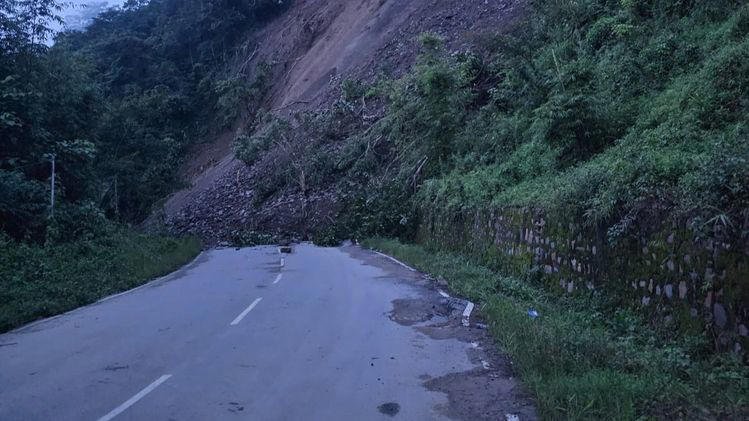
Nagaland landslide NH-2 disrupted traffic near Tsiesema Basa village, creating difficulties for commuters and goods transport. The sudden roadblock forced the district administration to notify an alternative route for light motor vehicles (LMVs). Heavy rainfall in the past few days triggered the landslide, leaving the highway impassable for larger vehicles.
The National Highway-2 serves as one of the most crucial lifelines for Nagaland, connecting Kohima to Dimapur and other parts of the Northeast. With this blockage, traffic congestion and delays became inevitable, prompting officials to act quickly.
Read More: Tripura CM Urges Clubs to Curb Noise and Subscriptions for Mayer Gaman
Nagaland landslide NH-2 causes major disruption
The landslide occurred near Tsiesema Basa, a point prone to soil erosion during monsoon months. Eyewitnesses reported that debris and mudslides covered a large stretch of the road, making movement impossible. Local authorities rushed to the spot and initiated clearance operations, though progress remained slow due to continuous rainfall.
The district administration confirmed that heavy vehicles cannot use the road until it is fully cleared. This has severely affected the supply of essentials, fuel, and other goods. However, officials assured that restoration work has already begun, with machinery deployed to speed up the process.
Alternative route for LMVs notified
To ease the pressure, an official notification announced a temporary diversion route exclusively for LMVs. The alternative route will help maintain essential traffic flow while ensuring safety. Authorities also appealed to commuters to avoid unnecessary travel through the affected stretch to reduce congestion.
The alternate route is expected to serve as a short-term measure. Officials emphasized that the priority remains clearing NH-2 for regular use, given its significance as a commercial and passenger route. Local residents and travelers have been advised to follow traffic updates and cooperate with the administration.
Impact of Nagaland landslide NH-2 on commuters
The disruption has led to longer travel times, with vehicles being diverted through less accessible village roads. Daily commuters, especially office workers and students, face delays in reaching their destinations. Transporters carrying perishable goods also expressed concerns over losses due to the extended travel hours.
The Nagaland landslide NH-2 incident highlights the challenges faced by the hill state during monsoon seasons. Landslides often result in road closures, posing risks to safety and livelihoods. Many residents urged for long-term solutions such as protective walls, better drainage, and stronger road infrastructure to prevent frequent roadblocks.
Government’s response and restoration work
Officials assured that clearing operations are underway with teams of workers, excavators, and loaders deployed at the site. However, continued rainfall is slowing down progress. The administration said that partial restoration for LMVs might be possible in the coming days if weather conditions improve.
Meanwhile, the Public Works Department and disaster management teams are monitoring other vulnerable spots along NH-2. This preventive approach aims to ensure no further blockages occur in nearby stretches.
Long-term concerns for Nagaland’s highways
The Nagaland landslide NH-2 incident once again draws attention to the need for robust infrastructure planning in the state. The hilly terrain combined with intense rainfall makes highways vulnerable. Experts recommend investing in slope stabilization projects, better water outlets, and early warning systems.
Residents also called for coordinated efforts between state agencies and national authorities to improve highway resilience. As NH-2 plays a vital role in linking Nagaland with neighboring states, maintaining its safety is critical.
Travelers urged to stay cautious
Authorities have urged travelers to remain cautious, particularly those driving small vehicles through the diversion routes. Slippery roads and narrow lanes pose risks, especially during continuous rainfall. Passengers are advised to check traffic updates before starting their journey.
In addition, local community volunteers have joined the efforts by helping guide vehicles along the alternative routes. Their role has been crucial in ensuring smooth movement of LMVs through the affected areas.
The Nagaland landslide NH-2 near Tsiesema Basa has disrupted daily life and trade, underscoring the vulnerability of highways in hilly regions. While the administration swiftly provided an alternative route for LMVs, the urgency of restoring the main highway remains clear. Long-term planning and stronger infrastructure will be essential to reduce such disruptions in the future.