




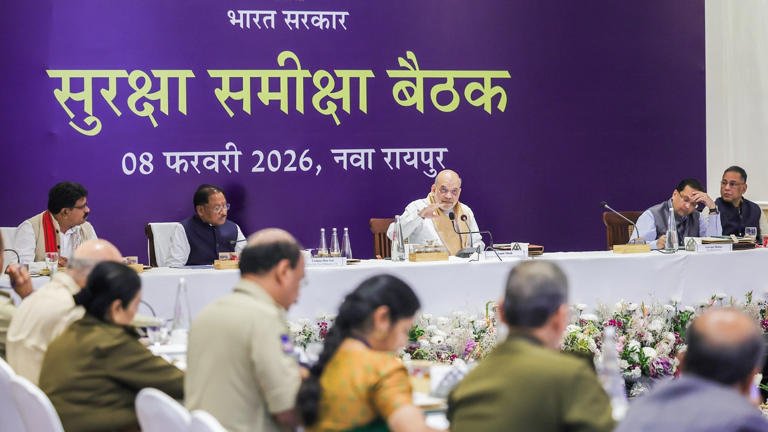
Union Home Minister Amit Shah on Tuesday asserted that the Maoist problem is not linked to development, reiterating that the Centre has set a clear March deadline to uproot Naxalism from the country. Speaking during his visit to Chhattisgarh, Shah said security action and governance reforms are moving in tandem to eliminate left-wing extremism.
Addressing security personnel and officials, the home minister said the narrative that underdevelopment fuels Maoism is misleading. He stressed that several regions affected by Naxal violence have received sustained development interventions over the years. Therefore, he argued, violence cannot be justified in the name of deprivation.
The statement comes as the Centre intensifies operations against Maoist groups, particularly in Chhattisgarh, which remains one of the most affected states.
Read More: Tripura CM Warns of Exposing ‘Unethical’ Conduct of TTAADC
Maoist issue not linked to development, says Amit Shah
Amit Shah said the Maoist issue not linked to development must be understood clearly to address the problem decisively. According to him, roads, schools, healthcare facilities, and welfare schemes have reached many remote areas, yet extremist violence continues.
He said Maoism thrives on ideology and coercion rather than genuine grievances. Therefore, security forces must continue firm action while the administration ensures governance reaches every village.
Shah added that the government will not allow armed groups to derail democratic processes under any pretext.
March deadline to uproot Naxalism reiterated
The home minister reiterated the Centre’s March deadline to uproot Naxalism, saying significant progress has already been made. He said coordinated action between central forces and state police has weakened Maoist networks.
According to Shah, many districts have been removed from the list of worst-affected areas in recent years. Violence incidents and fatalities have also declined steadily.
The Maoist issue not linked to development, he said, reinforces the need for decisive security operations without ideological hesitation.
Chhattisgarh at the centre of operations
Chhattisgarh remains central to the government’s anti-Naxal strategy due to dense forest terrain and long-standing Maoist presence. Shah praised security forces for sustained operations in difficult conditions.
He said improved intelligence, modern equipment, and better coordination have enhanced operational success. The government, he added, has provided full logistical and policy support to forces deployed in the region.
The home minister stressed that no area would remain outside the reach of the law.
Development continues alongside security action
While rejecting the link between Maoism and development, Shah said the government remains committed to inclusive growth. He highlighted infrastructure projects, welfare delivery, and employment schemes in tribal and remote areas.
The Maoist issue not linked to development, he said, does not mean development will slow down. Instead, governance and security will progress together.
He added that development initiatives gain effectiveness only when violence and intimidation end.
Strong message to Maoist cadres
Shah issued a clear message to Maoist cadres, urging them to surrender and join the mainstream. He said the government offers rehabilitation and support to those who abandon violence.
However, he warned that those who continue armed struggle will face decisive action. The March deadline, he said, reflects the government’s resolve to end the menace completely.
The Maoist issue not linked to development, he added, removes any moral justification for continued violence.
Decline in Maoist influence
Officials accompanying the home minister said Maoist influence has shrunk considerably across central and eastern India. Improved road connectivity and communication have reduced safe havens.
Security agencies said arrests, surrenders, and neutralisation of top leaders have weakened command structures. Shah credited this success to consistent policy and political will.
He said Chhattisgarh’s experience shows that sustained pressure delivers results.
Political and security implications
Political observers said Shah’s remarks signal a firm ideological stance by the Centre. By separating development from Maoism, the government seeks to delegitimise extremist narratives.
The Maoist issue not linked to development framing also strengthens the case for robust security measures. Analysts said this approach leaves little room for ambiguity in policy.
Opposition parties, however, may continue to argue for a stronger development-centric approach.
Role of state government and forces
Shah praised the Chhattisgarh government and local police for cooperation with central agencies. He said state support remains crucial for intelligence gathering and community outreach.
The home minister said morale of forces remains high due to political backing and clear objectives. Regular reviews, he added, ensure accountability and adaptability.
The March deadline, he said, requires continued coordination at all levels.
Impact on local communities
Shah said ending Naxalism will directly benefit local communities by restoring peace and enabling uninterrupted development. Fear and extortion, he said, have long blocked progress in affected areas.
Once security stabilises, schools, healthcare services, and markets can function normally. Therefore, eliminating Maoism remains a prerequisite for lasting prosperity.
The Maoist issue not linked to development, he said, highlights that violence itself is the main obstacle.
What lies ahead
In the coming months, security operations are expected to intensify further. The Centre will continue monitoring progress toward the March deadline.
Officials said focus will remain on intelligence-led operations, surrenders, and rehabilitation. At the same time, governance outreach will expand in reclaimed areas.
The government said success will be measured not only by reduced violence but also by restored normalcy.
Conclusion
Union Home Minister Amit Shah’s assertion that the Maoist issue is not linked to development, made during his Chhattisgarh visit, underscores the Centre’s uncompromising stance against left-wing extremism. By reiterating a March deadline to uproot Naxalism, the government has signalled clear intent and urgency.
As security operations intensify, the coming months will test whether coordinated action and political resolve can finally end decades of Maoist violence. If achieved, it would mark a major milestone in restoring peace, governance, and stability in some of India’s most affected regions.
Read More: President’s Rule Lifted in Manipur After Nearly a Year