





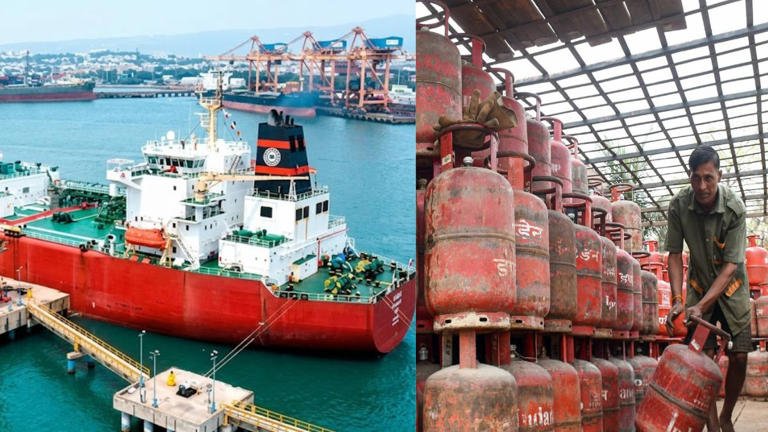
An Indian naval vessel, INS Shivalik, successfully escorted a tanker carrying about 40,000 metric tonnes of liquefied petroleum gas (LPG) through the strategically important Strait of Hormuz before the ship entered open sea safely. The development highlights the importance of maritime security for energy shipments bound for India and other countries.
The LPG cargo aboard the tanker represents a significant quantity of cooking fuel that can supply millions of households. Officials monitoring maritime routes have emphasized that safe navigation through the Strait of Hormuz remains critical because a large portion of the world’s oil and gas shipments pass through this narrow waterway connecting the Persian Gulf with the Arabian Sea.
Read More: Tripura CM Attends PM-Kisan Installment Event in Agartala
Strategic Importance Of The Strait Of Hormuz
The Strait of Hormuz is considered one of the most important maritime chokepoints in global energy trade. A significant percentage of the world’s crude oil and LPG shipments travel through this route every day.
Because of its strategic location, the strait often attracts global attention whenever geopolitical tensions rise in the region. Countries that rely heavily on energy imports closely monitor shipping movements through this passage.
For India, the route remains extremely important since a large share of its crude oil and LPG imports come from Gulf countries. Ensuring safe navigation through this corridor therefore remains a priority for maritime authorities and naval forces.
Role Of INS Shivalik In Escorting Vessel
INS Shivalik, a frontline stealth frigate of the Indian Navy, escorted the LPG tanker as it navigated through the Strait of Hormuz. Naval escorts are sometimes provided in sensitive maritime zones to ensure the safety of commercial vessels carrying critical cargo.
The presence of naval ships helps deter potential security threats and ensures uninterrupted passage for energy shipments.
INS Shivalik belongs to India’s advanced Shivalik-class stealth frigates, which are designed for multi-role operations including maritime security, anti-submarine warfare, and escort missions.
Such deployments highlight the importance of naval readiness in safeguarding energy supply routes that are essential for India’s economy.
Cargo Carrying 40,000 Metric Tonnes Of LPG
The tanker escorted by INS Shivalik carried approximately 40,000 metric tonnes of LPG cargo. Liquefied petroleum gas serves as one of the most widely used fuels for cooking and heating in many countries, including India.
LPG shipments from the Gulf region form a crucial part of India’s energy imports. The safe arrival of such shipments ensures uninterrupted supply to households and commercial users across the country.
Energy experts note that large cargo shipments like this play a vital role in maintaining supply chains for domestic cooking gas distribution networks.
How Many Domestic Cylinders Can 40,000 MT LPG Fill?
To understand the scale of the shipment, it is helpful to calculate how many domestic LPG cylinders the cargo could fill.
In India, the standard domestic LPG cylinder typically contains 14.2 kilograms of LPG. Therefore, converting the cargo volume into kilograms provides a clearer picture.
Forty thousand metric tonnes equals 40,000,000 kilograms of LPG. When this quantity is divided by 14.2 kilograms per cylinder, the cargo could theoretically fill approximately 2.8 million domestic LPG cylinders.
This means that a single tanker carrying 40,000 metric tonnes of LPG could potentially supply cooking gas to nearly 28 lakh households for one refill cycle.
Such calculations demonstrate the scale of energy shipments transported through international maritime routes.
Importance Of LPG For Indian Households
LPG has become one of the most widely used cooking fuels in India, particularly after the expansion of domestic LPG connections through government programs.
Millions of households rely on LPG cylinders for daily cooking needs because the fuel burns efficiently and produces fewer pollutants compared to traditional fuels such as firewood.
Regular supply of LPG therefore remains essential for both urban and rural households.
Large shipments transported through international sea routes help maintain stable supply levels and prevent shortages in domestic markets.
Maritime Security And Energy Supply
The safe escort of the LPG tanker through the Strait of Hormuz highlights the link between maritime security and energy supply chains.
Energy shipments often travel long distances through sensitive regions, making them vulnerable to disruptions caused by geopolitical tensions or security threats.
Naval forces from various countries often monitor key shipping lanes to ensure the uninterrupted flow of energy supplies.
For India, protecting maritime trade routes remains a strategic priority because the country imports a large portion of its energy requirements.
Ensuring the safety of shipping lanes helps maintain stable supply and prevents disruptions in domestic fuel availability.
India’s Dependence On Energy Imports
India is one of the world’s largest importers of crude oil and LPG. A substantial share of these imports originates from countries in the Middle East.
Because of this reliance, maintaining secure maritime transport routes becomes crucial for the country’s energy security.
Large shipments of LPG, such as the 40,000 MT cargo escorted by INS Shivalik, contribute to sustaining domestic energy supply.
The ability of naval forces to safeguard shipping routes therefore plays an important role in ensuring economic stability.
Safe Entry Into Open Sea
After successfully navigating the Strait of Hormuz, the LPG tanker escorted by INS Shivalik entered open sea safely. This marks an important step in the vessel’s journey toward its destination port.
The safe passage of the vessel demonstrates the effectiveness of maritime coordination and security measures implemented in the region.
Such operations also highlight the role of naval forces in supporting commercial shipping and protecting global energy supply chains.
With energy shipments continuing to move through critical maritime corridors, the safe escort of vessels like this LPG tanker underscores the importance of maritime security in ensuring uninterrupted fuel supply to millions of households.
Read More: PM Modi’s Leadership Turned Dreams Into Achievements in Assam: Sarma