




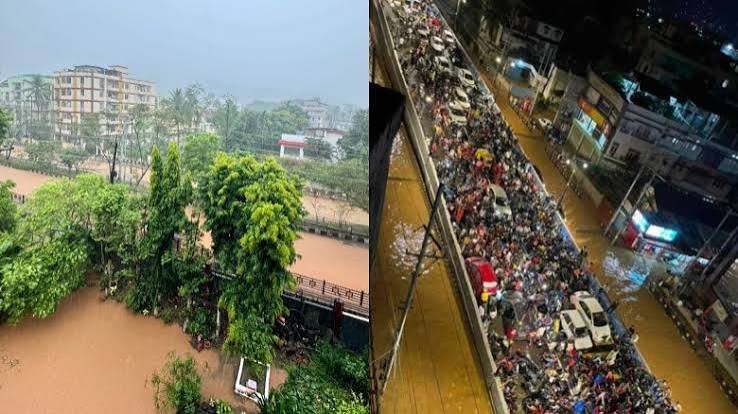
The Guwahati Water Row moved toward cooperation as Meghalaya Chief Minister Conrad Sangma agreed to establish a joint mechanism with Assam to study hilltop runoff issues. According to the available information, the initiative aims to examine water flow patterns from Meghalaya’s hill areas and understand their impact on flooding and drainage challenges in neighbouring Assam regions, particularly Guwahati.
Chandel Security Outposts: Two New Permanent Border Police Posts Established
The Guwahati Water Row update highlights efforts by both states to address environmental and urban water management concerns through coordination rather than disagreement. According to the available information, the proposed joint mechanism will involve studying runoff patterns, assessing possible causes, and identifying measures to improve water management.
Hilltop runoff has become an important issue in discussions surrounding urban flooding, drainage capacity, and environmental management. Moreover, scientific studies can help authorities develop practical solutions based on accurate data and coordinated planning.
The latest development underscores the importance of interstate cooperation in addressing shared environmental challenges. Therefore, Assam and Meghalaya authorities are expected to work together to better understand water movement across their geographical boundaries.
The initiative also reflects the need for sustainable urban planning in rapidly growing areas. Additionally, improved coordination between neighbouring states can support better flood prevention strategies and infrastructure planning.
Guwahati Water Row Leads to Joint Environmental Assessment
The Guwahati Water Row has encouraged discussions between Assam and Meghalaya regarding the impact of hilltop runoff on low-lying areas. According to the available information, Meghalaya has agreed to participate in a joint study mechanism with Assam.
Moreover, a coordinated assessment can help identify how rainfall patterns, natural slopes, land use changes, and drainage systems influence water movement. Consequently, both states can develop more effective strategies for managing runoff-related challenges.
Scientific evaluations are important for separating natural factors from infrastructure-related concerns. Furthermore, joint studies allow experts from both regions to share data and develop solutions based on technical findings.
The available information confirms that Meghalaya Chief Minister Conrad Sangma agreed to the joint mechanism. However, authorities have not announced the composition of the study team, timeline, methodology, or specific recommendations expected from the assessment.
Authorities Focus on Cooperation Through Guwahati Water Row Mechanism
The Guwahati Water Row initiative reflects a shift toward collaborative water management between Assam and Meghalaya. Officials from both states are expected to coordinate efforts to study runoff patterns and explore possible mitigation measures.
Additionally, interstate cooperation can improve understanding of environmental issues that extend beyond administrative boundaries. This coordinated approach supports better planning for drainage systems, flood management, and urban infrastructure.
Authorities continue examining ways to strengthen climate resilience and address recurring water-related challenges. Meanwhile, technical assessments can provide valuable information for future policy decisions and infrastructure improvements.
The available information does not mention any final agreement on infrastructure projects, funding arrangements, or implementation schedules. Therefore, the current update focuses on the decision to create a joint mechanism for studying hilltop runoff.
Further official announcements may provide additional details regarding the study process and proposed solutions.
Guwahati Water Row Highlights Need for Sustainable Water Management
The Guwahati Water Row highlights the importance of scientific planning and regional cooperation in addressing complex environmental issues. Effective water management requires coordination between states, local authorities, experts, and communities.
Moreover, climate change, rapid urban expansion, and changing rainfall patterns have increased the need for improved drainage and flood management strategies. Consequently, data-driven solutions can play an important role in reducing future risks.
The agreement between Meghalaya and Assam demonstrates the value of dialogue in resolving shared concerns. Similarly, joint environmental studies can strengthen relationships between neighbouring states while supporting sustainable development.
Improving water management remains a key priority for urban and regional planning. Therefore, the Guwahati Water Row update reinforces the importance of cooperation, scientific assessment, and long-term environmental planning.
As the joint mechanism progresses, future updates may provide further information regarding findings, recommendations, and possible mitigation measures.
Conclusion
The Guwahati Water Row has entered a cooperative phase after Meghalaya CM Conrad Sangma agreed to a joint mechanism with Assam to study hilltop runoff. The initiative is expected to improve understanding of water flow patterns and support better flood and drainage management strategies.
Furthermore, collaboration between Assam and Meghalaya can help address shared environmental concerns through scientific research and coordinated planning. Continued engagement between both states will remain important for developing sustainable solutions.
Overall, the Guwahati Water Row update highlights the importance of interstate cooperation, technical assessment, and responsible water management in addressing regional challenges.
FAQs
1. What is the latest update on the Guwahati Water Row?
The Guwahati Water Row update confirms that Meghalaya CM Conrad Sangma agreed to a joint mechanism with Assam to study hilltop runoff.
2. Why is hilltop runoff being studied?
The study aims to understand water flow patterns and assess their impact on flooding and drainage issues in areas around Guwahati.
3. Which states are involved in the joint mechanism?
The mechanism involves Assam and Meghalaya working together on the runoff assessment.
4. Has the study timeline been announced?
No. The available information does not mention the timeline, members of the study team, or the methodology.
5. What could be the outcome of the joint study?
The study may help authorities develop better water management, drainage planning, and flood mitigation strategies.