







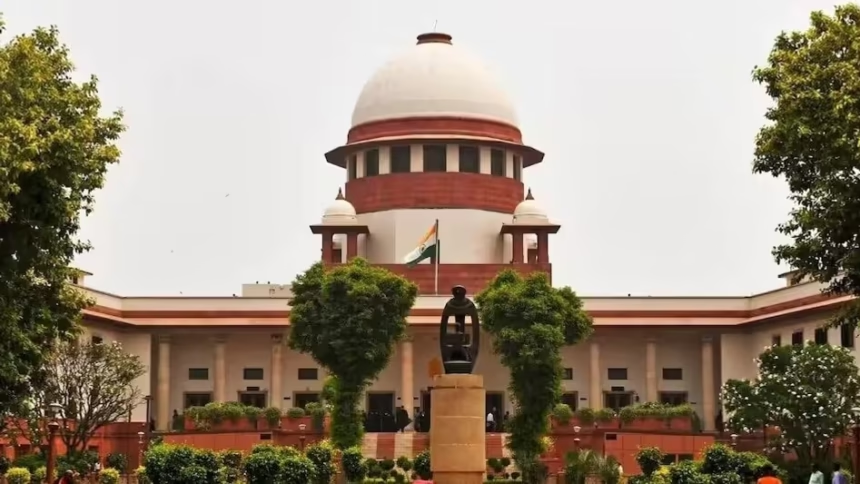
Aizawl, August 29: The Supreme Court has allowed a petitioner to challenge the constitutional validity of the 2026 amendments to Mizoram’s marriage, divorce and inheritance law before the Gauhati High Court. A three-judge bench led by Chief Justice of India Surya Kant declined to hear the petition directly at this stage.
However, the court allowed the petitioner to approach the principal bench of the Gauhati High Court, subject to the Chief Justice’s approval. The case raises concerns over alleged discrimination against Mizo women who marry non-Mizo men and their rights related to marriage, property and inheritance.
Read More: MPP Protests Killing of Four Naga Civilians in Manipur
Key Facts
- Case: Meriam L Hrangchal vs State of Mizoram
- Case number: Writ Petition (Civil) No. 1046/2026
- Court: Supreme Court of India
- CJI: Justice Surya Kant
- Other judges: Justice Joymalya Bagchi and Justice V Mohana
- Law challenged: Mizo Marriage, Divorce and Inheritance of Property Act, 2014
- Sections challenged: 2, 3(m), 25 and 26(1)
- Next forum: Gauhati High Court
Supreme Court Directs Petitioner to High Court
A three-judge Supreme Court bench headed by Chief Justice Surya Kant considered the constitutional challenge but declined to entertain the petition directly.
The bench observed that the Gauhati High Court could effectively examine the legal and constitutional questions raised in the case.
However, the Supreme Court took note of the petitioner’s concerns about pursuing the case before the Aizawl Bench of the Gauhati High Court.
The court therefore granted liberty to approach the principal bench of the Gauhati High Court, subject to the approval of its Chief Justice. The Supreme Court also indicated that the matter prima facie deserves preferential attention.
What Does the Petition Challenge?
The petition challenges amendments to Sections 2, 3(m), 25 and 26(1) of the Mizo Marriage, Divorce and Inheritance of Property Act, 2014.
The petitioner argues that the amendments create unequal treatment for Mizo women who marry men from outside the Mizo community.
According to the petition, the amended Section 2 covers marriages where both spouses are Mizo or where the husband is Mizo. The petitioner argues that this framework excludes Mizo women who marry non-Mizo men.
Dispute Over Definition of “Mizo”
The petitioner has also challenged the revised definition of “Mizo” under Section 3(m).
The plea alleges that the amended definition introduces a patrilineal criterion. It reportedly recognises individuals based on their birth or whether their father belongs to a Mizo tribe.
The petitioner argues that this approach could affect the independent identity of Mizo women. It could also create unequal consequences for children born to Mizo women who marry non-Mizo men.
Concerns Over Property and Inheritance Rights
The legal challenge also raises concerns about inheritance, succession, property and community-linked land rights.
Another major issue involves Section 25. The petitioner has challenged its provision that places a statutory limitation on a woman’s share in matrimonial property.
The petition also objects to changes under Section 26(1). According to the petitioner, the amendment removes an explicit safeguard that previously protected a woman’s personal property from interference.
Wider Implications for Women’s Rights
The petitioner has argued that the amendments could have wider consequences for women’s proprietary and inheritance rights.
The plea also raises concerns about access to protections associated with Scheduled Tribe status and community-linked rights.
However, the Supreme Court has not ruled on the constitutional validity of the amended law. The court’s latest order only allows the substantive challenge to proceed before the Gauhati High Court.
What Happens Next?
The petitioner can now approach the principal bench of the Gauhati High Court, subject to the Chief Justice’s approval.
The High Court will then consider the constitutional and legal issues raised against the amended provisions.
What Is the Case About?
The case challenges the constitutional validity of amendments to Mizoram’s marriage, divorce and inheritance law, particularly their alleged impact on Mizo women marrying non-Mizo men.
Has the Supreme Court Struck Down the Law?
No. The Supreme Court has not decided the constitutional validity of the amendments. It has directed the petitioner to pursue the substantive challenge before the Gauhati High Court.
Which Provisions Are Under Challenge?
The petition challenges Sections 2, 3(m), 25 and 26(1) of the Mizo Marriage, Divorce and Inheritance of Property Act, 2014.
Location Context
Mizoram is a key state in Northeast India, where customary practices, community identity, marriage, inheritance and land rights have strong social and legal significance. The case could therefore draw wider attention to the relationship between customary protections, women’s rights and constitutional equality.
Also Read: Devastating Nepal Floods: PM, Ministers to Donate One Month’s Salary for Relief – Prime 24 Seven