







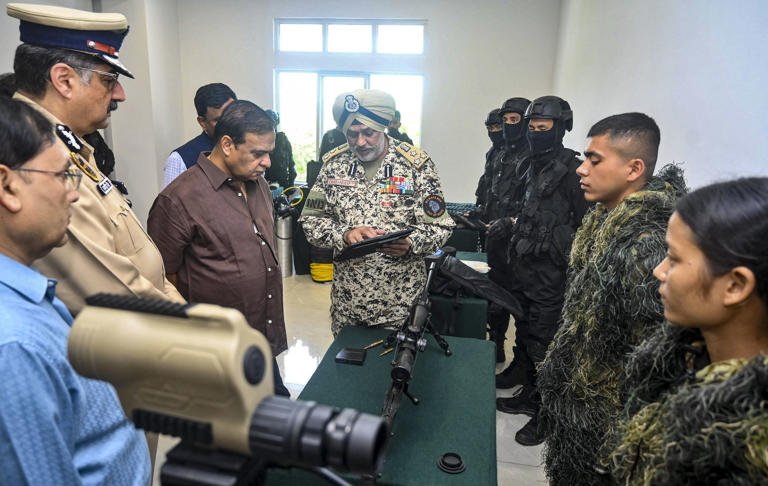
Assam Chief Minister Himanta Biswa Sarma has announced that the state will set up a dedicated Anti-Narcotics Task Force within the Assam Police to intensify its fight against drug trafficking and dismantle organised narcotics networks.
The new unit is expected to be raised within the next month. It will focus on the stronger implementation of the Narcotic Drugs and Psychotropic Substances (NDPS) Act and will include specialised legal and financial verticals.
Sarma announced the decision after the conclusion of a two-day conference of senior superintendents of police in Dergaon on September 3. He said the Centre had also suggested the creation of a dedicated task force to deal with the growing drug menace.
The proposed Assam Anti-Narcotics Task Force will focus not only on arrests and seizures but also on strengthening legal cases and targeting the financial networks that support drug cartels. The government hopes that the specialised approach will make the state’s anti-drug campaign more effective.
New Anti-Narcotics Task Force to Be Raised Within Assam Police
The proposed Anti-Narcotics Task Force will function as a dedicated unit within the Assam Police.
According to the Chief Minister, the force will have several specialised verticals to address different aspects of drug trafficking.
These will include legal and financial units.
The legal wing is expected to focus on strengthening cases under the NDPS Act and improving the prosecution of accused persons.
The financial wing will examine the money networks associated with drug trafficking.
Sarma said authorities must focus on breaking the financial backbone of drug cartels. Drug trafficking is often sustained through complex financial arrangements involving suppliers, transporters, distributors and other individuals.
Targeting only those caught carrying narcotics may not be enough to dismantle larger criminal networks.
The proposed task force will therefore seek to identify and disrupt the wider networks that enable drug trafficking.
The government expects to establish the new unit within the next month.
Focus on Stronger Implementation of NDPS Act
A key responsibility of the new task force will be the stronger implementation of the NDPS Act.
The law provides the legal framework for action against the production, possession, sale, transportation and trafficking of narcotic drugs and psychotropic substances.
However, successful enforcement requires more than arrests.
Investigators must collect evidence, establish links between accused persons and trafficking networks, and prepare strong cases for prosecution.
The proposed legal vertical of the Anti-Narcotics Task Force is expected to concentrate on these areas.
Sarma said the specialised unit would examine issues related to the legal process, including efforts to ensure that accused persons involved in serious drug crimes do not easily secure bail.
The government’s approach suggests a greater emphasis on taking drug cases through the entire criminal justice process.
Authorities aim to ensure that investigations result in effective prosecution and convictions.
Assam Targets Financial Networks of Drug Cartels
One of the most significant features of the proposed task force is its focus on the financial structure of drug trafficking networks.
Drug cartels depend on money to purchase, transport and distribute narcotics.
They may also use different channels to conceal or move illegal proceeds.
Sarma said the new Anti-Narcotics Task Force would work towards breaking these financial networks.
The financial vertical could help investigators move beyond individual drug seizures and examine the larger economic system supporting trafficking operations.
Following the money trail can potentially help authorities identify organisers and financiers who may not directly transport or possess narcotics.
The approach could also help investigators establish connections between different individuals and groups.
By targeting both the drugs and the money generated through trafficking, the government hopes to increase pressure on organised narcotics networks.
Assam Seeks Better Conviction Rate in Drug and Other Cases
The Chief Minister also highlighted the state’s efforts to improve conviction rates.
According to Sarma, the conviction rate in FIRs where chargesheets have been filed has increased significantly.
The rate has risen from around 7 per cent in 2020 to 29.3 per cent at present.
The state government is now targeting a conviction rate of 35 per cent within the current year in chargesheeted cases.
Improving convictions remains important for the effectiveness of the anti-drug campaign.
A high number of arrests alone may not be sufficient if cases fail to result in successful prosecution.
Strong investigations, proper evidence collection and effective legal representation can all influence the outcome of a case.
The proposed legal unit within the Anti-Narcotics Task Force could therefore play an important role in helping Assam improve the handling of narcotics-related cases.
The government hopes that stronger coordination between investigators and legal experts will improve the overall enforcement of the NDPS Act.
Two-Day SSP Conference Reviews Policing Strategy
Sarma announced the new task force after the conclusion of the two-day SSP conference in Dergaon.
The conference brought senior police officials together to review key policing and law enforcement issues.
Drug trafficking emerged as one of the major areas of concern.
The decision to establish a dedicated Anti-Narcotics Task Force reflects the government’s view that the drug menace requires a specialised and focused response.
General policing units often handle several categories of crime.
A dedicated task force can allow officers to focus specifically on narcotics trafficking and related criminal networks.
The force could also develop specialised expertise in drug investigations, financial tracking and legal procedures.
This may help Assam Police respond more effectively to changing trafficking methods.
Drug networks can alter their routes and concealment techniques to avoid detection.
Authorities therefore need intelligence, specialised investigations and coordination between different agencies.
The new task force is expected to strengthen these capabilities within the Assam Police.
Inter-State Coordination to Remain Important
Drug trafficking often involves routes that pass through more than one state.
For Assam, cooperation with neighbouring states is expected to remain important.
The state government has emphasised the need for greater coordination to block drug transit routes across the Northeast.
Recent concerns over emerging trafficking routes have reinforced the importance of intelligence-sharing between states.
Reports have indicated that authorities have identified new routes involving Arunachal Pradesh and Assam, adding to existing concerns about narcotics movement through the wider Northeast region.
The proposed task force could play an important role in coordinating with police forces and enforcement agencies outside Assam.
Drug traffickers may use multiple vehicles, intermediaries and routes.
No single state can always tackle such networks independently.
A coordinated approach could help authorities track consignments from their entry points to their intended destinations.
The government is therefore likely to focus on both internal enforcement and regional cooperation.
Dedicated Force May Strengthen Intelligence-Based Operations
Intelligence plays a crucial role in anti-narcotics operations.
Large drug consignments are often concealed inside commercial vehicles or transported through routes designed to avoid routine checking.
Specific intelligence can help law enforcement agencies identify suspicious movements and intercept consignments.
A specialised Anti-Narcotics Task Force could strengthen the collection and analysis of such information.
The force may be able to focus on patterns of trafficking and identify recurring routes.
Investigators could also examine links between seizures made in different districts.
Connecting separate cases can sometimes help authorities uncover larger networks.
The task force’s financial and legal wings could complement intelligence-based policing.
Information about financial transactions may help investigators identify those operating behind the scenes.
Meanwhile, legal specialists can help ensure that evidence gathered during investigations meets the requirements needed for prosecution.
The proposed structure therefore represents a broader approach to combating the drug menace.
Government Continues Crackdown on Drug Trafficking
Assam has continued to pursue a strong campaign against drug trafficking.
Police and other enforcement agencies have conducted regular operations against suspected narcotics networks.
The state government has repeatedly described drugs as a major social and security challenge.
Recent anti-drug operations have also resulted in significant seizures.
According to reports, Sarma recently highlighted major narcotics seizures and destruction of confiscated drugs as part of the government’s continuing campaign.
The creation of the Anti-Narcotics Task Force could give this campaign a permanent specialised structure.
Instead of relying only on individual operations, the government aims to develop a unit dedicated to investigating and dismantling drug networks.
The task force could also help improve coordination between different police units.
This would be particularly important in cases where trafficking networks operate across several districts.
Focus Shifts From Seizures to Entire Drug Networks
The announcement indicates that Assam’s anti-drug strategy is increasingly focusing on entire trafficking networks.
A seizure can remove narcotics from circulation.
However, traffickers may attempt to replace lost consignments if the larger organisation remains active.
Authorities therefore want to identify suppliers, transporters, financiers and other individuals involved in the network.
The new task force’s legal and financial components are expected to support this approach.
Investigators may focus on the links between accused persons and other suspected members of trafficking networks.
Financial investigations could also help authorities identify the proceeds generated through narcotics operations.
Sarma’s announcement makes it clear that the government wants to disrupt the systems that allow drug cartels to continue operating.
The success of the initiative will depend on effective investigations and cooperation between different enforcement agencies.
Assam Anti-Narcotics Task Force Marks New Phase in Drug Crackdown
The decision to establish an Anti-Narcotics Task Force marks a significant new step in Assam’s campaign against drug trafficking.
The specialised unit will operate within the Assam Police and is expected to be raised within the next month.
Its structure will include legal and financial verticals.
The force will focus on the stronger implementation of the NDPS Act, improving legal action and targeting the financial networks of drug cartels.
Chief Minister Himanta Biswa Sarma has also linked the initiative with the broader goal of improving conviction rates.
The state aims to increase its conviction rate in chargesheeted cases from the present 29.3 per cent to 35 per cent within the year.
The proposed Assam Anti-Narcotics Task Force reflects a shift towards a more specialised and network-focused approach.
The government wants to move beyond individual arrests and drug seizures by targeting the people and financial systems behind organised trafficking.
With drug routes continuing to evolve across the Northeast, the task force is also expected to strengthen intelligence-sharing and cooperation with neighbouring states.
As Assam prepares to establish the new unit, attention will now turn to its structure, staffing and operational strategy.
The effectiveness of the task force could play an important role in shaping the state’s next phase of action against the drug menace.