






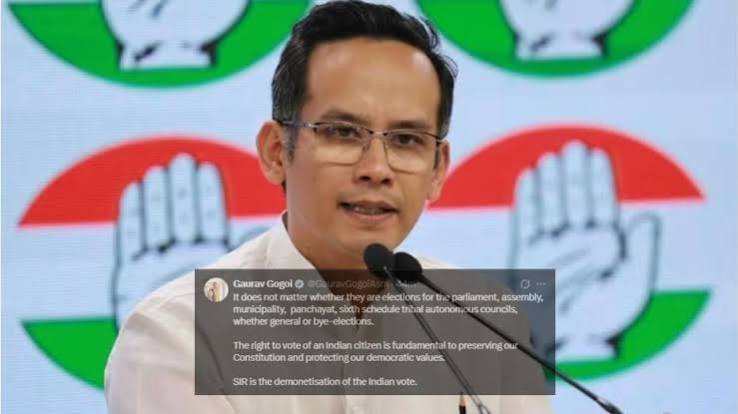
Gaurav Gogoi SIR criticism has intensified after the Assam Congress president accused Chief Election Commissioner Gyanesh Kumar of overseeing a voter-roll exercise that, in his view, threatens citizens’ voting rights. Gogoi compared the Special Intensive Revision (SIR) with the 2016 demonetisation exercise and called it “the demonetisation of the Indian vote.”
Gogoi made the remarks while reacting to the ongoing legal challenge to SIR in West Bengal. He argued that the right to vote remains fundamental across parliamentary, Assembly, municipal, panchayat and other elections.
Gaurav Gogoi SIR remarks draw focus to CEC
Gogoi also alleged that Gyanesh Kumar enjoys political protection that allows the SIR process to continue. He specifically named Prime Minister Narendra Modi, Union Home Minister Amit Shah and the BJP-RSS ecosystem while making that allegation. These are political claims by Gogoi and have not been established as facts.
The Congress leader has previously demanded Kumar’s resignation. On September 25, police detained Gogoi during a Congress protest in Guwahati seeking the CEC’s resignation and legal action over alleged irregularities in electoral-roll management.
The protest followed reports that Election Commissioners Sukhbir Singh Sandhu and Vivek Joshi had raised objections on several occasions over procedures and database-related decisions linked to the poll panel’s work. The Election Commission, however, rejected the suggestion of institutional dissent and said differing views are part of normal deliberations.
SIR remains at centre of voter roll dispute
The Election Commission describes SIR as an exercise aimed at maintaining accurate electoral rolls. Its stated objective is to ensure that eligible citizens remain on the rolls while ineligible persons are excluded. The commission has also provided mechanisms for claims, objections, appeals and voter registration during the revision process.
However, the scale of the West Bengal exercise has generated continuing legal and political scrutiny. According to figures submitted by the Election Commission to the Supreme Court, 38,20,683 appeals had been filed against orders linked to the SIR process, while 1,02,231 had been disposed of as of the commission’s September affidavit.
More recently, the Election Commission told the Supreme Court that 37,05,235 appeals remained pending before appellate tribunals. The figures include appeals concerning both deletions and inclusions in electoral rolls.
Gaurav Gogoi SIR concerns follow court scrutiny
The pending appeals have become an important part of the legal debate. The Supreme Court has sought information on the status of appeals and examined whether cases involving voters whose names were deleted should receive priority.
The court is scheduled to hear the West Bengal SIR matter on October 5. On September 28, it declined a request to advance the hearing ahead of the October 6 bypolls in Rejinagar and Nandigram.
Election Commission defends SIR process
The Election Commission has maintained that its decisions are taken collectively by the three-member constitutional body. It said internal observations and queries raised during the drafting stage form part of standard administrative practice.
The commission also stated that its SIR-related decisions over the past year were unanimous. Assam Chief Minister Himanta Biswa Sarma separately defended the CEC, saying the commission works through consensus or majority decisions rather than unilateral action by its chief.
Therefore, the dispute now involves competing claims about electoral-roll management, institutional procedure and safeguards for voters. The Supreme Court’s continuing scrutiny is expected to provide further clarity on the pending appeals and the implementation of the revision process.
Gaurav Gogoi SIR attack keeps voter rights debate alive
Gogoi’s latest remarks have added another political dimension to the wider SIR controversy. His comparison with demonetisation reflects his criticism of how voter lists are being revised, while the Election Commission continues to describe the exercise as a mechanism for maintaining accurate electoral rolls.
Meanwhile, the large number of pending appeals has kept attention on how quickly affected voters can seek remedies. As the Supreme Court prepares to hear the matter on October 5, the debate over SIR is likely to remain focused on the balance between electoral-roll accuracy and ensuring that eligible citizens retain their right to vote.