






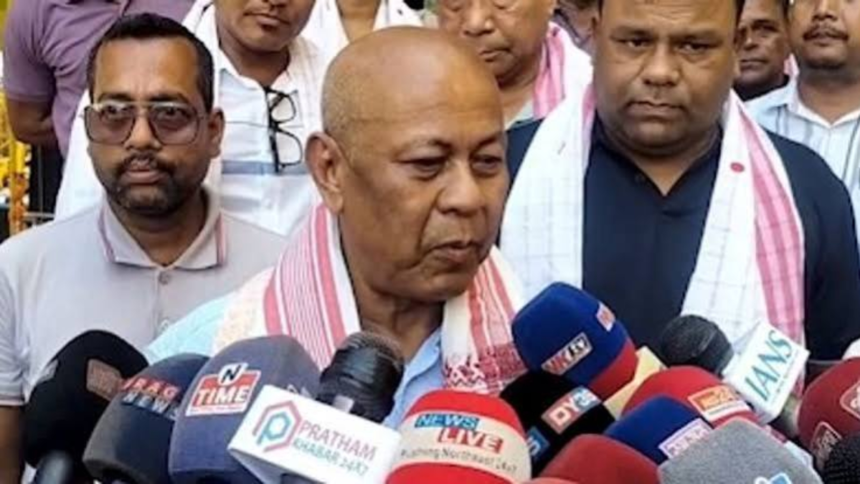
Hagrama Mohilary has recalled his decision to leave engineering studies and join political agitation, reflecting on the journey that shaped his role in the Bodo movement and Assam politics. His political career is closely linked to the struggle for greater autonomy and the formation of the Bodoland Territorial Council (BTC).
The Bodoland People’s Front (BPF) president emerged from a period of intense political mobilisation in the Bodo-dominated areas of Assam. Over the years, Hagrama Mohilary moved from agitation to mainstream politics, becoming one of the region’s most prominent political leaders.
Hagrama Mohilary and His Early Political Journey
Hagrama Mohilary’s early years coincided with growing demands for political rights and greater autonomy for the Bodo community. The movement gained momentum as organisations sought a separate administrative arrangement for Bodo-inhabited areas.
His decision to leave engineering for agitation reflected the political climate of the time. Rather than pursuing a conventional career, he became involved in a movement that would eventually reshape the region’s political landscape.
Moreover, the Bodo movement developed through several phases, involving student organisations, political groups and armed outfits. These developments created a complex environment in which demands for autonomy, identity and political representation became central issues.
From Agitation to Mainstream Politics
Hagrama Mohilary later became associated with the Bodo Liberation Tigers (BLT), an armed organisation that played a significant role in the movement for a separate Bodoland. The organisation eventually entered negotiations with the government.
In 2003, the signing of a peace agreement between the Centre, the Assam government and the BLT paved the way for the creation of the Bodoland Territorial Council. The agreement marked an important shift from armed conflict towards an institutional arrangement for regional governance.
Mohilary subsequently emerged as the first chief executive member of the BTC. His transition into electoral politics represented a major change in his public role, placing him at the centre of efforts to govern the region and pursue development.
However, the transition also brought new responsibilities. Regional leaders had to address expectations around political representation, infrastructure, education, employment and relations among communities living within the territory.
Hagrama Mohilary and the Bodoland People’s Front
In 2005, Hagrama Mohilary founded the Bodoland People’s Front and became its president. The party established itself as a significant force in Assam’s regional politics, particularly in the Bodoland Territorial Region.
The BPF’s political influence grew through its participation in elections and its role in BTC administration. Mohilary served as the council’s chief executive member for several years, making him a central figure in the region’s governance.
Furthermore, the party built alliances with larger political formations to strengthen its position in Assam. These relationships reflected the importance of regional parties in state politics, where local concerns often shape electoral strategies and coalition arrangements.
Nevertheless, the region’s political priorities have continued to evolve. Questions surrounding autonomy, development, representation and the implementation of peace agreements remain important to voters and political organisations.
What His Recollections Reveal About the Bodo Movement
Mohilary’s account of leaving engineering for agitation offers a personal perspective on the choices that shaped his political career. It also provides an opportunity to examine how regional movements can influence individual lives and institutional change.
The Bodo movement developed over decades, with different organisations pursuing distinct approaches to political autonomy. Negotiations and peace agreements eventually created new administrative structures, although governance and development challenges continued.
Consequently, the journey from agitation to elected leadership remains an important part of the region’s political history. Mohilary’s experience illustrates how a movement’s leaders can move into formal governance while continuing to face public expectations and political competition.
Hagrama Mohilary’s Political Legacy
Hagrama Mohilary’s career reflects a significant chapter in Assam’s regional politics. His shift from engineering studies to agitation, followed by his entry into mainstream politics, mirrors the wider transformation of the Bodo movement.
Today, his political legacy is closely associated with the BTC’s formation and the BPF’s role in regional governance. His recollections also highlight the personal decisions behind political movements that often shape the future of communities.
Overall, the significance of Mohilary’s journey lies in the transition from agitation to institutional politics. The long-term impact of that transition will continue to depend on governance, development and the ability of regional leaders to respond to the aspirations of the people they represent.