





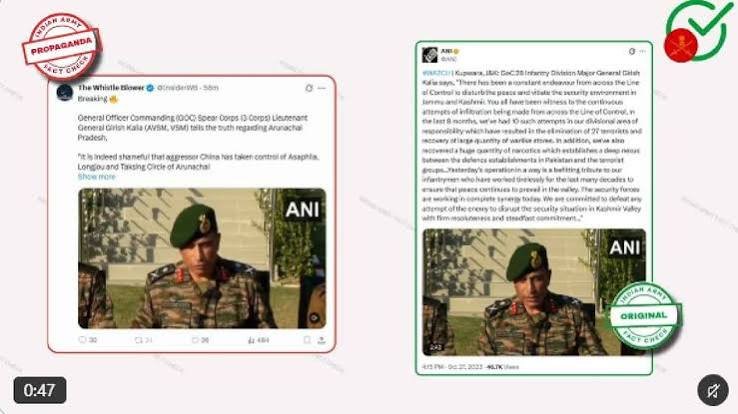
Indian Army debunks fake video claims after a digitally manipulated clip circulated on social media, falsely alleging that China had taken control of several areas in Arunachal Pradesh. The video attributes fabricated remarks to senior Army officer Lieutenant General Girish Kalia.
The Army’s official fact-checking account has rejected the claims, identifying the footage as digitally altered content. Moreover, officials clarified that the original recording showed a military briefing in Jammu and Kashmir in 2023, not an admission about Chinese control of Indian territory.
Indian Army debunks fake video about Arunachal Pradesh
The viral clip claims that China has taken control of Asaphila, Longjou and Taksing Circle in Arunachal Pradesh. It also alleges that Indian Army personnel deployed in the region were denied essential supplies.
However, the Army said these claims were fabricated and falsely attributed to Lt Gen Girish Kalia, the General Officer Commanding of Spear Corps, also known as 3 Corps.
According to the Army’s fact-check, the video uses synthetic-generated information, including AI-based lip-syncing and voice cloning, to make the officer appear to deliver statements he never made.
The clip reportedly presents the fabricated remarks as a leaked admission by a senior military officer. Therefore, the Army warned that the video could mislead viewers and create unnecessary public concern about national security.
The clarification directly challenges the video’s central allegation. The Army stated that the original footage contains no such remarks about Chinese control over the named locations or restrictions on supplies to Indian troops.
Indian Army debunks fake video using original footage
The Army traced the video to an earlier press briefing held in Kupwara, Jammu and Kashmir, on October 27, 2023.
At that time, Kalia served as a Major General and headed the 28 Infantry Division. He addressed the media about counter-terrorism operations and infiltration attempts along the Line of Control (LoC).
The original briefing focused on security operations in Jammu and Kashmir. It had no connection to the territorial claims now circulating online about Arunachal Pradesh.
During that briefing, Kalia reported that security forces had foiled 10 infiltration attempts, eliminated 27 terrorists and recovered weapons, other warlike stores and narcotics.
Furthermore, the Army clarified that the officer did not mention China, the three Arunachal locations or any alleged denial of essential supplies to Indian troops.
This distinction is important because the viral clip uses genuine archival footage to lend credibility to fabricated statements. By changing the audio and apparent speech, the manipulated video presents an unrelated military briefing as evidence for claims it does not support.
How the fake video spreads military misinformation
The incident highlights the growing challenge of identifying manipulated videos on social media. Advances in artificial intelligence allow creators to alter voices and synchronise apparent lip movements with fabricated speech.
As a result, viewers may mistake digitally modified footage for an authentic statement, particularly when it features a recognisable military officer or official setting.
In this case, the video combines old footage with fabricated remarks and unsupported territorial claims. That combination can make false information appear credible, especially when users share clips without checking their origins.
Moreover, claims involving border security can generate concern because they relate to national sovereignty and the safety of military personnel. Unverified allegations about territorial control or supply shortages can therefore spread confusion before reliable information becomes available.
The Army’s clarification separates the original briefing from the misleading narrative. It also demonstrates why viewers should check the complete recording and official statements before accepting claims presented as confidential disclosures.
Indian Army debunks fake video and urges verification
The Army has urged social media users to examine suspicious content carefully and verify information through authentic sources before sharing it further.
The warning is particularly relevant when a video attributes sensitive statements to serving military officers. A convincing appearance alone does not establish that the person actually made the remarks.
Users can begin by checking the original footage, reviewing official fact-checks and comparing claims with credible news reports. They should also remain cautious when a clip makes dramatic allegations without verifiable evidence.
Meanwhile, the Army’s fact-check provides a clear account of the recording’s origin and the changes made to its context. The original briefing concerned infiltration attempts along the Line of Control in Jammu and Kashmir, not Chinese control of areas in Arunachal Pradesh.
Overall, the viral video’s claims about Chinese control and the alleged denial of supplies are not supported by the original recording. The Army has identified the clip as digitally manipulated and rejected the remarks attributed to Kalia.
The clarification serves as a reminder that misleading videos can exploit genuine footage to create false narratives. Verifying military claims through reliable sources remains essential to preventing misinformation from spreading online.
Nongkseh SC Begin I-League 3 Campaign with Dominant 4-1 Win Over Kuppuraj FC