







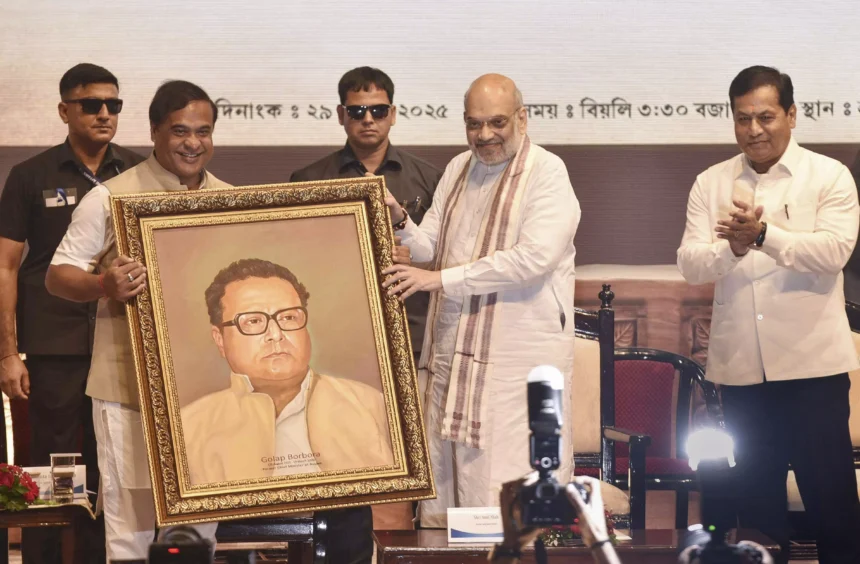
Union Home Minister Amit Shah on August 29 paid glowing tributes to Assam’s first non-Congress Chief Minister, Golap Borbora.
Speaking at Borbora’s birth centenary celebrations, Shah described him as a leader who transformed the political history of Assam.
He recalled Borbora’s courage, his sacrifices during the Emergency, and his enduring contributions to the state.
Shah said Borbora’s rise in 1978 marked a defining moment.
“For the first time, Assam saw the leadership of a non-Congress Chief Minister,” he noted.
“This was not just a change in government, but a major shift in political history.”
Golap Borbora: A Political Pioneer
Golap Borbora became Assam’s Chief Minister in 1978, leading a coalition that broke the Congress party’s long dominance in the state.
Though his tenure was short, Borbora left a strong impression on the people of Assam.
He focused on social justice, rural development, and empowerment of marginalized communities.
Shah emphasized that Borbora’s leadership paved the way for later political changes.
His government inspired new forms of regional assertion and created space for leaders beyond the Congress fold.
“Despite mistakes after independence, no non-Congress Chief Minister was elected until 1978. Borbora changed that history,” Shah said.
Memories of the Emergency Years
One of the most emotional moments in Shah’s address came when he recalled Borbora’s ordeal during the Emergency imposed by then Prime Minister Indira Gandhi.
“Golap Borbora was the first leader to be arrested and the last to be released,” Shah said.
“He was kept in jail for a full 19 months. His sacrifice reflected his commitment to democracy and the people of Assam.”
The Home Minister stressed that Borbora’s resistance against authoritarian rule made him a symbol of democratic resilience.
His imprisonment was not just a personal sacrifice, but part of a wider struggle for liberty and justice.
Borbora’s Enduring Legacy in Assam
Though Borbora’s tenure as Chief Minister lasted less than two years, his governance style earned respect across party lines.
He pushed for land reforms, welfare schemes, and policies designed to protect the rights of peasants and workers.
His efforts created long-lasting changes in Assam’s socio-political fabric.
Shah observed that Borbora’s legacy is still remembered in villages and towns across the state.
“Even today, people speak of his honesty, his simplicity, and his tireless work for the common man,” Shah said.
He added that Borbora’s contributions should be taught to future generations as part of Assam’s political history.
Amit Shah on Assam’s Political Journey
Shah also used the occasion to reflect on Assam’s broader political journey since independence.
He said Borbora’s emergence in 1978 signaled the possibility of alternatives beyond the Congress.
This shift eventually paved the way for stronger regional and national political movements in Assam.
Shah linked Borbora’s vision to the ongoing efforts of the central government in strengthening Assam’s role in India’s growth.
He noted that Prime Minister Narendra Modi’s leadership has ensured a new era of peace, development, and connectivity in the Northeast.
Call for Preserving Assam’s Political History
The Home Minister urged political leaders, historians, and academics to preserve Borbora’s memory.
He said that remembering leaders like Borbora is important not only for their political contributions but also for their personal sacrifices for democracy.
“Assam should celebrate its heroes who shaped its destiny. Golap Borbora is one of the finest examples,” Shah said.
Wider Reactions to Shah’s Tribute
The centenary celebrations brought together political leaders, academics, and citizens who admired Borbora.
Many speakers echoed Shah’s words and emphasized the importance of studying Borbora’s model of leadership.
Cultural performances and exhibitions highlighted Borbora’s life, including his role in farmers’ movements and democratic struggles.
Political observers noted that Shah’s tribute comes at a time when the BJP is strengthening its presence in Assam and the Northeast.
By recalling Borbora’s contributions, Shah sought to connect the present generation with Assam’s political pioneers.
Amit Shah’s remembrance of Golap Borbora underscored the importance of revisiting Assam’s political history.
By recalling Borbora’s 19-month imprisonment during the Emergency and his brief but impactful tenure as Chief Minister, Shah highlighted the values of courage, democracy, and leadership.
As Assam continues to evolve politically, the legacy of Borbora remains a guiding light.
His story is not just about the past but also about the future direction of democratic politics in the state.

