



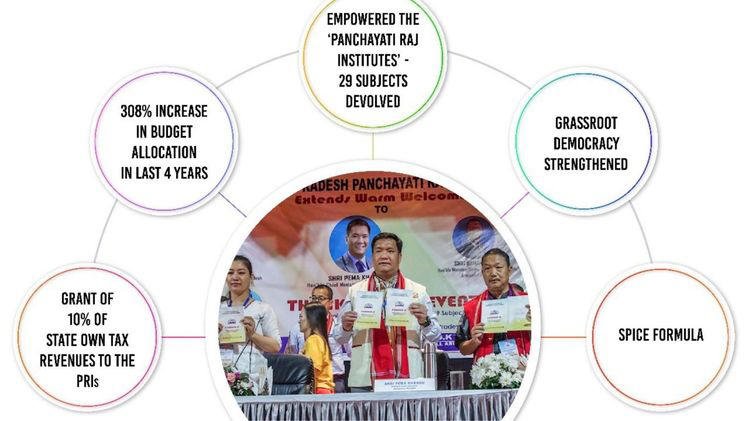
Arunachal Pradesh Chief Minister Pema Khandu has introduced the SPICE formula to empower Panchayati Raj Institutions (PRIs). With this model, the government aims to strengthen grassroots democracy and promote inclusive governance. The SPICE formula stands for S – Skill development, P – Participation, I – Innovation, C – Collaboration, and E – Empowerment.
This initiative highlights the state government’s commitment to building strong local governance. By applying the SPICE formula, officials hope to bridge gaps in rural administration and make governance more efficient.
A New Approach to Local Governance
The SPICE formula places special emphasis on empowering Panchayats with skills and resources. Skill development will help local representatives handle administrative tasks more effectively. At the same time, participation ensures that community members engage actively in decision-making.
Innovation is another pillar of the formula. The government wants Panchayats to adopt digital tools, modern techniques, and new ideas for better service delivery. Furthermore, collaboration between state officials and Panchayat leaders will help solve local problems faster. Finally, empowerment will give Panchayat representatives both authority and confidence to carry out responsibilities.
Chief Minister’s Vision for Stronger Panchayats
Chief Minister Pema Khandu emphasized that Panchayati Raj is the backbone of India’s democratic setup. Strengthening Panchayats, he said, means strengthening rural development. He noted that the SPICE formula would bring uniform growth in villages while encouraging transparency and accountability.
Khandu also urged Panchayat leaders to view themselves not only as administrators but as agents of social change. With improved skills and technology, they can play a major role in transforming rural Arunachal Pradesh.
Training and Capacity Building
To put the SPICE formula into action, the government will focus heavily on training. Special workshops and orientation programs will be organized to enhance leadership qualities among Panchayat members. These training sessions will also cover financial management, digital literacy, and policy implementation.
Moreover, officials will design resource materials and toolkits for representatives. Such resources will help them understand their roles better and carry out projects with more efficiency. By providing structured training, the government expects to create a more confident and capable cadre of Panchayat leaders.
Encouraging Grassroots Participation
Community involvement is at the heart of the SPICE model. Villagers will now have a greater say in local policies and development plans. Meetings, discussions, and awareness drives will encourage more people to participate in governance. This approach will not only improve transparency but also help address issues specific to each village.
For example, decisions regarding water supply, road maintenance, and education will now involve greater input from villagers. This method ensures that policies reflect actual needs rather than top-down instructions.
Technology and Innovation in Rural Governance
The SPICE formula strongly promotes innovation. Panchayats will adopt digital platforms for record-keeping, grievance redressal, and communication. These platforms will help in reducing paperwork and speeding up services.
In addition, the government plans to introduce mobile apps for monitoring development projects. With these tools, officials and villagers can track the progress of schemes in real time. Such innovations are expected to reduce corruption and delays.
Collaboration Across All Levels
Another key feature of SPICE is collaboration. Panchayats will work closely with government departments, NGOs, and local organizations. Joint efforts will make projects more sustainable and impactful. For instance, collaboration in healthcare can improve rural health facilities, while joint agricultural initiatives can boost farmers’ incomes.
Chief Minister Khandu stressed that no government program can succeed in isolation. Only by working together can different stakeholders ensure meaningful development at the grassroots level.
Empowerment Through Policy Support
The final component of SPICE is empowerment. The state government plans to provide legal, financial, and administrative support to Panchayats. By delegating more powers, the government hopes to make PRIs self-reliant.
Financial autonomy will allow Panchayats to manage funds for local projects more freely. Administrative powers will also ensure that they do not need constant approval from higher authorities for small projects. This empowerment is expected to build stronger trust between villagers and their representatives.
Positive Reception Among Leaders
Panchayat representatives have welcomed the SPICE initiative. Many leaders believe this formula will address long-standing challenges in rural governance. They also expressed hope that increased resources and training will help them deliver better services to their communities.
Civil society groups have also praised the move. They see SPICE as a forward-looking model that could inspire other states. With the right implementation, Arunachal Pradesh could set a benchmark in Panchayat empowerment.
A Step Towards Inclusive Development
The SPICE formula comes at a crucial time for Arunachal Pradesh, where rural development remains a priority. By focusing on skill, participation, innovation, collaboration, and empowerment, the government is charting a path toward inclusive growth.
If implemented successfully, the initiative can transform the state’s Panchayats into strong institutions of democracy. It can also ensure that rural citizens have a greater voice in shaping their futures.
Arunachal Pradesh’s SPICE formula marks a significant step toward Panchayat empowerment. By combining training, innovation, participation, and empowerment, the government aims to build resilient and capable local governance structures.
Chief Minister Pema Khandu’s vision reflects a deep commitment to democratic principles. The SPICE initiative, if pursued diligently, can redefine rural governance in the state and serve as a model for others to follow.
Read More: Assam Rifles Seizes Arms Cache in Mizoram
Read Here: PM inaugurates Aunta-Simaria Bridge in Bihar