





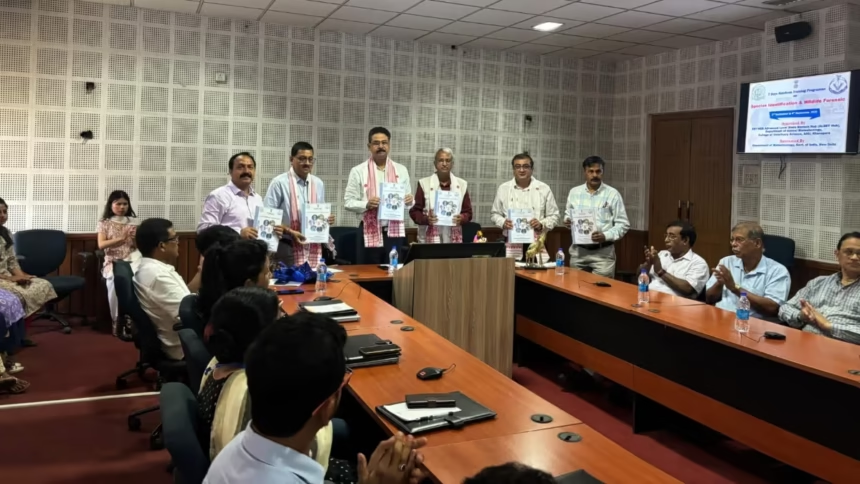
The College of Veterinary Science at Assam Agricultural University (AAU), Khanapara, has reinforced its leadership in wildlife research and forensic science.
The Department of Animal Biotechnology, in collaboration with the Advanced Level State Biotech Hub (ALSBT), concluded a seven-day training program on species identification and wildlife forensics.
The initiative, sponsored by the Department of Biotechnology (DBT), Government of India, ran from September 2 to 8, 2025.
Training Focused on Wildlife Protection and Forensic Science
The training emphasized practical knowledge of wildlife conservation and forensic methods.
Participants received extensive exposure to techniques for species identification and DNA-based analysis.
Experts highlighted the importance of molecular tools in addressing wildlife crimes and conserving biodiversity.
The event attracted researchers, students, and professionals from across Assam and beyond.
It served as a platform to exchange knowledge, develop forensic expertise, and strengthen collaboration between wildlife scientists and law enforcement agencies.
Advanced Tools for Wildlife Crime Investigations
Wildlife crime remains a major concern in Assam due to its rich biodiversity and proximity to international borders.
The program showcased how DNA barcoding and molecular diagnostics can provide accurate species identification.
These tools play a crucial role in solving poaching cases, illegal wildlife trade investigations, and habitat monitoring.
The college’s biotechnology department demonstrated its capacity to conduct high-level forensic analysis.
By building expertise in wildlife forensics, AAU Khanapara is set to become a regional hub for scientific wildlife investigations.
Assam’s Growing Role in Wildlife Conservation
Assam is home to iconic species like the one-horned rhinoceros, Asian elephants, and Bengal tigers.
With biodiversity hotspots such as Kaziranga and Manas National Parks, the state is often at the center of conservation efforts.
This program marks a major step toward integrating science and conservation policies to safeguard endangered wildlife.
Officials stressed the importance of collaboration between researchers, veterinarians, and forest departments.
The training program highlighted how partnerships between government agencies and academic institutions can address growing conservation challenges.
Bridging Knowledge Gaps
Participants received detailed lessons on laboratory techniques, forensic sample collection, and molecular diagnostics.
The event aimed to equip young researchers with practical skills to strengthen wildlife conservation projects.
It also provided an opportunity for law enforcement to understand how scientific evidence supports legal action against wildlife crime.
The program addressed gaps in forensic expertise in the Northeast, a region critical to India’s ecological security.
The integration of biotechnology in conservation projects is expected to improve monitoring and species management strategies.
AAU Khanapara’s Expanding Impact
The College of Veterinary Science at AAU has consistently advanced veterinary research, disease diagnostics, and biotechnology.
This program adds to its achievements, positioning the institution as a leader in conservation science.
Officials confirmed that similar workshops will be held in the future to scale up capacity building in wildlife forensics.
The ALSBT Hub also reaffirmed its commitment to empowering researchers and contributing to sustainable wildlife management in Assam.
Its infrastructure and expertise have been instrumental in carrying out advanced training programs and scientific investigations.
Call for Stronger Collaboration
The success of the training program reflects Assam’s growing emphasis on science-backed conservation policies.
Stakeholders emphasized that combating wildlife crime requires coordination between police, forest officials, forensic scientists, and researchers.
The collaboration will help bring poachers and traffickers to justice while ensuring evidence-based conservation planning.
Participants expressed appreciation for the hands-on approach, noting that practical training is crucial for strengthening scientific networks.
The program has encouraged young researchers to pursue careers in wildlife biology, biotechnology, and forensic science.
Assam Sets Benchmark in Wildlife Forensics
The event concluded with a call for greater investment in biotechnology research to address environmental challenges.
Experts highlighted that empowering local institutions is key to tackling wildlife trafficking and safeguarding ecosystems.
By integrating forensic science with field conservation, Assam is setting an example for other states.
The College of Veterinary Science plans to continue supporting innovative initiatives to protect the region’s biodiversity.
With government support and academic expertise, Assam is emerging as a hub for cutting-edge wildlife research.