





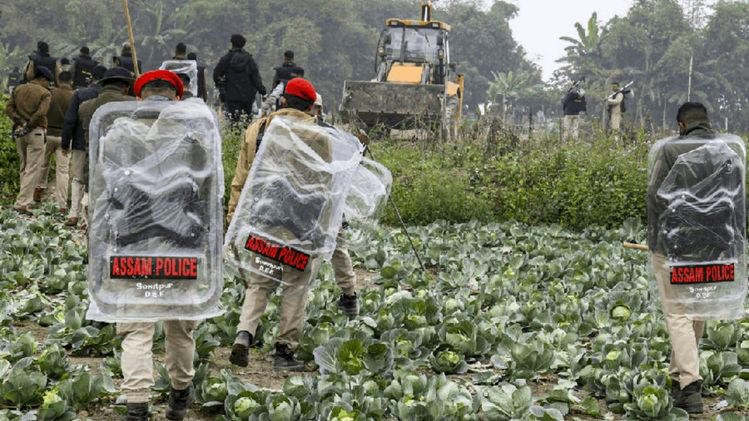
The Assam government has successfully concluded a massive two-day anti-encroachment operation. This drive focused on the Burhachapori Wildlife Sanctuary, located in the Sonitpur district. By Tuesday evening, January 6, 2026, authorities had cleared approximately 6,200 bighas of illegally occupied land. This reclamation is a key part of the state’s broader mission to protect its natural heritage and vital wildlife corridors.
Read More: War on Drugs: 12.9 Hectares of Illegal Poppy Fields Destroyed in Senapati
Details of the 48-Hour Operation
The eviction drive began on Monday morning under tight security. It targeted various regions within the sanctuary, including Jamuktol, Arimari, and Siyalichar. According to Sonitpur District Commissioner Ananda Kumar Das, the mission affected roughly 710 families. These individuals had reportedly settled within the protected forest area over several decades.
To ensure a smooth process, the administration deployed over 300 police and paramilitary personnel. Furthermore, they utilized 36 excavators and 60 tractors to dismantle unauthorized structures. Despite the large scale of the operation, officials reported that the drive concluded without any major law-and-order incidents. The reclaimed land, roughly 830 hectares, will now be restored to its natural state.
Why the Burhachapori Wildlife Sanctuary Matters
Burhachapori is not just any forest; it is a critical ecological link. It forms an integral part of the Laokhowa-Burhachapori ecosystem. More importantly, it acts as a notified buffer zone for the Kaziranga National Park and Tiger Reserve. Consequently, the Burhachapori Wildlife Sanctuary eviction is essential for the movement of rhinos, tigers, and elephants.
The sanctuary is also home to the critically endangered Bengal florican. In recent years, illegal settlements had obstructed the natural corridors used by these animals. Chief Minister Himanta Biswa Sarma recently noted that rhinos have already started returning to the area following earlier clearing efforts. By removing the remaining 710 illegal structures, the government aims to fully restore this “wild heritage.”
Key Facts About the Reclaimed Land:
- Total Area Cleared: Approximately 6,200 bighas (nearly 830 hectares).
- Scope of Eviction: 710 families were moved from the protected zone.
- Geographical Reach: Areas spanned across both Sonitpur and Nagaon districts.
- Wildlife Impact: The move secures a vital corridor for one-horned rhinoceros and tigers.
Challenges and Humanitarian Concerns
While the government prioritizes conservation, the Burhachapori Wildlife Sanctuary eviction faced some local resistance. Many affected families cited the harsh winter conditions as a reason for delay. They requested more time to harvest standing crops and relocate their belongings. However, the administration remained firm on its timeline.
District Commissioner Das stated that no exemptions could be made for illegal occupation of protected forest land. Many residents chose to dismantle their own homes voluntarily to save their building materials. Nevertheless, the lack of a formal rehabilitation package for those without land titles remains a point of intense political debate in the state.
The Broader “War on Encroachment”
This latest drive is part of a statewide campaign led by the BJP-led government. Since 2021, Assam has reclaimed over 1.45 lakh bighas of forest and government land. Just days before this operation, the CM announced the successful clearing of 5,250 bighas in Hojai’s Jamuna-Moudanga Reserve Forest.
The government views these evictions as a “civilizational duty” to protect the state’s resources. Critics, however, often point to the demographic impact, as many affected families belong to minority communities. Despite the controversy, the state has vowed to continue these drives until all 29 lakh bighas of currently encroached land are free.
Conclusion: Restoring the Amazon of the East
The successful clearing of the Burhachapori Wildlife Sanctuary marks a victory for environmentalists. Reclaiming 6,200 bighas of land will allow the forest department to begin massive afforestation projects. This will eventually provide a safer and more expansive habitat for Assam’s iconic wildlife.
As the 2026 Assembly elections approach, these drives will likely remain a central political theme. For the nature lovers of Assam, the return of the rhinoceros to these quiet riverine forests is the ultimate reward. The government’s decisive action ensures that the state’s green cover remains a priority for generations to come.
Read More: Chabimura Eco-Tourism Makeover: Tripura’s Hidden Gem Goes Global