




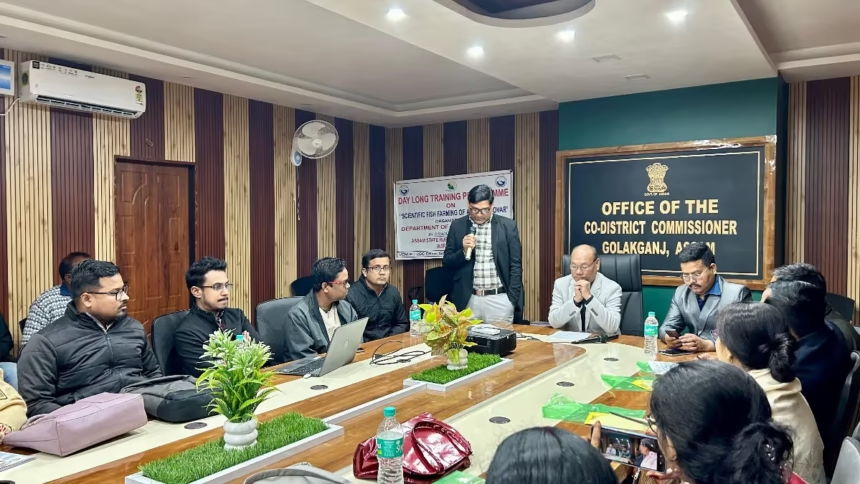
A two-day Farmers–Scientist Interaction Programme under the CSS-ATMA scheme (2025-26) concluded on Monday at the ADO Office in Bilasipara, Dhubri. The event, organized by Agriculture Extension along with CSS-ATMA, marked a key effort to connect scientific insights with grassroots farming in rural Assam.
The initiative brought together farmers, agricultural scientists, and extension officers to discuss pressing challenges and practical solutions. The goal was to foster innovation and increase productivity through direct dialogue and demonstrations.
Bridging Science and Farming
The interaction programme saw active participation from local farmers who shared concerns over crop diseases, low yield, and unpredictable weather. Scientists from Assam Agricultural University (AAU) and the Agriculture Extension Department offered guidance on sustainable techniques.
Topics such as integrated pest management, soil health improvement, and climate-resilient cropping systems formed the core of discussions. Extension officers later visited nearby fields to demonstrate equipment and share best practices.
What CSS-ATMA Brings to the Table
The CSS-ATMA (Centrally Sponsored Scheme – Agricultural Technology Management Agency) supports grassroots innovation through community-led learning. Its programmes include farmer training, farm schools, and interactive workshops Agri Welfaresameti.assam.gov.in.
Through such schemes, farmers benefit from demonstrations, workshops, and access to extension personnel. These efforts aim to democratize scientific knowledge and create farmer groups that support each other sameti.assam.gov.in.
Empowering Farmers with Knowledge
Many farmers left the sessions feeling empowered and optimistic. One participant said, “We learned ways to protect our crops without harmful pesticides.” Another remarked on discovering seed treatment methods that could reduce crop loss.
Extension officers distributed pamphlets and demonstration samples. They also briefed farmers on forming Farmers’ Interest Groups (FIGs) or Commodity Interest Groups (CIGs) for better resource sharing—concepts promoted under CSS-ATMA arias.in.
Government Support Bolsters Confidence
Mrinal Kanti Kachary, Assistant Director of Agriculture in Dhubri, called the programme a “landmark in local outreach”. He said that such initiatives would be expanded to other sub-divisions. His goal is to ensure all farmers have direct access to scientific knowledge.
Chief Agriculture Officer Dipankar Sarma hinted at upcoming training sessions at the district level and public awareness drives around homestead farming and crop diversification.
Innovation in Rural Assam
Observers see this interaction programme as a game-changer for Dhubri’s farming economy. Empowered with new methods, farmers gain resilience against crop failures, pests, and market fluctuations.
This interaction aligns with NEP 2020’s aim to promote experiential learning and farmer-driven extension. Assam’s early adopter status in rural innovation may serve as a model for other states.
What Tomorrow Holds
With this workshop concluded, officials plan follow-up activities—field visits, Q&A sessions, and possibly a Kisan Mela. By mid-2026, they aim to track yield improvements and farmer satisfaction.
Farmers have called for mobile-based advisory services and regular interactive platforms to maintain the dialogue with researchers.
Call to Action
Farmers interested in joining future workshops under CSS-ATMA can register through their local Block Technology Manager or Farmer Friend sameti.assam.gov.in.
Agriculture students and researchers may contribute by offering field-based solutions. This collaborative model promises to transform Assam’s agri-extension landscape.
Summary Table
| Focus Area | Details |
|---|---|
| What? | Farmers–Scientist Interaction Programme |
| Where? | Bilasipara, Dhubri |
| Organized by | Agriculture Extension + CSS-ATMA |
| Topics Covered | Pest management, soil health, crop system resilience |
| Key Impact | Empowered farmers, improved awareness |
| Next Steps | Training, field visits, digital advisories |