





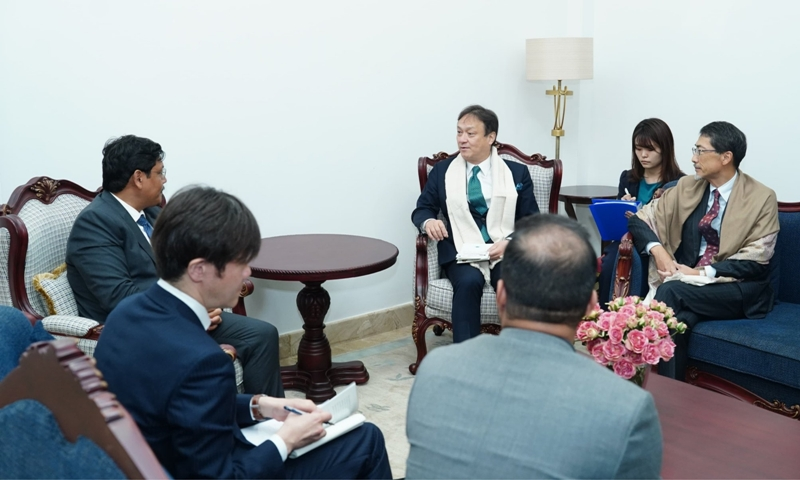
Japan has pledged support for projects aimed at strengthening connectivity between Northeast India and the Bay of Bengal, as well as the wider Indian Ocean region.
Japan’s Deputy Foreign Minister Horii Iwao made the announcement on Friday while addressing the Sixth India-Japan Intellectual Conclave in Shillong. The foreign policy think tank Asian Confluence organised the event.
Read More: Mizoram Reaffirms 1875 Inner Line as Assam Border
Northeast as Strategic Gateway
Horii highlighted the strategic importance of Northeast India in advancing regional integration. He described the region as a natural gateway to Southeast Asia. According to him, stronger integration with neighbouring countries such as Bangladesh, Nepal, Bhutan, and other Southeast Asian nations can unlock major economic potential.
He stressed that improved physical and economic connectivity would allow the region to serve as a bridge between South Asia and Southeast Asia. This approach aligns with Japan’s broader Indo-Pacific strategy.
Focus on Infrastructure and Trade
Horii reaffirmed Tokyo’s commitment to supporting growth in Northeast India. He said Japan would back initiatives that strengthen trade networks, infrastructure development, and people-to-people exchanges.
Under the leadership of Prime Minister Sanae Takaichi, Japan plans to expand private-sector cooperation with India. Key focus areas include semiconductors, clean energy, and economic security. He noted that these sectors will drive sustainable growth and technological advancement.
Japan also aims to deepen industrial collaboration by encouraging Japanese companies to explore investment opportunities in the region.
Industrial Value Chain under FOIP
Horii explained that Japan’s Free and Open Indo-Pacific (FOIP) vision includes the creation of an “Industrial Value Chain” connecting the Bay of Bengal to Northeast India. This plan seeks to enhance supply chains and improve access to sea routes.
He said better connectivity to ports along the Bay of Bengal would help integrate the Northeast with global markets. As a result, local industries could benefit from faster trade routes and expanded export opportunities.
Growing India–Japan Engagement
The announcement follows several high-level interactions between the two countries. Prime Minister Narendra Modi visited Japan in August 2025 to strengthen bilateral ties. He also met Prime Minister Takaichi during the G20 Summit in South Africa in November.
Earlier this year, External Affairs Minister S Jaishankar hosted his Japanese counterpart Toshimitsu Motegi in New Delhi to review progress in strategic cooperation.
Officials from both sides have consistently emphasised the importance of economic partnerships, supply chain resilience, and regional stability.
Strategic Significance for Northeast India
Japan’s renewed focus on Northeast India underscores the region’s rising geopolitical and economic significance. Improved connectivity with the Bay of Bengal and the wider Indo-Pacific could transform trade dynamics and attract foreign investment.
Observers believe that sustained collaboration between India and Japan will accelerate infrastructure development in the Northeast. It may also strengthen India’s Act East Policy and enhance regional integration.
With Tokyo reaffirming its commitment, connectivity projects linking Northeast India to the Bay of Bengal are expected to gain fresh momentum in the coming years.