





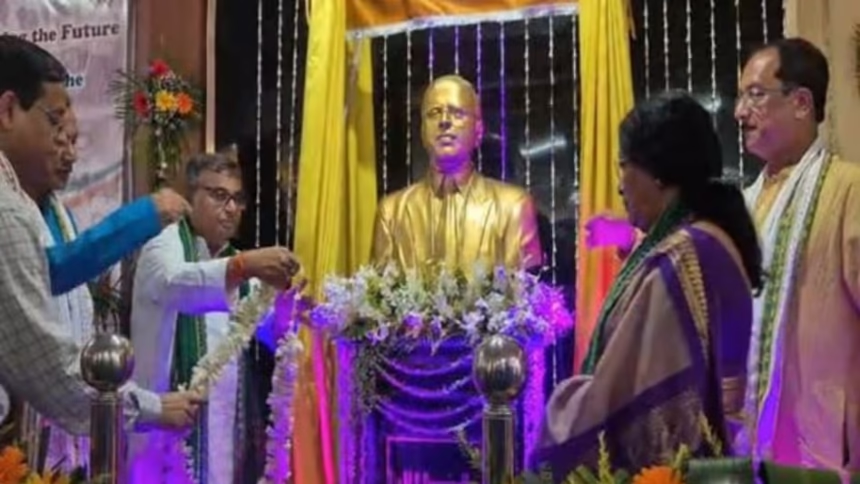
Agartala, Aug 20, 2025 – Tripura Agriculture Minister Ratan Lal Nath on Wednesday unveiled a statue of eminent agricultural scientist MS Swaminathan, widely known as the father of India’s Green Revolution. The inauguration took place at the Agricultural Research Center in West Tripura district. By drawing farmers, researchers, and students from across the region.
The minister said the tribute marked not only a recognition of Swaminathan’s legacy but also a reminder of the urgent need for self-reliance in agriculture. “MS Swaminathan changed the face of Indian farming through innovation and dedication. His life inspires us to move towards self-sufficiency and sustainability in food production,” Nath said.
A Symbol of Inspiration for Farmers
The statue has been installed at a time when the state is pushing for reforms in paddy cultivation, seed certification, and crop diversification. Nath said that honoring Swaminathan in Tripura was especially relevant. Also, farmers in the Northeast are increasingly adopting scientific practices to overcome climate challenges.
“Farmers today face unpredictable rainfall, soil degradation, and rising costs of production. Swaminathan’s vision of farmer-centric research continues to guide us,” he said. Officials of the Agriculture Department noted that the installation of the statue aims to serve as a symbol of motivation for young agripreneurs and students in agricultural sciences.
Linking Past Achievements to Present Challenges
MS Swaminathan, who passed away in 2023, was a global advocate for food security and sustainable farming. He spearheaded India’s Green Revolution in the 1960s. Which helped the nation overcome food shortages. His contributions are still regarded as the foundation of India’s self-reliance in food grain production.
Nath underlined that while Swaminathan’s Green Revolution transformed India, today’s generation must embrace a “second green revolution” rooted in organic practices, soil health, and technology adoption. “Our aim is not just production, but safe, sustainable, and profitable farming,” he added.
Push for Self-Reliance in Tripura Agriculture
The minister also used the event to highlight ongoing agricultural initiatives in Tripura. These include the promotion of hybrid paddy, seed certification, integrated farming, and organic crop production. Nath said the state was steadily moving towards reducing dependency on external markets.
“Tripura must be able to meet its own food requirements while also contributing to the needs of neighboring states,” he stressed. He pointed out that the recent decision by the Centre to authorize Tripura to certify paddy seeds for Manipur and Mizoram. It was a recognition of the state’s growing agricultural capacity.
Farmers’ Response and Expert Views
Farmers present at the ceremony welcomed the move, saying the installation of the statue would remind them of Swaminathan’s philosophy of “lab to land.” They emphasized the need for greater access to quality seeds, irrigation facilities, and market linkages.
Agricultural experts from the research center added that Swaminathan’s focus on integrating science with farmer welfare remained as relevant today as it was in the 1960s. They urged policymakers to invest in technology-driven solutions, including climate-resilient varieties and digital advisory platforms.
Broader Significance for the Northeast
The unveiling of the statue is also being seen as part of Tripura’s larger effort to position itself as an agricultural hub for the Northeast. With seed certification now under its mandate, the state is expected to play a stronger role in regional food security.
Nath said that the government’s goal was to make Tripura a model of self-reliant agriculture, where innovation, local resources, and farmer participation work hand in hand. He called on youth to take up agriculture not as a fallback but as a profitable and respected profession.
The statue of MS Swaminathan stands not just as a tribute to a visionary scientist but also as a call to action for a new era of farming in Tripura. As the minister put it, “Self-reliance in agriculture is not an option but a necessity. Swaminathan showed us the path, and it is our responsibility to carry his legacy forward.”