





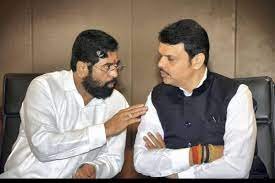
In a strategic move to assert its dominance in Maharashtra’s political landscape, the Shiv Sena, led by Chief Minister Eknath Shinde, placed a full-page advertisement in multiple newspapers. The advertisement, titled “Modi for India, Shinde for Maharashtra,” aimed to highlight a survey that depicted Shinde as the preferred choice for the state’s top post over BJP leader Devendra Fadnavis.
The advertisement’s content stirred a reaction within the party and drew attention from various political figures. Sanjay Raut, a prominent Shiv Sena (UBT) leader, took the opportunity to label the party as “Modi-Shah’s Shiv Sena,” implying an alignment with the national ruling party. On the other hand, Deepak Kesarkar, a Shiv Sena leader and the Minister of School Education, dismissed the opposition’s criticisms as mere jealousy, emphasizing the camaraderie and collaborative efforts between Shinde and Fadnavis.
The advertisement itself serves as a strategic move by the Shiv Sena to solidify its position and establish Chief Minister Eknath Shinde as a strong leader in Maharashtra. By referencing a survey that allegedly portrays Shinde as the more preferred candidate for the top post, the party seeks to garner public support and showcase their confidence in his leadership abilities. The ad’s title, “Modi for India, Shinde for Maharashtra,” appears to position Shinde as a regional counterpart to Prime Minister Narendra Modi, further emphasizing the party’s commitment to Maharashtra’s progress.
However, the advertisement’s release sparked internal and external discussions regarding the Shiv Sena’s political trajectory and its relationship with the Bharatiya Janata Party (BJP). Sanjay Raut’s remark, labeling the party as “Modi-Shah’s Shiv Sena,” hints at a perceived alignment with the national ruling party, possibly implying that the Shiv Sena is adopting similar strategies and ideologies. This observation sheds light on the evolving dynamics between the two parties, considering their former alliance that ended in a dramatic split in 2019.
Shiv Sena leader Deepak Kesarkar’s response to the advertisement’s critics reflects a united front within the party, stressing the cooperative relationship between Eknath Shinde and Devendra Fadnavis. By describing the two leaders as working like “brothers,” Kesarkar attempts to defuse any speculations or doubts regarding internal rifts or conflicts. This narrative reinforces the Shiv Sena’s image as a cohesive and formidable force, willing to collaborate with political opponents for the betterment of Maharashtra.
As the advertisement continues to generate discussions and debates, its underlying message is clear: the Shiv Sena, under the leadership of Eknath Shinde, is determined to solidify its position as the dominant political force in Maharashtra. By showcasing Shinde’s perceived popularity over Devendra Fadnavis, the party aims to bolster its public image and project confidence in its ability to govern effectively. However, the advertisement has also raised questions about the party’s alignment and relationship with the BJP, hinting at the ever-evolving dynamics within Maharashtra’s political landscape.