





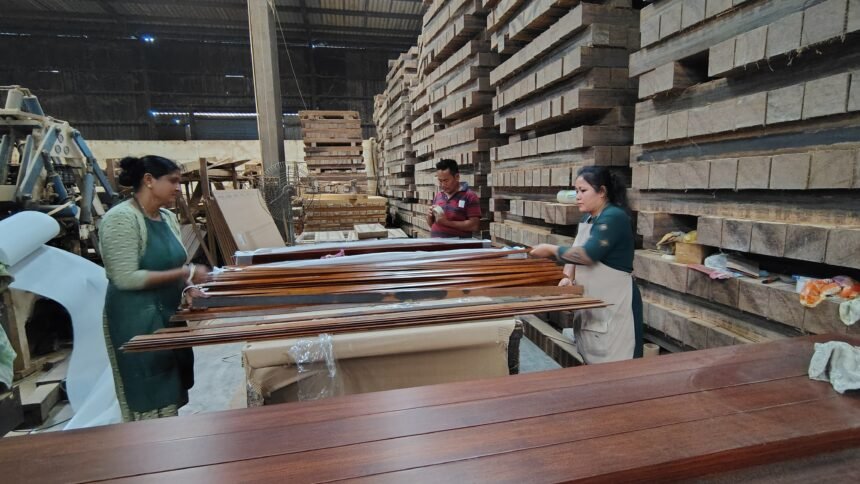
Tripura has entered a strategic collaboration with a central ministry to expand bamboo-based industrial units across the state. The initiative aims to strengthen rural industries, promote sustainable resource utilization, and generate employment opportunities. Moreover, officials stated that the partnership focuses on developing value-added bamboo products for domestic and export markets. The move highlights Tripura’s growing emphasis on bamboo as a key economic resource.
Security Forces Rescue 115 Human Trafficking Victims From Assam; 9 Traffickers Arrested in Bihar
Border Trade via Moreh Remains Suspended Amid Prevailing Regional Security Protocols
Strategic Partnership to Boost Bamboo Industrial Growth
Tripura enters strategic collaboration with central ministry for expanding bamboo-based industrial units, marking a major step in industrial development. Consequently, new bamboo processing and manufacturing units are expected to be established.
The collaboration focuses on strengthening the entire bamboo value chain, from cultivation to finished products. Moreover, improved infrastructure will support large-scale production. Therefore, the bamboo sector is expected to become more commercially viable.
Officials emphasized that Tripura has abundant bamboo resources suitable for industrial use. Furthermore, the state has already developed expertise in bamboo craftsmanship. As a result, the sector holds strong growth potential.
Meanwhile, feasibility studies are being conducted to identify suitable industrial locations. Consequently, investment planning is being streamlined.
Promotion of Bamboo-Based Value-Added Industries
The Tripura enters strategic collaboration with central ministry for expanding bamboo-based industrial units with a focus on value addition. Moreover, bamboo is being promoted beyond traditional uses. Therefore, diversified industrial applications are being encouraged.
The initiative includes production of bamboo furniture, handicrafts, packaging materials, and construction components. Consequently, new market opportunities are expected to emerge. Such diversification increases economic resilience.
Furthermore, modern processing technologies will be introduced to improve product quality. As a result, Tripura’s bamboo products may gain stronger national and international demand.
Meanwhile, training programs are being planned for local artisans. Similarly, skill development initiatives will support workforce readiness.
Employment Generation and Rural Development Impact
Tripura enters strategic collaboration with central ministry for expanding bamboo-based industrial units to generate employment in rural areas. Moreover, bamboo-based industries are labor-intensive and community-driven. Therefore, they offer strong livelihood potential.
The expansion of industrial units is expected to create both skilled and unskilled job opportunities. Consequently, rural youth may find new employment avenues. Such developments can reduce migration to urban areas.
Furthermore, women’s participation in bamboo-based enterprises is being encouraged. As a result, inclusive economic growth is expected.
Meanwhile, cooperative models and self-help groups are being integrated into the sector. Similarly, micro-enterprise development is being promoted.
Sustainable Resource Utilization and Industrial Policy Support
The initiative emphasizes sustainable use of bamboo resources in line with environmental goals. Moreover, bamboo is a fast-growing renewable resource. Therefore, it is well-suited for eco-friendly industrial development.
Officials highlighted that bamboo-based industries generate low carbon emissions compared to conventional manufacturing. Consequently, the initiative supports green growth objectives. Such alignment strengthens environmental sustainability.
Furthermore, policy support is being extended to encourage private investment. As a result, industrial expansion is expected to accelerate.
Meanwhile, research and development efforts are being encouraged to improve product innovation. Similarly, quality standards are being introduced for exports.
Conclusion
Tripura enters strategic collaboration with central ministry for expanding bamboo-based industrial units, marking a significant milestone in industrial and rural development. Moreover, the initiative promotes sustainable resource use and employment generation.
The collaboration is expected to strengthen the bamboo value chain and enhance economic opportunities. Therefore, it supports both environmental and economic objectives.
As Tripura enters strategic collaboration with central ministry for expanding bamboo-based industrial units, it reinforces the state’s potential as a major bamboo-based industrial hub.
FAQs
1. What collaboration has Tripura entered into?
A strategic partnership with a central ministry for bamboo industries.
2. What is the main focus of the initiative?
Expansion of bamboo-based industrial units.
3. What products will be made?
Furniture, handicrafts, packaging, and other bamboo goods.
4. Who benefits from the project?
Rural workers, artisans, and local industries.
5. Why is bamboo important?
It is a sustainable and renewable industrial resource.