





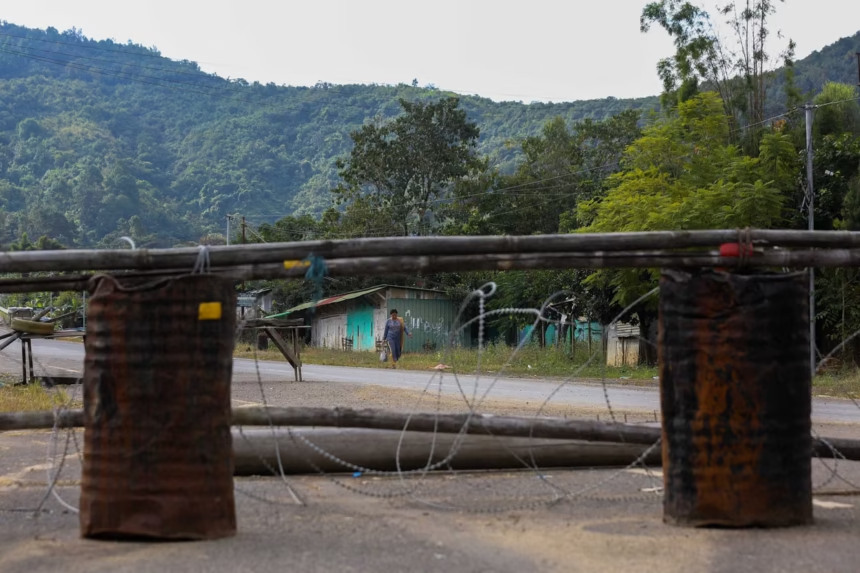
Border trade activities through Moreh in Manipur remain suspended due to prevailing regional security protocols and ongoing administrative restrictions. The suspension has impacted cross-border commercial movement and routine trade exchanges in the area. Moreover, officials stated that the measure has been implemented as part of broader security and regulatory considerations. The situation continues to affect traders dependent on Indo-Myanmar border commerce.
Naga Insurgent Group Leader Issues Public Statement
Sikkim Governor Flags Off the First Official Batch of Pilgrims for the Kailash Mansarovar Yatra
Trade Suspension Continues at Key Border Hub
Border trade via Moreh remains suspended amid prevailing regional security protocols, leading to a halt in regular cross-border transactions. Consequently, commercial activities that depend on daily movement of goods have been significantly disrupted.
Moreh, a key trading point along the Indo-Myanmar border, has historically served as an important economic link. Moreover, the suspension has slowed down supply chains connected to regional markets. Therefore, traders are facing operational uncertainty.
Authorities indicated that the restrictions are linked to security assessments in the region. Furthermore, movement control measures have been reinforced in sensitive border zones. As a result, normal trade flow has not yet resumed.
Meanwhile, local business associations are closely monitoring the situation. Consequently, there is growing concern over prolonged economic disruption.
Impact on Local Traders and Border Economy
Border trade via Moreh remains suspended amid prevailing regional security protocols, directly affecting traders who rely on cross-border commerce for their livelihood. Moreover, many small and medium traders are experiencing financial strain. Therefore, the economic impact is being felt across the local supply chain.
Goods that typically move between India and Myanmar through Moreh are currently held back. Consequently, inventory management and pricing stability have been affected. Such disruptions have a cascading effect on regional markets.
Furthermore, transport operators and laborers dependent on border trade are also impacted. As a result, allied economic activities have slowed significantly.
Meanwhile, stakeholders are seeking clarity on resumption timelines. Similarly, discussions on alternative trade arrangements are being explored.
Security Considerations Driving Administrative Measures
The continued suspension of border trade via Moreh reflects heightened security protocols in the region. Moreover, border areas often require strict monitoring due to their strategic importance. Therefore, administrative caution has been prioritized.
Officials stated that movement restrictions are necessary to ensure stability in sensitive zones. Consequently, enforcement agencies are maintaining heightened vigilance. Such measures are standard during periods of security assessment.
Furthermore, coordination between security forces and civil administration remains active. As a result, decision-making is being guided by real-time assessments.
Meanwhile, periodic reviews of the situation are being conducted. Similarly, adjustments to restrictions may be considered based on evolving conditions.
Future Outlook for Cross-Border Trade
The suspension of border trade via Moreh remains temporary, with future resumption dependent on improved security conditions. Moreover, structured protocols are expected to guide the reopening process. Therefore, stakeholders are awaiting official updates.
Trade facilitation mechanisms may be reintroduced in phases once conditions stabilize. Consequently, gradual normalization of economic activity is anticipated. Such phased approaches help maintain stability.
Furthermore, long-term plans for regulated border trade are under consideration. As a result, more structured and secure trade systems may emerge.
Meanwhile, traders continue to advocate for clear communication from authorities. Similarly, policy discussions around border trade frameworks are ongoing.
Conclusion
Border trade via Moreh remains suspended amid prevailing regional security protocols, resulting in significant disruption to cross-border economic activity. Moreover, the measure reflects ongoing security considerations in the region.
The suspension has impacted traders and associated livelihoods, highlighting the importance of the border trade route. Therefore, resolution of security concerns will be key to restoring normal activity.
As border trade via Moreh remains suspended amid prevailing regional security protocols, it underscores the close link between regional stability and economic connectivity.
FAQs
1. Where is the trade suspension taking place?
At Moreh in Manipur.
2. Why is border trade suspended?
Due to prevailing regional security protocols.
3. Who is affected by the suspension?
Local traders and border-dependent businesses.
4. Is the suspension permanent?
No, it is temporary based on security conditions.
5. What is Moreh known for?
It is a key Indo-Myanmar border trade hub.