





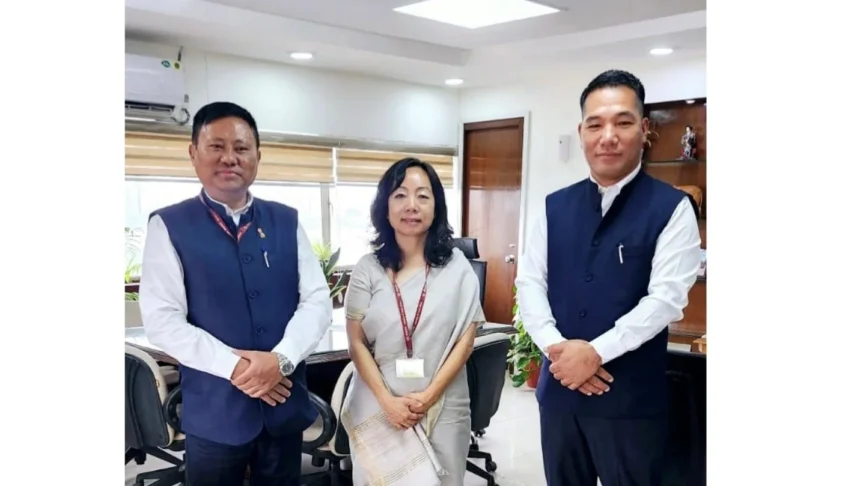
Nagaland Health Minister P. Paiwang Konyak has called for region-specific budget allocations under Centrally Sponsored Schemes (CSS), highlighting the unique geographical and infrastructural challenges faced by Northeastern states. Speaking at the 16th Conference of the Central Council of Health and Family Welfare held in New Delhi on June 29, the minister emphasized that hilly terrain, difficult logistics, and higher construction costs require a differentiated funding approach. Moreover, he urged the Centre to consider regional realities while designing and implementing national health and infrastructure programs.
Passing of Former Mizoram Governor Lt Gen. M.M. Lakhera
Impact TV Hosts Special Dialogue to Promote Restoration of Manipur’s Traditional Theatre
Nagaland Minister Raises Funding Concerns at National Health Conference
Participating in the 16th Conference of the Central Council of Health and Family Welfare, Health Minister P. Paiwang Konyak presented Nagaland’s concerns regarding the financial structure of Centrally Sponsored Schemes. Consequently, the issue of equitable resource allocation for hilly and remote states received renewed attention.
According to the minister, the existing funding framework often fails to account adequately for the significantly higher costs associated with developing infrastructure in mountainous regions. Moreover, transportation, construction, and service delivery expenses in Northeastern states remain considerably higher than those in many other parts of the country. Therefore, he argued that region-specific budget provisions are necessary.
Officials noted that geographical challenges continue to affect the implementation of development projects across the Northeast. Furthermore, differences in terrain and accessibility frequently increase project timelines and operational costs. As a result, state governments have repeatedly sought greater flexibility in funding mechanisms.
Meanwhile, discussions regarding equitable resource allocation continue to remain an important aspect of intergovernmental policy dialogue. Consequently, the issue received considerable attention during the conference.
Hilly Terrain and Logistics Challenges Highlighted
During his address, the Nagaland Health Minister emphasized that mountainous geography creates substantial financial and logistical challenges for infrastructure development and public service delivery. Moreover, remote locations often require additional investment in transportation, construction materials, and workforce deployment. Therefore, uniform budgetary models may not adequately address regional realities.
The minister pointed out that healthcare facilities, roads, and public infrastructure projects in hilly regions frequently involve significantly higher expenditures than projects undertaken in plains areas. Consequently, he urged policymakers to adopt a more region-sensitive approach to budgeting. Such measures, he argued, would improve the effectiveness of development programs.
Furthermore, officials observed that weather conditions, difficult terrain, and limited connectivity further increase operational complexities. As a result, governments in the Northeast continue to advocate for enhanced financial support mechanisms.
Meanwhile, policymakers continue to examine strategies for improving development outcomes in geographically challenging regions. Similarly, discussions on regional equity remain ongoing.
Call for Region-Specific Budgeting Under Centrally Sponsored Schemes
A central focus of the minister’s intervention involved the need to restructure funding models under Centrally Sponsored Schemes to account for regional variations. Moreover, he emphasized that differentiated financial allocations could help states address local developmental priorities more effectively. Therefore, greater flexibility in budget planning was proposed.
Officials noted that region-specific budgeting mechanisms could improve project implementation, infrastructure development, and public service delivery in remote areas. Consequently, such proposals have gained increasing attention among policymakers and state governments. These discussions remain important in the context of balanced regional development.
Furthermore, the minister argued that recognizing geographical disparities would contribute to more equitable and efficient resource allocation. As a result, calls for policy reforms and funding adjustments continue to emerge from several northeastern states.
Meanwhile, central and state authorities remain engaged in discussions regarding development financing frameworks. Similarly, policy reviews continue in various sectors.
Northeast Development Challenges Receive National Attention
The issues raised during the conference reflect broader concerns regarding development planning and resource allocation in India’s northeastern region. Moreover, states in the region have long highlighted the challenges posed by difficult terrain, limited connectivity, and higher infrastructure costs. Therefore, discussions regarding specialized policy approaches continue to remain relevant.
Experts noted that region-specific planning and investment strategies can play a crucial role in reducing developmental disparities and improving public services. Consequently, policymakers continue to evaluate mechanisms aimed at strengthening regional equity. Such efforts contribute to inclusive national development.
Furthermore, the conference provided an opportunity for northeastern states to articulate their specific concerns and priorities before national policymakers. As a result, discussions on differentiated development strategies remain active.
Meanwhile, governments across the region continue to advocate for greater financial flexibility and institutional support. Similarly, policy discussions concerning regional development remain ongoing.
Conclusion
Nagaland Health Minister P. Paiwang Konyak’s call for region-specific budgeting under Centrally Sponsored Schemes has renewed attention on the unique challenges faced by Northeastern states. Moreover, his remarks highlighted the significant impact of geography, logistics, and infrastructure costs on development outcomes.
The discussion underscores the importance of adopting flexible and equitable funding mechanisms capable of addressing regional disparities. Therefore, continued dialogue between the Centre and state governments remains essential for promoting balanced development.
As policymakers continue to evaluate resource allocation frameworks, the concerns raised by northeastern states are expected to remain an important part of national development discussions.
FAQs
1. Who raised the demand for region-specific budgeting?
Nagaland Health Minister P. Paiwang Konyak raised the issue.
2. Where was the demand made?
The demand was made during the 16th Conference of the Central Council of Health and Family Welfare in New Delhi.
3. Why did the minister seek special budget provisions?
He argued that hilly terrain and logistical challenges significantly increase development costs.
4. Which funding programs were discussed?
The discussion focused on Centrally Sponsored Schemes (CSS).
5. What is the main objective of region-specific budgeting?
The objective is to ensure more equitable and effective allocation of resources based on regional needs and conditions.