




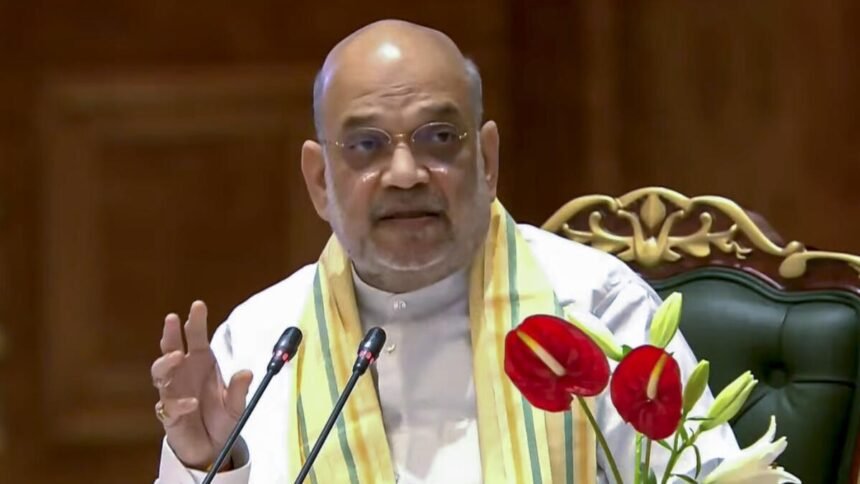
Union Home Minister Amit Shah has reiterated the Central Government’s commitment to substantially phase out the Armed Forces (Special Powers) Act (AFSPA) from most parts of Northeast India by 2027. The statement reflects the government’s continued emphasis on improving the security environment, promoting peace initiatives, and strengthening democratic governance across the region. Moreover, the announcement has renewed discussions regarding security reforms, regional stability, and the long-term peace process in the northeastern states.
Northeast India Records 80% Decline in Insurgency-Related Violence
Cross-Border Arms Intercept Foils Smuggling
Centre Reaffirms Commitment to AFSPA Reduction
Home Minister Amit Shah reaffirmed that the government intends to continue the gradual withdrawal of AFSPA from large parts of the Northeast, citing improvements in the security situation across several states. Consequently, the announcement has drawn significant political and strategic attention throughout the region.
According to government officials, the phased reduction of AFSPA has been accompanied by efforts to strengthen local governance institutions, enhance security coordination, and promote socio-economic development. Moreover, authorities have emphasized that security assessments and administrative reviews remain central to the decision-making process. Therefore, the government’s long-term objective continues to focus on normalizing security conditions.
Political observers noted that the gradual rollback of AFSPA in various northeastern regions over recent years has been presented as an indicator of improving law and order conditions. As a result, expectations regarding future policy decisions have increased.
Meanwhile, security agencies continue to monitor regional developments and evaluate operational requirements.
Security Improvements Cited as Key Factor
The government’s position on reducing AFSPA coverage has largely been linked to improvements in internal security and a decline in insurgency-related incidents in several northeastern states. Moreover, peace agreements, enhanced border management, and coordinated security operations have contributed to changing security assessments. Therefore, policymakers continue to emphasize a phased and conditional approach.
Security experts observed that any decision regarding AFSPA implementation typically involves detailed assessments by security agencies and administrative authorities. Consequently, periodic reviews remain an important aspect of the policy framework. Such evaluations help determine the suitability of reducing or withdrawing special security provisions.
Furthermore, ongoing peace initiatives and development programs have been cited as important contributors to regional stability. As a result, efforts to strengthen institutional governance and public confidence continue.
Meanwhile, authorities remain focused on maintaining peace and ensuring effective security management.
Northeast Peace Process Continues to Receive Priority
The reiteration of the 2027 target underscores the government’s broader strategy of promoting peace, stability, and economic development in the northeastern region. Moreover, various political agreements and development initiatives have been introduced over recent years to support long-term regional transformation. Therefore, the future of AFSPA remains closely linked to broader peace-building efforts.
Political analysts noted that the Northeast has witnessed significant political and security developments in recent years, resulting in renewed discussions regarding governance and security reforms. Consequently, the government’s stated objective of reducing AFSPA coverage has become an important element of its regional policy framework.
Furthermore, continued engagement with local stakeholders and security institutions is expected to remain crucial in shaping future decisions. As a result, discussions surrounding AFSPA and regional security policies continue to evolve.
Meanwhile, policymakers continue to emphasize balanced approaches that address both security concerns and democratic aspirations.
Debate Over AFSPA Continues
The Armed Forces (Special Powers) Act has remained a subject of political, legal, and public debate for decades. Moreover, discussions regarding its implementation often involve considerations related to security, human rights, governance, and regional stability. Therefore, any proposal regarding its expansion or withdrawal attracts considerable attention.
Experts emphasized that long-term peace and stability require sustained efforts involving governance reforms, security coordination, economic development, and community engagement. Consequently, decisions regarding AFSPA are likely to remain closely monitored by political leaders, civil society organizations, and security experts alike.
Furthermore, the government’s stated target of phasing out AFSPA from most parts of the Northeast by 2027 is expected to influence future discussions on regional security policy. As a result, the issue will likely remain an important component of political and strategic discourse.
Meanwhile, security reviews and policy consultations continue at multiple levels.
Conclusion
Home Minister Amit Shah’s reiteration of the government’s intention to phase out AFSPA from most of Northeast India by 2027 reflects the broader focus on peace-building, security normalization, and regional development. Moreover, the statement highlights ongoing efforts to balance security requirements with democratic governance and long-term stability.
As security conditions and political developments continue to evolve, decisions regarding AFSPA will remain closely tied to regional assessments and policy priorities. Therefore, the government’s progress toward its stated objective will continue to attract significant public and political attention.
The announcement underscores the continuing importance of peace initiatives, institutional coordination, and strategic planning in shaping the future of Northeast India.
FAQs
1. What did Home Minister Amit Shah reiterate?
He reiterated that the government aims to phase out AFSPA from most parts of Northeast India by 2027.
2. What is AFSPA?
The Armed Forces (Special Powers) Act is a law that grants special powers to armed forces operating in designated areas.
3. Why is the government considering reducing AFSPA coverage?
The government has cited improvements in security conditions and regional stability.
4. Does AFSPA removal happen immediately?
No, decisions regarding AFSPA are generally made through phased reviews and security assessments.
5. Why is the issue significant?
AFSPA has long been an important topic in discussions about security, governance, and peace in Northeast India.