





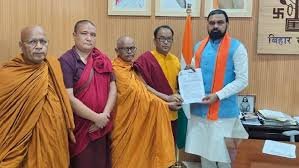
Mahabodhi Temple management has returned to the spotlight after Bihar Chief Minister Samrat Choudhary met representatives of a Buddhist forum seeking greater control over the sacred shrine at Bodh Gaya. The forum has long demanded that the temple be managed entirely by Buddhists.
Choudhary’s assurance of a review comes as the dispute over the temple’s management remains tied to the Bodh Gaya Temple Act, 1949. The law created a management structure involving both Buddhist and Hindu representatives.
Buddhist forum seeks full management control
The Buddhist forum has argued that the Mahabodhi Temple should be administered by Buddhists because of its central importance to the faith. The group has sought changes to the existing legal framework and greater community control over the shrine.
The demand is not new. Buddhist organisations, including the All India Buddhist Forum, have campaigned for the repeal of the 1949 law and full Buddhist control over the temple’s administration. Protests intensified in Bodh Gaya during 2025, with demonstrators calling for changes to the management system.
However, the issue remains contested. The present arrangement was created to regulate the administration of the temple and balance the interests of different communities associated with the historic site.
How the Mahabodhi Temple is managed
The Mahabodhi Temple is administered through the Bodh Gaya Temple Management Committee, or BTMC, under the 1949 Act. The structure provides representation to both Buddhists and Hindus, while the Gaya district magistrate serves as the committee’s chairperson under the amended legal framework.
The arrangement has been a longstanding source of concern for Buddhist groups. They argue that the system does not give Buddhists sufficient authority over one of the most important pilgrimage sites in their religion.
The law was amended in 2013 to remove the earlier requirement that the district magistrate serving as chairperson must be Hindu. Despite that change, the broader demand for exclusive Buddhist management has continued.
Legal dispute adds another layer
The demand for changes to the Mahabodhi Temple administration is also linked to a legal challenge. A petition before the Supreme Court seeks to challenge the constitutional validity of the Bodh Gaya Temple Act and calls for a new framework under which the temple would be placed under Buddhist management.
The Supreme Court deferred the hearing of the challenge on August 11, 2026. The petition seeks repeal of the 1949 law and asks for the “total management, control and administration” of the temple to be vested in Buddhists.
Therefore, the state government’s review will take place alongside an unresolved legal process. Any major change to the existing arrangement could consequently have wider legal and administrative implications.
Temple’s heritage and global importance
The Mahabodhi Temple is located at Bodh Gaya, where Buddhist tradition identifies the place where Siddhartha Gautama attained enlightenment. The temple complex was added to the UNESCO World Heritage List in 2002 and remains a major international Buddhist pilgrimage destination.
The site also attracts pilgrims from several Buddhist countries. During Buddha Purnima celebrations in 2026, thousands of devotees from India and abroad gathered in Bodh Gaya. Chief Minister Samrat Choudhary also visited the temple during the celebrations and reviewed development-related work.
Moreover, the Bihar government has recently focused on conservation and heritage development around Bodh Gaya. In August, Choudhary ordered a non-invasive scientific survey of the temple premises using LiDAR and Ground Penetrating Radar to identify possible archaeological remains.
Review could shape the next step
The meeting between the Bihar chief minister and the Buddhist forum gives the management dispute renewed political attention. The government’s review could provide an opportunity to examine the forum’s demands, the existing law and the concerns raised by different stakeholders.
At the same time, the Mahabodhi Temple dispute involves religious rights, heritage protection and legal questions. Any decision will therefore need to consider the temple’s international importance as well as the ongoing court proceedings.
For now, the government’s assurance signals that the demand for greater Buddhist control will receive consideration. However, no change to the existing management structure has been announced. The next steps are likely to depend on the government’s review and the outcome of the legal challenge.