







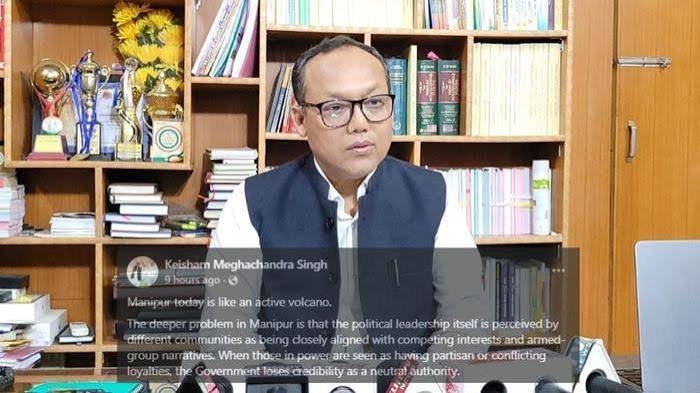
Manipur government faces a fresh test over its ability to act as a neutral authority amid continuing ethnic tensions, Congress Legislature Party leader Keisham Meghachandra Singh said on September 2. He described the state as an “active volcano” and called for governance that rises above competing community interests.
Singh said political leadership must not be seen as protecting violence or favouring one group. He argued that public confidence can return only when the government applies the same standards of justice and accountability to everyone.
Manipur government urged to remain neutral
The Congress leader said the state needs a government that is viewed as neutral by all communities. His remarks came amid efforts to restore peace after more than three years of ethnic conflict between Meitei and Kuki-Zo communities.
Singh said the administration should follow a clear policy of providing no political protection to violence. He also called for no selective justice or armed intimidation.
He stressed that accountability should apply equally, regardless of a person’s community. He said every victim must have access to justice to rebuild trust.
Why Manipur government faces a difficult task
Manipur has remained deeply divided since ethnic violence broke out in May 2023. The conflict has caused deaths, displacement and deepened mistrust between communities.
However, the political situation has changed since then. President’s Rule was imposed in February 2025, before a new elected government was formed in February 2026 under Chief Minister Yumnam Khemchand Singh.
The government has since repeatedly stressed unity and the need to place the interests of the state above community-specific considerations. In August, Khemchand said Meiteis, Nagas and Kukis should work together in the larger interest of a united Manipur.
Those appeals underline the central challenge facing the administration. The Manipur government must show that neutrality is more than a stated principle. Peace efforts require not only security measures but also confidence that state institutions will act fairly.
Trust remains central to peace
For the Manipur government, restoring trust is particularly difficult because perceptions of bias can deepen existing divisions. Singh argued that a neutral state authority is essential if communities are to believe that laws and institutions will protect them equally.
His comments reflect a wider debate over how the government should respond to competing political and community demands. Questions of security, displacement, land, representation and identity continue to shape public debate.
Therefore, the credibility of government action may be as important as individual measures. Decisions seen as favouring one side can quickly deepen tension.
Manipur government faces pressure to deliver justice
Singh’s call for accountability comes as the state continues to seek a durable political solution to the conflict. He said there should be no political protection for violence and that justice must not depend on community identity.
The government, meanwhile, has been presenting peace, development and reconciliation as major priorities. The chief minister has also appealed for dialogue and cooperation among the state’s communities.
Yet rebuilding relations will require more than public appeals. It will involve sustained engagement, credible law enforcement and measures addressing fears on all sides.
The administration must balance public order with space for dialogue. Consequently, peace will depend on whether people see institutions as fair and dependable.
A broader test for governance
The phrase “active volcano” used by Singh is a political description of the continuing risks in Manipur, not a reference to actual volcanic activity. India’s only active volcano is Barren Island in the Andaman and Nicobar Islands.
His warning points to the danger of unresolved grievances building beneath a fragile calm. The Manipur government faces the task of ensuring that political decisions do not deepen community divisions.
Ultimately, lasting peace will depend on whether the administration can demonstrate impartiality in practice. That means applying the law consistently, protecting civilians and keeping channels of dialogue open.
For Singh and the Congress, the demand for a government above community interests is also a political challenge to the present administration. For the state as a whole, however, the larger issue is institutional trust. The Manipur government will be judged by how consistently it applies that standard.
Sreemanta Nagar, Assam: Police Recover Allegedly Stolen Goods, Arrest Two