






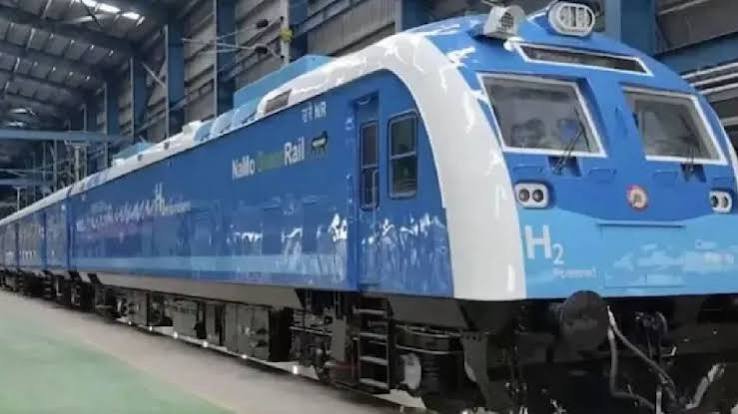
The hydrogen train has completed speed trials at up to 120 kmph, marking an important step in Indian Railways’ effort to expand cleaner rail transport. The train is currently operating at a maximum speed of 75 kmph on the Jind-Sonipat section in Haryana.
Railway Board Chairman and CEO Satish Kumar said on September 6 that efforts were underway to raise the train’s operational speed to 110 kmph. The Railways is also examining suitable routes, technical requirements and arrangements for a steady hydrogen fuel supply.
Hydrogen train completes high-speed trials
The latest development follows the successful completion of a 120 kmph trial run in June. The trial was conducted on the Jind-Sonipat section of Northern Railway, which was selected as the pilot route for the country’s first hydrogen-powered passenger train.
However, the 120 kmph trial speed does not mean passengers are currently travelling at that speed. The train’s present operational limit remains 75 kmph. Railway authorities are now working towards increasing that limit to 110 kmph after assessing the results of the high-speed trials.
What the speed upgrade means
The proposed 110 kmph operating speed is in line with the train’s design capability. Before the service was launched, Indian Railways said the train had a design speed of 110 kmph while its approved operating speed on the Jind-Sonipat route was 75 kmph.
Therefore, the planned upgrade would allow the train to use more of its designed performance during regular passenger operations.
Hydrogen train brings cleaner rail technology
Unlike conventional diesel trains, the hydrogen train uses fuel-cell technology to generate electricity onboard. Hydrogen reacts with oxygen in the fuel cells, producing electricity to power the train.
The direct by-products are water vapour and heat. As a result, the system does not produce smoke or tailpipe carbon emissions during operation. Indian Railways has described the technology as an important part of its move towards cleaner and more sustainable rail transport.
The train is also equipped with several safety systems. These include equipment designed to detect hydrogen leaks, heat, flames and smoke. Automatic safety measures and continuous monitoring are part of the system developed for the train.
Ten-coach train built for passenger service
The indigenous hydrogen train has a 10-coach configuration and can accommodate around 2,600 passengers. It includes two Hydrogen Driving Power Cars and eight trailer coaches.
Each power car contains hydrogen fuel-cell equipment, lithium iron phosphate batteries and hydrogen storage cylinders. Together, the two power cars provide 2,400 kW of power.
A dedicated hydrogen storage and refuelling facility has also been established at Jind. The facility is intended to support regular operations and forms part of the hydrogen railway infrastructure developed for the pilot project.
Railways weighs routes and fuel supply
Meanwhile, the Railways is looking beyond the current Jind-Sonipat operation. Satish Kumar said consultations were underway with stakeholders to determine the sections where the hydrogen-powered train could operate.
Technical requirements and fuel supply arrangements are also being examined. This process will be important because hydrogen-powered services require dedicated infrastructure for storage, compression and refuelling.
The first hydrogen-powered train was flagged off on July 17 and operates on the 89-km Jind-Sonipat route. Since its launch, the service has provided Indian Railways with practical experience in operating hydrogen fuel-cell technology under passenger conditions.
A new phase for hydrogen rail in India
The successful 120 kmph trial gives Indian Railways a stronger technical basis for increasing regular operating speeds. However, the proposed 110 kmph service will depend on further operational assessments and the necessary arrangements.
Overall, the hydrogen train represents a new phase in India’s clean mobility programme. If the planned speed increase and future route expansion move ahead, the project could provide valuable experience for wider use of hydrogen-powered trains across suitable railway sections.