




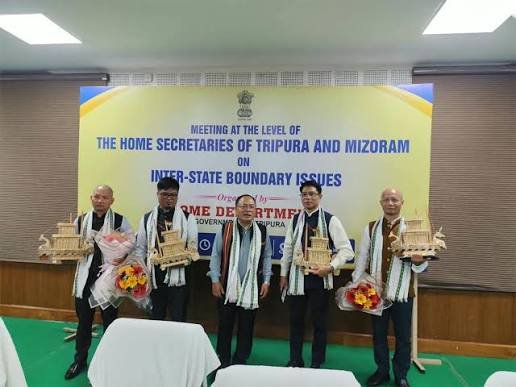
Tripura Mizoram Border Talks have gained fresh momentum after senior officials from both states met in Agartala to discuss their long-standing inter-state boundary issues. The high-level meeting brought together Home Secretaries, Revenue Secretaries, District Magistrates and senior police officials. Both sides agreed to maintain the existing status quo while continuing discussions and technical assessments aimed at finding a mutually acceptable solution.
Gauhati University poll now faces hunger strike
Tripura Mizoram Border Talks Focus on Maintaining Status Quo
The latest Tripura Mizoram Border Talks mark an important administrative step in managing a boundary dispute that has remained unresolved for decades. Officials from both states met at the State Guest House in Agartala on Thursday. The meeting focused on coordination, records and formal discussions.
Moreover, both sides agreed to maintain the existing arrangements in the disputed areas. Officials will continue discussions while working toward a longer-term understanding. This decision can help prevent fresh tensions and give both administrations time to examine records and local concerns.
The meeting did not produce a final settlement. Instead, it created a framework for continued dialogue, documentation and technical examination. Therefore, officials will treat the status quo as a stabilising measure rather than a final boundary decision.
India Today NE reported that the discussions have moved the issue toward official and technical talks. Both states are expected to examine shared records and consider joint surveys before any fresh demarcation.
Tripura Mizoram Border Talks Bring Senior Officials Together
The level of participation highlights the importance both governments attach to the boundary issue. Home Secretaries from Tripura and Mizoram joined the discussions. Revenue Secretaries, District Magistrates and Superintendents of Police also took part.
Additionally, district-level participation gives the process an operational focus. District administrations handle issues involving residents, development work and law and order. Their involvement can therefore connect state-level decisions with developments in border areas.
The meeting followed renewed efforts by both states to address the boundary question through dialogue. Tripura Chief Minister Manik Saha has expressed confidence that discussions with Mizoram Chief Minister Lalduhoma can move the issue toward a resolution.
Furthermore, the latest talks followed a political-level interaction between the two chief ministers during a North Eastern Council meeting in Shillong. Officials then began developing mechanisms to continue the dialogue.
The latest development therefore shows a shift from broad political discussions toward a more structured administrative process.
Tripura Mizoram Border Talks Set Stage for Technical Assessment
A major part of the discussions involves examining records linked to the disputed boundary. Both states are expected to form teams for studying documents and collecting relevant information.
Meanwhile, another reported outcome involves a joint technical mechanism with the Survey of India. According to UNI, future demarcation efforts will involve joint technical work. Nodal officers from both states will also support regular coordination.
The Survey of India is expected to facilitate meetings between the technical teams. This approach can give future decisions a clearer technical basis.
Officials can examine available records and technical evidence before considering new field demarcation. Additionally, the process can help identify differences between the records or interpretations held by the two states.
Those differences can then form part of formal discussions between the administrations. However, the formation of technical teams does not mean that both states have reached a final boundary agreement.
Further examination and consultation will remain necessary. The states may also need joint field work before they can settle outstanding boundary questions.
Tripura Mizoram Border Talks Linked to Local Development and Coordination
The status quo understanding also affects development activity in border areas. UNI reported that routine development work will continue while both states pursue a longer-term solution.
This point matters because boundary disputes can complicate administrative decisions. They can also create uncertainty around development projects when both sides claim authority over specific areas.
Maintaining existing arrangements can therefore give local administrations greater predictability. Meanwhile, officials can continue working on the broader boundary question.
Recent reports have also linked renewed attention to the dispute with objections from Mizoram villagers. The objections reportedly concerned a tourism-related construction activity in Tripura.
The issue has added urgency to efforts to improve communication between the two administrations. Furthermore, regular coordination can help officials respond faster when local disagreements arise.
Nodal officers and district-level communication channels can provide a way to address emerging concerns. Such mechanisms can also reduce the risk of local disputes becoming larger administrative issues.
The broader objective remains a peaceful and mutually acceptable resolution. Therefore, continued communication will remain important as technical teams examine records and prepare for future surveys.
Conclusion
The latest Tripura Mizoram Border Talks have created a formal platform for managing the long-running boundary issue. The process will focus on dialogue, documentation and technical assessment.
Both states have agreed to maintain the existing status quo. At the same time, separate teams and technical mechanisms will examine available records.
The meeting does not represent a final settlement. However, continued participation from senior administrative and police officials can strengthen coordination between the two states.
The next stage will focus on records, designated officials and technical assessments. Consequently, the progress of the Tripura Mizoram Border Talks will depend on continued cooperation between both governments.
Both sides will need to maintain dialogue while working toward a mutually acceptable outcome.
FAQs
1. What was decided in the Tripura Mizoram Border Talks?
Tripura and Mizoram agreed to maintain the existing status quo in the concerned border areas while continuing discussions and detailed assessment of boundary-related matters.
2. Where were the Tripura Mizoram Border Talks held?
The high-level meeting was held at the State Guest House in Agartala, Tripura, on Thursday.
3. Did the meeting permanently settle the Tripura-Mizoram border dispute?
No. The meeting established a framework for further examination, documentation and technical discussions. A final settlement has not yet been announced.
4. What role will technical teams play?
The states are expected to form teams to examine boundary-related records and gather relevant information. A joint technical process involving the Survey of India is also expected to support future demarcation efforts.
5. Why is maintaining the status quo important?
Maintaining the existing arrangements can help prevent escalation while officials continue examining the boundary dispute. Additionally, it allows routine administration and development activities to continue during the negotiation process.