






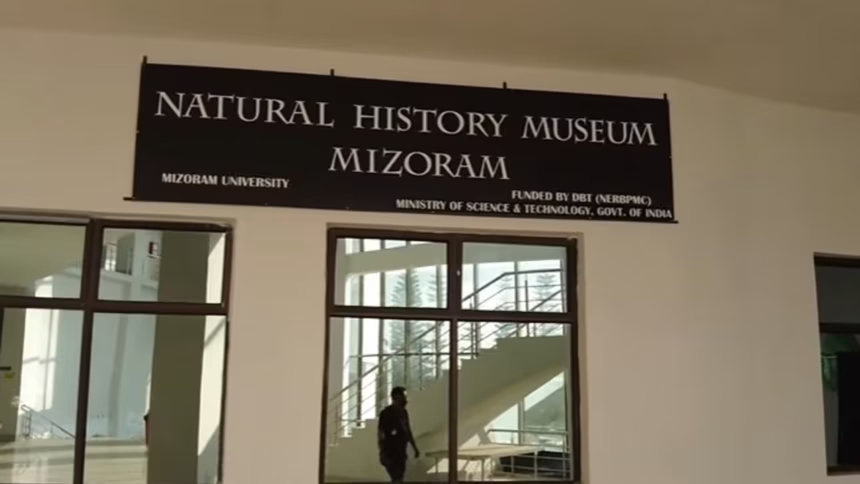
The Mizoram heritage preservation strategy has gained fresh momentum after the state confirmed that 79 monuments and archaeological sites have received State Protected Monument status. The protection operates under the Mizoram Ancient Monuments and Archaeological Sites and Remains Act, 2001. Art and Culture Minister C. Lalsawivunga provided the latest details during the Mizoram Legislative Assembly session in August 2026.
The move places a larger focus on documenting, protecting and maintaining Mizoram’s historical remains. It also comes as the state expands efforts to identify additional sites with archaeological and cultural significance.
Breaking News: MNF Flags Mizoram SASCI Funding Gap
Mizoram Heritage Preservation Strategy Expands Protection
The Mizoram heritage preservation strategy covers 79 monuments and archaeological sites that the state has declared protected. The Art and Culture Department manages the state’s heritage-protection framework under the 2001 legislation.
The law provides a legal mechanism for the state government to declare ancient monuments as protected monuments. It covers structures and sites with historical, archaeological or artistic significance, including caves, monoliths, rock sculptures and other remains.
Mizoram’s heritage inventory includes different categories of cultural and historical structures. A NITI Aayog assessment previously recorded archaeological sites, cultural landscapes, memorial structures, public structures, residential structures and water-related heritage under the Art and Culture Department.
Furthermore, the state’s heritage framework extends beyond physical protection. Documentation, investigation, verification and preservation of historical remains form part of the department’s responsibilities.
The government has also been working to identify additional heritage locations. Minister Lalsawivunga said proposals are under consideration to declare four more sites as Protected Monuments.
Champhai Sites Receive National Recognition
Mizoram’s heritage protection system operates alongside protection provided by the Archaeological Survey of India. Two heritage locations in Champhai district have received recognition as Monuments of National Importance.
Kawtchhuah Ropui and Ralven Puk at Vangchhia were declared Monuments of National Importance in 2012. Lianpui Hmun, also known as Lungphun Ropui, at Lianpui village received the same national recognition in 2025.
Kawtchhuah Ropui, meaning the Great Entranceway, is particularly significant for its collection of carved standing stones. The site contains more than 170 intricately carved menhirs, making it an important archaeological location in eastern Mizoram.
Lianpui Hmun contains 114 carved memorial stones along with other archaeological features. These include petroglyphs, anthropic holes, Y-shaped wooden posts and ancient pathways that provide evidence of the area’s historical cultural practices.
Meanwhile, Ralven Puk is a rock-cut cave associated with traditional accounts of its use as a lookout or watchpost. Together, these sites illustrate the range of archaeological remains found across Mizoram.
The recognition also highlights Champhai’s importance within the state’s heritage landscape. The district’s location near the Myanmar border adds further geographical and cultural significance to several archaeological sites.
Four More Heritage Sites Under Consideration
The state government is also considering additional locations for protected status. Four sites identified by the Art and Culture Minister are Reng Puk in Rengdil village and Lung Milem in Kolalian village, both in Mamit district.
The other two sites are Pipute Lungdawh at Vangchhia in Champhai district and Ruhro Puk at North Khawlek in Saitual district. Proposals are under consideration for their declaration as Protected Monuments.
Such proposals can expand the state’s protected heritage inventory if the sites meet the requirements under the applicable legislation. The process also provides a framework for recognising locations that may otherwise face deterioration or insufficient documentation.
Additionally, the state has already undertaken archaeological exploration and documentation at several locations. Earlier work included investigations at Hriangmual, Hriangtuinek and Khaungzangpuk at Phuaibuang, along with studies of stone tools held by the Mizoram State Museum.
The Art and Culture Department has also worked on documentation of Mizoram’s built heritage. Digitisation of archives forms another part of the broader preservation effort.
Therefore, protection status represents one stage of heritage management rather than the entire preservation process. Regular documentation, maintenance, research and public awareness are also necessary to safeguard archaeological resources.
Heritage Protection Supports Research and Tourism
Mizoram’s archaeological sites can contribute to research into the state’s history, cultural practices and traditional communities. Proper documentation can help researchers understand the significance of structures, carvings, caves and other remains.
The state has also linked heritage institutions with educational and tourism opportunities. In May 2026, Mizoram Governor General Vijay Kumar Singh inspected ongoing work at the Tribal Research Institute and Ropuiliani Tribal Freedom Fighters Museum at Kelsih. He stressed the importance of preserving tribal culture, heritage and traditions and called for the institutions to become useful destinations for tourists, students and researchers.
However, archaeological preservation requires careful management. Development around heritage locations can create pressure if construction, infrastructure or land use affects protected areas.
At the national level, the Archaeological Survey of India follows statutory safeguards for centrally protected monuments. The Union government has stated that protected monuments generally have a 100-metre prohibited area and a 200-metre regulated area under the Ancient Monuments and Archaeological Sites and Remains Act, 1958.
Mizoram’s state-protected sites operate primarily under its own 2001 legislation. That framework defines maintenance to include activities such as fencing, covering, repairing, restoring and cleansing a protected monument where necessary for preservation and access.
Consequently, the expansion of protected status can create a stronger administrative basis for safeguarding important sites while allowing authorities to plan their future use carefully.
State and National Protection Work Together
The 79 State Protected Monuments should be distinguished from Mizoram’s centrally protected monuments. The Archaeological Survey of India currently lists two centrally protected monuments or sites in Mizoram in its state-wise inventory.
This distinction matters because state and national protection operate through different legal and administrative frameworks. The state government manages its protected monuments under the Mizoram legislation, while the ASI manages monuments of national importance under the central framework.
The Union government reported in March 2026 that the ASI was responsible for 3,686 protected monuments and archaeological sites across India. Mizoram accounted for two of those centrally protected sites at that time.
Meanwhile, the state-level inventory is considerably broader. The declaration of 79 sites gives Mizoram a wider framework for protecting locations that hold state-level historical, archaeological or cultural value.
The government’s consideration of four additional sites indicates that the inventory could grow further. Their eventual status will depend on the relevant assessment and statutory process.
As a result, the Mizoram heritage preservation strategy is developing through several layers: state protection, national recognition, archaeological documentation and institutional efforts to promote cultural heritage.
Conclusion
The Mizoram heritage preservation strategy has expanded with 79 monuments and archaeological sites now protected under the state’s 2001 heritage law. The recognition provides a legal framework for preserving archaeological remains, documenting historical resources and supporting future research.
The state is also considering four additional sites for protected status, while Champhai’s nationally recognised heritage locations demonstrate the wider importance of Mizoram’s archaeological landscape. Continued documentation, maintenance and responsible development will remain important to ensure that these sites are preserved for future generations.
FAQs
What is the Mizoram heritage preservation strategy?
The Mizoram heritage preservation strategy refers to the state’s legal and administrative efforts to identify, protect, document and maintain monuments and archaeological sites. The state has declared 79 such locations as State Protected Monuments under the 2001 Act.
How many monuments are protected by Mizoram?
Mizoram has declared 79 monuments and archaeological sites as State Protected Monuments under the Mizoram Ancient Monuments and Archaeological Sites and Remains Act, 2001.
Which Mizoram heritage sites have national importance?
Kawtchhuah Ropui and Ralven Puk at Vangchhia received national importance status in 2012. Lianpui Hmun, or Lungphun Ropui, at Lianpui received the status in 2025.
Which four sites may receive protected status next?
The four sites under consideration are Reng Puk in Rengdil, Lung Milem in Kolalian, Pipute Lungdawh at Vangchhia and Ruhro Puk at North Khawlek.
Why is archaeological preservation important in Mizoram?
Archaeological preservation helps protect physical evidence of Mizoram’s history and cultural traditions. It also supports documentation, research, education and responsible heritage-based tourism.