




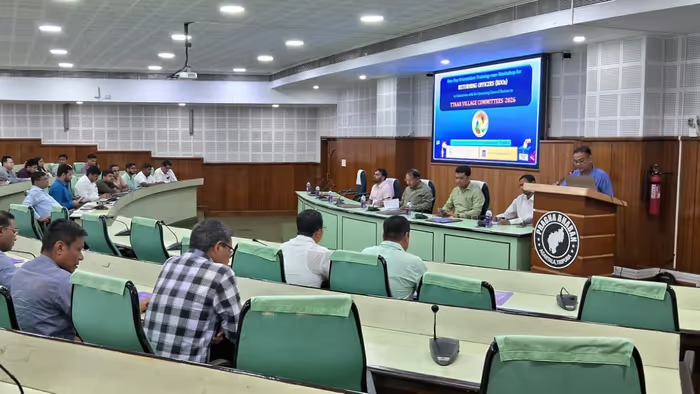
Tripura prepared 45 counting halls across 44 blocks for the TTAADC Village Committee election results announced from October 5. The State Election Commission made extensive arrangements for the counting process after polling on September 28.
The election covered 587 Village Committees under the Tripura Tribal Areas Autonomous District Council (TTAADC). Voting took place through ballot papers, while Returning Officers were assigned to declare results round by round as counting progressed.
State Election Commission Secretary Anurag Sen said the authorities had strengthened security around the counting venues. Central Armed Police Forces, Tripura Police and other security personnel were deployed to maintain order during the result process.
Tripura Congress Raises Concerns Over Border Trade Infrastructure Gaps
TTAADC Village Committee Counting Arrangements Across Tripura
The TTAADC Village Committee counting process followed polling conducted across the council’s areas on September 28. The election involved 587 Village Committees and a large number of candidates competing for the seats that went to direct polling.
Before counting began, the State Election Commission said 45 counting halls had been designated across 44 blocks. Most blocks were assigned one counting hall. However, the Manu block in Dhalai district required two halls because of its larger number of Village Committee seats.
Counting venues were arranged either at block headquarters or at other locations identified by the respective Returning Officers. This arrangement allowed officials to manage the ballot papers according to the number of committees and seats assigned to each area.
The commission also planned round-wise declaration of results. Therefore, results could emerge at different times depending on the workload at individual counting locations. Areas with fewer ballots could complete the process earlier, while larger blocks could require additional time.
A later report on the counting day referred to 44 counting centres, while earlier SEC briefings described 45 designated halls. The distinction appears to relate to the counting arrangements and reporting of centres or halls. The consistent point across the reports is that counting covered all 44 blocks, with an additional hall planned for the higher-volume Manu block.
TTAADC Village Committee Counting Begins Under Tight Security
Security formed a major part of the preparations for the TTAADC Village Committee counting process. Officials planned layered security around the counting locations to protect election materials and maintain order as candidates and supporters awaited results.
The State Election Commission said Central Armed Police Forces would assist in maintaining security. Tripura Police and Tripura State Rifles personnel were also involved in the arrangements reported for counting day. Around 2,000 personnel were assigned to the counting exercise, according to reports citing officials.
Furthermore, authorities planned strict access controls around the counting venues. Frisking and controlled entry were included in the arrangements announced before counting began. Such measures were intended to limit unnecessary movement inside sensitive counting locations.
Additional security deployment also focused on the post-poll situation. Officials recognised that political supporters would closely follow the results, making crowd management and law-and-order arrangements important beyond the counting halls themselves.
The security preparations came after isolated incidents during the election period. A firing incident at Gamaria in Gomati district had raised concerns during polling, while a Tipra Motha candidate was injured in a separate shooting incident at Warengbari. Authorities therefore maintained heightened attention around the counting process.
At the same time, Tipra Motha leader Pradyot Kishore Debbarman appealed for supporters to avoid violence during and after counting. He stressed that electoral victories and defeats should be accepted peacefully.
TTAADC Village Committee Counting Covers 587 Committees
The TTAADC Village Committee counting followed an election covering 587 Village Committees across Tripura’s tribal areas. The State Election Commission’s original election schedule listed 4,597 seats across 2,634 constituencies.
However, not every seat required polling. After the nomination and withdrawal process, 2,950 seats went to direct contests, while other seats were decided without a contest. Reports on counting day said the BJP and Tipra Motha had secured a substantial number of seats uncontested.
Polling on September 28 recorded turnout of more than 81 per cent. The high participation added significance to the results, particularly because the Village Committees form an important layer of local governance within the TTAADC areas.
The election also carried wider political significance. The TTAADC region covers a large part of Tripura and includes 20 Assembly constituencies. Consequently, political parties closely watched the Village Committee results as an indicator of their grassroots position in the tribal areas.
The BJP and Tipra Motha contested the Village Committee elections as allies under the broader NDA arrangement. However, the two parties did not maintain a uniform seat-sharing arrangement across every committee. Their performance was therefore being assessed both individually and within the alliance framework.
The results also provided an opportunity for opposition parties and independent candidates to assess their support at the local level. CPI(M), Congress and IPFT candidates were among those contesting seats, alongside BJP, Tipra Motha and independents.
TTAADC Village Committee Counting Uses Ballot Papers
Unlike the April 2026 TTAADC general election, the Village Committee election used ballot papers. That method affected the speed of the TTAADC Village Committee counting process because officials had to manually handle and count the ballots.
SEC Secretary Anurag Sen said some areas could finish counting during the day, while larger blocks might continue into the following morning. Manu in Dhalai was specifically identified as an area where the higher number of Village Committees could make counting more time-consuming.
The commission’s decision to allow round-wise result declarations also meant that the public would receive results progressively. Returning Officers could announce results after completing the required counting for individual seats and rounds.
Moreover, the ballot-paper process required officials to maintain careful procedures for sorting, validating and recording votes. The TTAADC Village Committee election rules include formal counting sheets for recording valid ballots, rejected ballots and votes secured by individual candidates.
The process was therefore expected to move at different speeds across the state. Smaller counting locations could finish earlier, while areas handling larger numbers of seats could require substantially more time.
By October 5, counting had begun across the designated locations. Early results showed Tipra Motha taking a strong lead, although figures changed as Returning Officers entered results from different counting centres. The State Election Commission’s results portal cautioned that its online information was based on data entered by Returning Officers at their respective counting centres.
Consequently, early figures needed to be treated as provisional until the commission completed the counting and formally declared the results. The final distribution of seats could differ from numbers shown during the counting process.
Conclusion
The TTAADC Village Committee counting process was organised across 44 blocks, with the State Election Commission designating 45 counting halls before results began. Security arrangements involved central forces and state police, while Returning Officers were tasked with announcing results round by round.
The ballot-paper system meant that counting could take longer in larger blocks such as Manu. Meanwhile, the high voter turnout and political importance of the tribal areas kept attention focused on the results. The counting process was expected to conclude after officials completed the verification and declaration of results from all relevant seats.
FAQs
When did TTAADC Village Committee vote counting begin?
Counting began at 8 am on October 5, 2026, following polling for the Village Committee elections on September 28.
How many counting centres were prepared for the TTAADC Village Committee results?
The State Election Commission designated 45 counting halls across 44 blocks. Most blocks had one hall, while Manu block had two because of its larger number of seats.
Why could TTAADC Village Committee counting take longer?
The election used ballot papers rather than electronic voting machines. Officials said larger blocks with more Village Committees could require additional time, with counting potentially extending into the following morning.
How many Village Committees were covered by the election?
The election covered 587 Village Committees under the Tripura Tribal Areas Autonomous District Council. The original election schedule covered 4,597 seats across 2,634 constituencies.
What security arrangements were made for TTAADC Village Committee counting?
Authorities deployed Central Armed Police Forces, Tripura Police and Tripura State Rifles personnel as part of layered security arrangements. Officials also planned controlled access and additional forces for maintaining law and order around the counting process.