




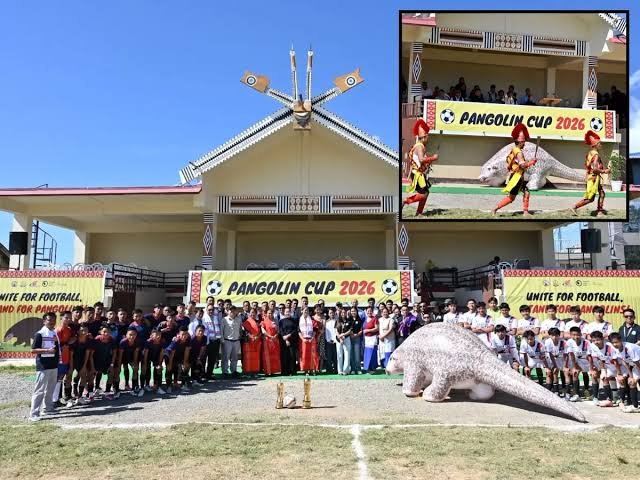
The Pangolin Cup 2026 Nagaland tournament brings football and wildlife conservation together, encouraging local communities to protect endangered pangolins and their natural habitats. The second edition began on October 26 at Meluri Local Ground, with the Meluri Range Sports Association (MRSA) collaborating with the Wildlife Trust of India (WTI) and Nagaland’s Department of Environment, Forest and Climate Change. Eight local teams are competing in the tournament, which uses the popularity of football to engage young people, community leaders and residents in conservation efforts. Moreover, the initiative highlights the role of traditional community institutions in addressing illegal wildlife trade across Nagaland and neighbouring Manipur.
Tripura BJP Candidate List Finalised Ahead of ULB Polls
Meluri Range Sports Association Partners With Wildlife Trust of India
The Meluri Range Sports Association and the Wildlife Trust of India have joined hands to organise the second edition of the Pangolin Cup. The Nagaland Department of Environment, Forest and Climate Change also supports the initiative, which connects local sporting activities with environmental awareness.
The tournament began at Meluri Local Ground on October 26. The opening programme brought together footballers, conservation representatives, government officials and community leaders to promote the protection of pangolins.
MRSA president Sathosie Nyuwi delivered the welcome address, while Chingrisoror Rumthao of WTI introduced the tournament and explained its conservation objectives. Their remarks highlighted the importance of involving local residents in wildlife protection.
The opening ceremony also featured a traditional cultural performance by the Meluri Area Public Organisation (MAPO). Organisers recognised community leaders for their contributions to conservation, while local representatives shared their experiences of protecting wildlife and maintaining traditional environmental values.
The collaboration reflects a broader approach to conservation. Rather than relying only on awareness campaigns, the organisers aim to make local communities active participants in protecting wildlife.
Football provides a familiar platform for this effort. Local clubs already bring together players, supporters and young residents. Consequently, a conservation-themed tournament can help introduce environmental issues to people who might not otherwise participate in formal wildlife programmes.
The event also creates opportunities for conversations between conservation organisations and community institutions. These relationships can help strengthen local understanding of wildlife threats and encourage people to support conservation measures.
The Pangolin Cup is supported by the Pangolin Crisis Fund under the Wildlife Conservation Network and the Serenity Trust. It forms part of WTI’s Countering Pangolin Trafficking project, which focuses on illegal pangolin trade in Nagaland and Manipur. <Cite refs={[“turn100578search0″,”turn100578search2”]}/>
Eight Football Teams Compete in the Pangolin Cup
Eight local teams are participating in the 2026 tournament. They are Royals FC, Knight Riders Club, Jessami Students Club, Khumiaii FC, Meluri Town Club, United Brothers Club, Wukruorii FC and Kara Junior.
The opening match featured Royals FC and Knight Riders Club at Meluri Local Ground. The fixture marked the start of a tournament designed to unite local football communities around a shared conservation message.
Organisers scheduled the competition to run from October 26 to 31, although some published reports listed October 30 as the closing date. The event therefore combines several days of football with a wider programme of conservation outreach and community participation. <Cite refs={[“turn100578search0″,”turn100578search2″,”turn100578search7”]}/>
The involvement of eight teams gives the initiative a strong local focus. Players can carry the conservation message beyond the ground through their clubs, families and wider social networks. Meanwhile, supporters attending matches can learn why pangolins face growing threats and why communities have an important role in protecting them.
Sports-based campaigns can also make environmental issues more accessible to younger audiences. Football encourages teamwork, discipline and collective responsibility. These values align with the cooperation required to protect wildlife and discourage illegal hunting and trafficking.
During the inauguration, Meluri Additional Deputy Commissioner Shelly Katiry emphasised ecological balance and the importance of protecting wildlife. She described the tournament as a platform for promoting environmental awareness alongside sports.
Meluri Sub-Divisional Police Officer Dr T. Desela Sangtam also highlighted the importance of teamwork and collective action. She urged players to maintain discipline, respect their opponents and participate in the true spirit of sportsmanship.
These messages connect the sporting purpose of the tournament with its environmental goals. The organisers want participants to recognise that protecting wildlife requires cooperation rather than isolated action.
Pangolin Protection Remains Central to the Conservation Campaign
Pangolins are mammals covered in protective scales, and they feed mainly on ants and termites. Their feeding habits help regulate insect populations, giving them an important ecological role.
However, illegal hunting and trafficking threaten pangolin populations. Demand for their scales and meat drives a significant part of the illegal trade, while trafficking networks can move wildlife products across regions and international borders.
The Pangolin Cup seeks to draw attention to these threats, particularly in Nagaland and Manipur. Through WTI’s Countering Pangolin Trafficking project, organisers aim to strengthen community awareness and encourage local participation in wildlife protection.
Wildlife Warden of Kiphire Siechutho Katiry called for younger generations to reconnect with traditional conservation values. He explained that ancestral beliefs had helped communities leave pangolins undisturbed in the past, but the growing influence of illegal wildlife trade has placed the animals under increasing pressure.
He urged residents to protect their natural heritage and ensure that future generations continue to encounter pangolins in the wild. His message connected cultural traditions with the need for practical conservation action.
WTI Joint Director Sunil Kyarong delivered the keynote address on the theme “Communities as Partners in Conservation.” He highlighted the ecological importance of pangolins and the need to combine public awareness with community-led measures and efforts against illegal wildlife trade.
Kyarong also referred to WTI’s work with communities across Northeast India over the past 25 years. He cited conservation initiatives such as the protection of Amur falcons in Nagaland as examples of how community participation can contribute to wildlife protection. <Cite refs={[“turn100578search0″,”turn100578search3”]}/>
The tournament aims to extend this approach by using an activity that already attracts local interest. By linking football with pangolin conservation, organisers hope to make wildlife protection a shared community responsibility.
More Than 30 Pochury Villages Support Pangolin Conservation
Community participation forms a central part of the Pangolin Cup’s message. During the inauguration, the Pochury Hoho highlighted local resolutions designed to discourage pangolin hunting and illegal wildlife trade.
According to the organisation, more than 30 Pochury villages have adopted resolutions prohibiting pangolin hunting. The community measures include a fine of ₹50,000 for offenders involved in hunting or illegal wildlife trade, as reported by the Hoho. <Cite refs={[“turn100578search1″,”turn100578search3”]}/>
These resolutions demonstrate how community institutions can contribute to wildlife protection. Local leaders and village organisations can help spread awareness, encourage compliance with conservation commitments and reinforce the importance of protecting natural resources.
Nevertheless, community resolutions work best when residents understand their purpose and support their implementation. Awareness, local cooperation and coordination with the relevant authorities remain important parts of broader conservation efforts.
The Pangolin Cup provides a public platform for reinforcing these commitments. Football matches bring people together, while speeches and cultural programmes give community leaders opportunities to discuss wildlife protection.
The involvement of young players is particularly relevant. Younger generations can carry conservation messages into schools, families, sports clubs and community groups. Furthermore, connecting wildlife protection with local identity may help strengthen long-term support for conservation.
The initiative also highlights the value of collaboration between sports associations, conservation organisations, government departments and traditional institutions. Each group brings different strengths, from organising community activities to sharing environmental knowledge and supporting wildlife protection.
If these partnerships continue beyond the tournament, the Pangolin Cup could help maintain public attention on pangolins and the threats they face. Sustained engagement will remain important because illegal wildlife trade cannot be addressed through a single sporting event alone.
Conclusion
The Pangolin Cup 2026 brings the Meluri Range Sports Association and the Wildlife Trust of India together with Nagaland’s environment department to promote wildlife conservation through football. The tournament began on October 26 at Meluri Local Ground, with eight local teams participating. Moreover, the event combines sporting competition, cultural performances and community engagement to raise awareness about pangolin protection and illegal wildlife trade.
The conservation campaign also highlights the role of traditional institutions. More than 30 Pochury villages have reportedly adopted resolutions prohibiting pangolin hunting, with a ₹50,000 fine for offenders involved in hunting or illegal wildlife trade. These community commitments demonstrate how local leadership can support conservation alongside the work of wildlife organisations and government authorities.
Looking ahead, the lasting impact of the Pangolin Cup will depend on continued awareness and action beyond the football ground. Community participation, respect for traditional conservation values and cooperation with enforcement agencies can help strengthen wildlife protection. By bringing young people and local residents into the conversation, the tournament offers an opportunity to make pangolin conservation a shared responsibility across Nagaland and the wider Northeast.
FAQs
1. What is the Pangolin Cup 2026?
The Pangolin Cup 2026 is a football tournament in Meluri, Nagaland, that aims to raise awareness about pangolin conservation and illegal wildlife trade.
2. Who is organising the Pangolin Cup in Nagaland?
The Wildlife Trust of India, the Meluri Range Sports Association and Nagaland’s Department of Environment, Forest and Climate Change are organising the tournament.
3. How many teams are participating in the tournament?
Eight local teams are participating: Royals FC, Knight Riders Club, Jessami Students Club, Khumiaii FC, Meluri Town Club, United Brothers Club, Wukruorii FC and Kara Junior.
4. Why is pangolin conservation important?
Pangolins help regulate ant and termite populations. However, illegal hunting and trafficking threaten their survival, making community awareness and wildlife protection important.
5. What conservation measures have Pochury villages adopted?
The Pochury Hoho reports that more than 30 villages have adopted resolutions prohibiting pangolin hunting, with a ₹50,000 fine for offenders involved in hunting or illegal wildlife trade.