

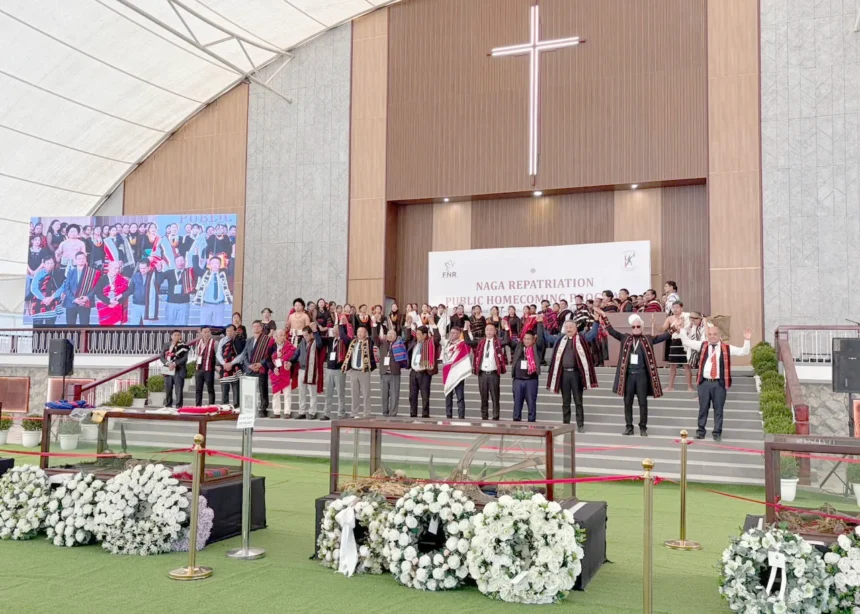
Nagaland witnessed a historic moment on November 28, 2026, as Chief Minister Neiphiu Rio and community leaders welcomed home 39 ancestral human remains repatriated from the Pitt Rivers Museum at the University of Oxford, United Kingdom. The public homecoming ceremony in Kohima marked the culmination of a six-year effort to bring the remains back to their homeland after more than a century abroad. The return represents an important step towards restoring ancestral dignity, preserving Naga heritage and promoting healing and reconciliation.
Assam Goods Train Derailment Strands 194 Mizoram-Bound Schoolchildren
Kohima Hosts Historic Homecoming Ceremony for 39 Naga Ancestors
The Nagaland Baptist Church Council (NBCC) Convention Centre in Kohima hosted the public homecoming ceremony on Saturday, November 28.
Chief Minister Neiphiu Rio joined representatives of Naga tribes, community organisations, church leaders, elders and members of the public to welcome the 39 ancestral human remains.
The remains came from the Pitt Rivers Museum at the University of Oxford, where they had remained for more than a century. Their return followed years of discussions, research and coordination between Naga organisations and British institutions.
Addressing the gathering, Rio described the occasion as a historic moment for the Naga people. He said the homecoming represented more than the physical return of ancestral remains. Instead, it restored an important part of Naga identity, history and collective memory.
Moreover, he acknowledged the painful history of colonial encounters that led to the removal of these remains from their homeland.
The Chief Minister also thanked the organisations, researchers, tribal leaders and government officials who contributed to the repatriation process.
Ancestral Remains Belong to Eight Naga Tribal Communities
The 39 ancestral human remains belong to members of eight Naga tribal communities.
These communities include:
- Phom
- Konyak
- Yimkhiung
- Khiamniungan
- Sümi
- Pochury
- Chang
- Tangkhul
According to reports, the Phom community accounts for the largest number, with 24 ancestral remains.
The remains arrived in Nagaland in eight boxes. Representatives of different Naga tribes, community organisations and officials received them at Dimapur Airport on November 27 before their onward journey to Kohima.
The public ceremony allowed community members to pay their respects and participate in a collective act of remembrance.
Furthermore, the return carries significance for families and communities seeking to reconnect with their ancestors and cultural heritage.
Six-Year Effort Led to Repatriation From Oxford
The repatriation process began in 2020 after the Pitt Rivers Museum removed human remains from public display and initiated discussions about their future care.
The Forum for Naga Reconciliation (FNR) played a central role in facilitating dialogue between the museum and Naga communities.
In 2021, the FNR established the Recover, Restore and Decolonise (RRaD) initiative to coordinate research, community consultations and efforts to secure the return of ancestral remains.
The process involved tribal Hohos, elders, churches, researchers, civil society organisations and communities across the Naga homeland.
A Naga delegation also visited Oxford in June 2025 to advance discussions with the university and museum authorities. During the visit, representatives presented the Naga-Oxford Declaration, expressing their collective commitment to bringing the ancestors home and providing them with a common resting place.
The University of Oxford Council approved the return of the 39 ancestral human remains in July 2026. Subsequently, the formal transfer of custodianship to the Naga people through the FNR and Naga Tribes Hoho took place at the Pitt Rivers Museum on November 9, 2026.
The remains reached New Delhi on November 25 before arriving in Nagaland two days later.
Naga Ancestral Remains Were Taken During Colonial Period
The repatriation also draws attention to the colonial-era removal of human remains from indigenous communities.
According to historical accounts shared during the repatriation process, British colonial administrators, anthropologists and collectors took the remains from the Naga homeland, largely between 1910 and 1940.
The Pitt Rivers Museum, established in 1884, held Naga ancestral remains and other cultural materials in its collections.
For Naga communities, the issue extended beyond museum ownership or historical collections. It involved questions of human dignity, cultural rights, ancestral identity and the treatment of indigenous heritage.
Therefore, the return represents an opportunity for communities to address a painful part of their history.
The homecoming also highlights the growing importance of dialogue between museums, universities and indigenous communities over the return of ancestral remains and cultural objects.
Neiphiu Rio Thanks Organisations and Government Agencies
During the ceremony, Chief Minister Neiphiu Rio recognised the contributions of the Forum for Naga Reconciliation and the RRaD initiative.
He specifically acknowledged FNR convener Rev. Dr Wati Aier and RRaD coordinator Dr Ellen Konyak Jamir for their roles in coordinating the effort.
Rio also thanked tribal Hohos, researchers, volunteers and the 28-member delegation that accompanied the remains during their journey home.
The Nagaland government provided administrative and financial assistance to facilitate the repatriation.
A ministerial committee headed by Deputy Chief Minister Y. Patton coordinated the state’s efforts. Meanwhile, several central government ministries and departments helped secure the necessary permissions and arrange transportation.
The Chief Minister also appreciated the cooperation extended by the Pitt Rivers Museum and the University of Oxford.
He recalled writing to the Ministry of External Affairs in October 2024 after learning about a proposed auction of a 19th-century Naga human skull in the United Kingdom. Following the intervention, the auction house withdrew the item from sale and exhibition.
Public Viewing and Burial Scheduled in Kohima
The homecoming ceremony forms part of a series of events planned to honour the returned ancestors.
The Naga Tribes Hoho and the Forum for Naga Reconciliation announced the following programme:
| Date | Programme |
|---|---|
| November 28, 2026 | Public homecoming ceremony at NBCC Convention Centre, Kohima |
| November 29, 2026 | Public viewing, prayers and wreath-laying from 9 am |
| November 30, 2026 | Final burial rites at Naga Solidarity Park, Kohima, at 2 pm |
The final burial will provide the ancestral remains with a common resting place in their homeland.
Community leaders have encouraged people across the Naga homeland to participate in the ceremonies and honour the ancestors with dignity and respect.
Repatriation Promotes Healing, Reconciliation and Naga Unity
Speakers at the Kohima ceremony highlighted the wider cultural and emotional importance of the homecoming.
Rev. Dr Wati Aier urged the Naga people to remember their history in ways that encourage healing and reconciliation rather than hatred or revenge.
Similarly, representatives of tribal organisations described the return as an opportunity to strengthen collective identity and mutual understanding.
Professor Dr Dolly Kikon, associated with the RRaD initiative, described the event as a significant journey of historical remembrance and collective affirmation.
The Naga Students’ Federation also called for greater unity among communities. Its president, Mteisuding Heraang, stressed that tribal identities should strengthen rather than divide the wider Naga community.
These messages reflected a shared hope that the repatriation would help communities acknowledge the past while building a more united future.
Conclusion
The return of 39 Naga ancestral human remains from the United Kingdom marks a significant chapter in Nagaland’s cultural and historical journey.
After more than a century at the Pitt Rivers Museum, the remains have returned home following six years of sustained efforts by the Forum for Naga Reconciliation, the RRaD initiative, tribal organisations and government authorities.
Chief Minister Neiphiu Rio described the homecoming as a restoration of identity, dignity and collective memory. Meanwhile, community leaders called for healing, reconciliation and unity.
With public viewing scheduled for November 29 and burial rites planned for November 30 at Naga Solidarity Park, Kohima, the return offers Naga communities an opportunity to honour their ancestors and reconnect with an important part of their shared heritage.
Frequently Asked Questions (FAQs)
1. How many Naga ancestral remains have returned from the UK?
A total of 39 Naga ancestral human remains have returned to Nagaland from the Pitt Rivers Museum at the University of Oxford.
2. When did Nagaland welcome the ancestral remains?
A public homecoming ceremony took place on November 28, 2026, at the NBCC Convention Centre in Kohima.
3. Which museum returned the Naga ancestral remains?
The remains came from the Pitt Rivers Museum at the University of Oxford in the United Kingdom.
4. Which Naga tribes do the ancestral remains belong to?
The remains belong to eight communities: Phom, Konyak, Yimkhiung, Khiamniungan, Sümi, Pochury, Chang and Tangkhul.
5. When will the final burial rites take place?
The final burial ceremony is scheduled for November 30, 2026, at 2 pm at Naga Solidarity Park in Kohima.
6. Which organisations led the repatriation effort?
The Forum for Naga Reconciliation (FNR) and its Recover, Restore and Decolonise (RRaD) initiative played leading roles, alongside Naga tribal organisations and government authorities.