




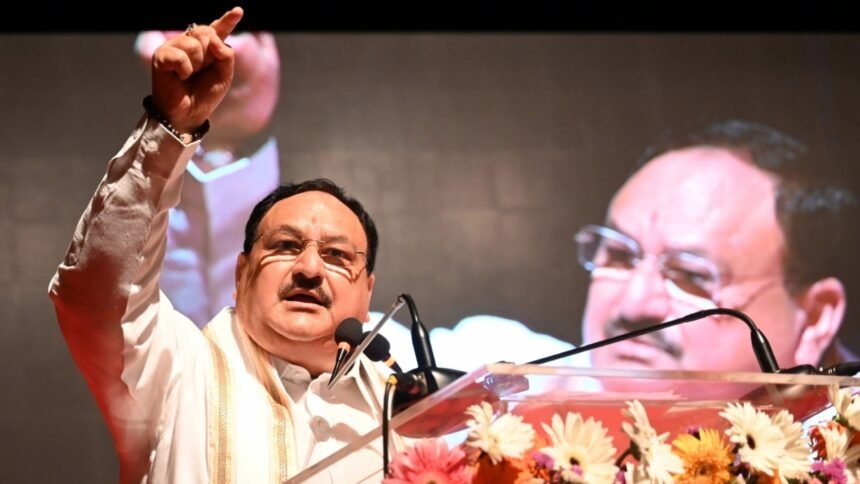
BJP President J.P. Nadda has taken a dig at opposition parties for boycotting the inauguration of the new Parliament building. Nadda stated that what unites these parties is their dynastic leadership, whose “monarchic” methods contradict the principles of the Constitution.
In a series of tweets, Nadda criticized the boycotting parties, alleging that they lack a genuine commitment to democracy and instead seek to perpetuate a select group of dynasties. He asserted that such an approach is an insult to the framers of the Constitution and urged these parties to introspect.
Among the dynastic parties targeted by Nadda, the Congress and the Nehru-Gandhi dynasty drew particular attention. Nadda claimed that these parties struggle to accept the fact that the people of India have placed their trust in a leader who comes from a humble background.
The inauguration of the new Parliament building holds significant symbolic importance, representing the democratic values and aspirations of the Indian people. However, the absence of several opposition parties has raised eyebrows and led to a political debate.
Opposition parties have cited various reasons for their decision to boycott the event. Some argue that the construction of a new Parliament building at this time is unnecessary, given the pressing issues facing the country, such as the COVID-19 pandemic and economic challenges. Others claim that the government’s handling of key issues, such as farmers’ protests and the contentious Citizenship Amendment Act, has strained relations between the ruling party and the opposition.
However, Nadda sees the opposition’s boycott as emblematic of a larger problem – the prevalence of dynastic leadership within these parties. He believes that these parties prioritize the perpetuation of familial control over democratic principles, which, in his view, contradicts the spirit of the Constitution.
The BJP president’s comments have reignited the debate surrounding dynastic politics in India. Critics argue that dynastic leadership stifles internal democracy within political parties and limits opportunities for aspiring leaders outside of established political families. Proponents, on the other hand, contend that family lineage brings experience and continuity to the political landscape.
Nadda’s remarks echo the BJP’s longstanding criticism of dynastic politics and its commitment to promoting leaders from diverse backgrounds. The party has often contrasted the rise of Prime Minister Narendra Modi, who hails from a humble background, with the perceived entitlement and privilege associated with dynastic politics.
The ongoing controversy over the inauguration of the new Parliament building reflects the deep divisions and contrasting ideologies within Indian politics. As the nation moves forward, it is crucial for political parties to engage in constructive dialogue and prioritize the democratic principles enshrined in the Constitution, rather than focusing on personal attacks or political vendettas. Only through such meaningful discourse can India’s democracy continue to flourish and address the challenges facing the nation.