





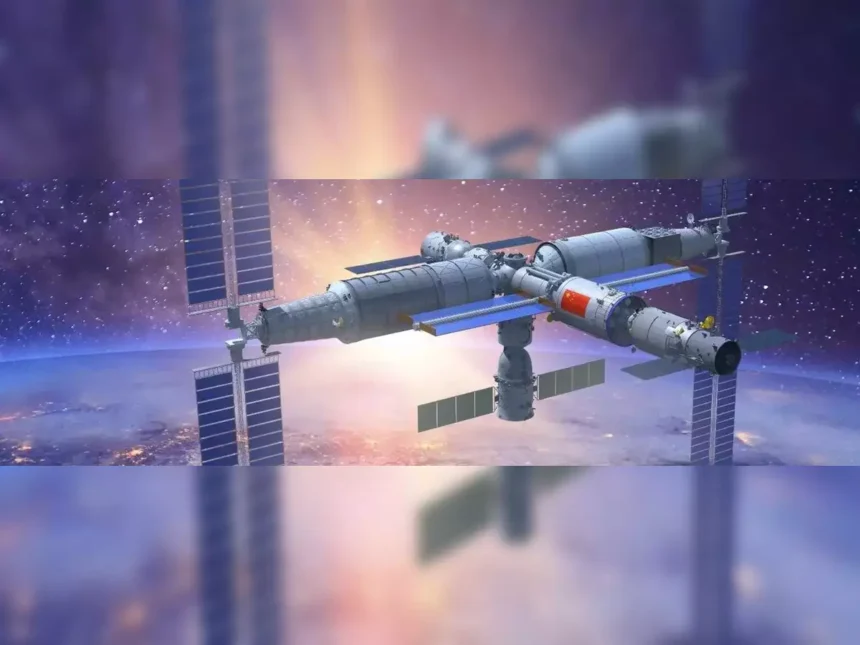
China has announced its ambitious plans to send a manned mission to the moon by 2030, marking a significant development in its ongoing space race with Western nations. The announcement came from Lin Xiqiang, Deputy Director of the China Manned Space Agency (CMSA), during preparations for the launch of a third set of astronauts to China’s space station, Tiangong.
The Chinese space program has been making steady progress in recent years, with successful missions and advancements in space technology. The planned manned moon mission is part of China’s broader strategy to establish itself as a major player in space exploration and scientific research.
Lin Xiqiang’s announcement took place at the Jiuquan Satellite Launch Centre in Inner Mongolia, where the preparations for the launch of the spacecraft were underway. The upcoming mission will transport three astronauts to the Tiangong space station, which serves as a crucial component of China’s lunar exploration program.
China’s manned lunar exploration program encompasses multiple phases, and the establishment of the Tiangong space station is an integral step towards achieving the ultimate goal of landing humans on the moon. The country has been investing heavily in its space capabilities, aiming to catch up with and potentially surpass the achievements of Western nations in space exploration.
With this announcement, China sends a clear signal that it intends to compete with the West in the race to return humans to the moon. While the United States and NASA have been the dominant forces in lunar exploration historically, China’s recent advancements have caught the attention of the international community.
China’s space program has achieved several significant milestones in the past decade. In 2013, it became the third country to successfully land a rover on the moon with the Chang’e-3 mission. Since then, China has made steady progress, including the Chang’e-4 mission in 2019, which successfully landed on the far side of the moon, a region that had remained unexplored until then.
The upcoming manned lunar mission is expected to build upon these achievements and further enhance China’s technological capabilities in space. The country has been investing in research and development, as well as infrastructure, to support its lunar exploration ambitions.
China’s space program has also been highly focused on scientific research and exploration. Through its lunar missions, China aims to study the moon’s geology, collect samples, and gain a deeper understanding of our celestial neighbor. These scientific endeavors align with China’s long-term goals of advancing its technological prowess and contributing to humanity’s knowledge of space.
The announcement of the manned moon mission comes at a time when space exploration is experiencing renewed interest and competition. Western nations, particularly the United States, have also set their sights on returning humans to the moon. NASA’s Artemis program aims to land astronauts on the lunar surface by 2024, marking a significant milestone in the agency’s space exploration plans.
The intensified space race between China and the West has geopolitical implications as well. Space capabilities are seen as a symbol of national prestige and technological superiority. China’s advancements in space technology could potentially challenge the dominance of the United States in the field, leading to increased competition and cooperation among nations.
As China prepares to send astronauts to its space station, Tiangong, it signals its growing presence and influence in space exploration. The manned moon mission, planned for 2030, represents a significant leap forward in China’s space ambitions. The country’s continued investments in space technology and research demonstrate its commitment to becoming a major player in the exploration of our solar system and beyond.