





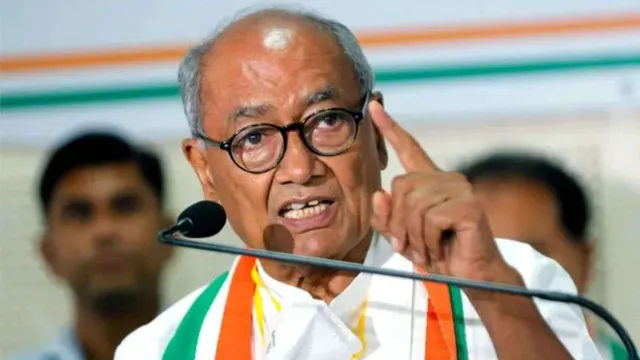
In a recent press conference held in Jabalpur, Madhya Pradesh, senior Congress leader Digvijaya Singh expressed his views on Hindutva, stating that it is not a “dharma” or religion. Singh emphasized his belief in Sanatam dharma, a term referring to the eternal and universal principles of righteousness, harmony, and the welfare of all beings.
During the press conference, Singh criticized the Bajrang Dal, the youth wing of the Vishwa Hindu Parishad, labeling them as a “goondon ki jamat” or a group of goons. He went on to highlight the distinction between Hindutva and Sanatam dharma, asserting that the latter promotes inclusivity and compassion while criticizing Hindutva for its tendency to attack those who hold differing opinions.
Singh elucidated the core principles of Sanatam dharma, exemplified by the slogans often heard at gatherings affiliated with the ideology. Slogans such as “Dharm Ki Jai Ho, Adharm Ka Nash Ho, Praniyo Me Saddhbhawna Ho, Vishwa Ka Kalyan Ho” encapsulate the essence of Sanatam dharma, emphasizing the victory of righteousness, the eradication of injustice, empathy towards all living beings, and the well-being of the world.
By rejecting Hindutva as a religion, Singh underscored his preference for Sanatam dharma, which encompasses a broader philosophical framework rooted in the principles of mutual respect, harmony, and social welfare. Sanatam dharma does not limit itself to any specific religious or sectarian identity but encompasses a holistic vision for the betterment of society as a whole.
Singh’s remarks shed light on the ongoing debate surrounding the interpretation and application of Hindutva. While some consider Hindutva as a religious and cultural identity synonymous with Hinduism, others view it as a political ideology emphasizing Hindu nationalism. Singh’s stance reflects his disagreement with the latter perspective, highlighting the need for a more inclusive and tolerant approach towards religious and ideological differences.
The Congress leader’s assertion in favor of Sanatam dharma aligns with the party’s broader emphasis on secularism and pluralism, promoting the coexistence of diverse religious beliefs and cultures within the framework of a democratic society. Singh’s remarks serve as a reminder of the Congress party’s commitment to fostering harmony and understanding among different communities while upholding the principles of social justice and welfare.
It remains to be seen how Singh’s comments will be received by various sections of society, particularly those who identify with Hindutva as a religious or political ideology. The debate surrounding the nature of Hindutva and its place within the broader religious landscape of India is likely to continue, with different voices offering varying perspectives on the matter.
Ultimately, Singh’s rejection of Hindutva as a dharma and his advocacy for Sanatam dharma’s principles of harmony and welfare reflect his vision for a more inclusive and compassionate society. As the discourse on religious identity and ideology evolves, it is crucial to engage in constructive dialogue that fosters understanding and unity while respecting the diverse beliefs and values that shape India’s cultural fabric.