




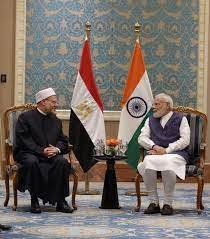
Prime Minister Narendra Modi and the Grand Mufti of Egypt, Shawky Ibrahim Abdel-Karim Allam, met recently to discuss various important matters pertaining to social harmony, extremism, and radicalization. During his two-day state visit to Egypt, the Prime Minister informed the Grand Mufti about India’s plans to establish a Centre of Excellence in IT at the Dar-al-Ifta, an advisory body for Islamic legal research in Egypt that operates under the Ministry of Social Justice.
The discussions between the Prime Minister and the Grand Mufti primarily revolved around the deep cultural and people-to-people relations between India and Egypt. Both leaders emphasized the importance of fostering social and religious harmony within their respective societies. They also underscored the need to counter the rising challenges of extremism and radicalization effectively.
The meeting between Prime Minister Modi and the Grand Mufti highlights the commitment of both India and Egypt to promote mutual understanding, peace, and tolerance. The establishment of the Centre of Excellence in IT signifies India’s dedication to enhancing technological capabilities in Egypt, particularly in the field of Islamic legal research.
By setting up this Center of Excellence, India aims to provide comprehensive support and expertise in IT to the Dar-al-Ifta. The Ministry of Social Justice in Egypt will oversee the functioning of this center, ensuring its alignment with the country’s objectives of promoting social harmony and countering extremism. The collaboration between India and Egypt in the field of IT will pave the way for knowledge-sharing, skill development, and capacity building, contributing to the overall advancement of both nations.
The discussions held during the meeting shed light on the shared vision of India and Egypt in tackling social and religious challenges effectively. Recognizing the significance of cultural and people-to-people exchanges, the leaders expressed their commitment to strengthening the already robust ties between the two countries. Such exchanges play a vital role in promoting understanding, respect, and harmony among diverse communities.
Moreover, both leaders acknowledged the need to address the growing menace of extremism and radicalization that poses a threat to global peace and security. They emphasized the importance of collaborative efforts in countering these challenges and reiterated their commitment to working together to eradicate extremism at its roots. This joint commitment reflects the shared determination of India and Egypt to safeguard their societies against the adverse effects of radical ideologies.
The meeting between Prime Minister Modi and the Grand Mufti serves as a significant step in deepening the bilateral relationship between India and Egypt. It showcases the mutual willingness to engage in constructive dialogue, exchange best practices, and learn from each other’s experiences in promoting social harmony and countering extremism. Both nations stand united in their pursuit of peace, stability, and inclusive development.
The establishment of the Centre of Excellence in IT at the Dar-al-Ifta represents a concrete example of India’s commitment to supporting Egypt’s efforts in Islamic legal research. By leveraging technological advancements and knowledge-sharing, this center will contribute to the development of innovative solutions in addressing societal challenges, particularly in the areas of social harmony and countering extremism.
The meeting between Prime Minister Narendra Modi and the Grand Mufti of Egypt, Shawky Ibrahim Abdel-Karim Allam, underscored the strong cultural and people-to-people relations between India and Egypt. Their discussions revolved around promoting social harmony, countering extremism, and establishing a Centre of Excellence in IT. The collaborative efforts between the two countries exemplify their shared commitment to fostering understanding, peace, and inclusive development.