





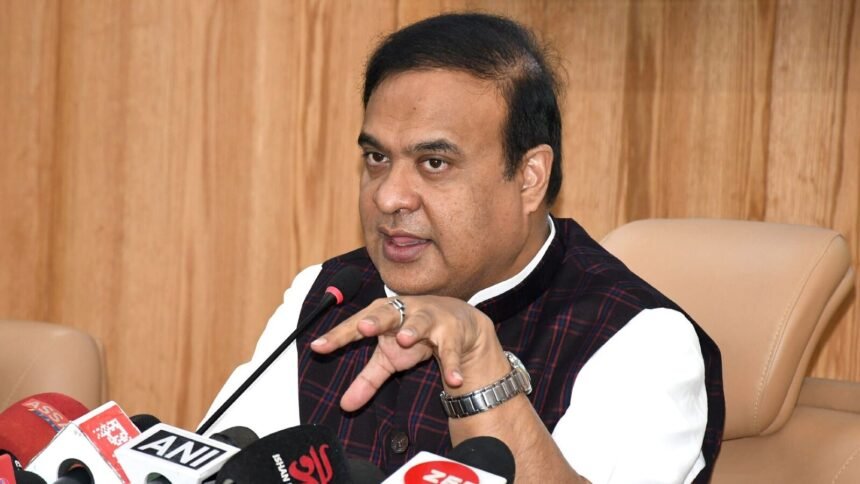
Chief Minister Himanta Biswa Sarma announced that Assam has cleared 1.19 lakh bighas of land from illegal occupation. However, a staggering 63 lakh acres still remain under encroachment, sparking concerns over land rights and environmental degradation. The Assam CM on land encroachment revealed these figures during his Independence Day address in Guwahati.
Read More: China’s Brahmaputra dam won’t affect us immediately: Assam CM
A continuing mission to reclaim land
The Assam government has taken up land reclamation as one of its key priorities. Since 2021, several eviction drives have been conducted in districts such as Barpeta, Hojai, Sonitpur, and Nagaon. According to Sarma, these efforts are aimed at restoring government land meant for agriculture, development, and forest preservation.
He added that while the administration has made notable progress, the battle is far from over. “We have reclaimed around 1.19 lakh bighas. But the truth is, Assam still has over 63 lakh acres of land under encroachment,” Sarma said.
Transitioning from tolerance to action
For years, the problem of illegal occupation had been tolerated, either due to political pressure or weak enforcement. However, the Assam CM on land encroachment insisted that his government has adopted a zero-tolerance approach. “We are committed to protecting our public land, forests, and tribal belts,” he said during his speech.
Sarma stressed that the state has the legal right and responsibility to reclaim land from both individual and organized encroachers. He also noted that no community or individual will be above the law, and all action would be taken under constitutional provisions.
Focus on protected forests and tribal areas
A significant portion of the encroached land lies in reserve forests, wildlife sanctuaries, and tribal belt areas. These zones are critical not only for biodiversity but also for safeguarding the rights of indigenous communities. The Chief Minister mentioned that the government has already initiated steps to protect these sensitive regions.
In many cases, the encroachments have led to human-wildlife conflict and degradation of water resources. “When forests are taken over illegally, it’s not just the land that suffers. Our rivers shrink, and animals lose their homes,” Sarma remarked.
Legal and administrative strategy in place
To tackle this issue, the government has empowered deputy commissioners and forest officials to act swiftly against illegal land occupation. Several eviction notices have been issued, and court cases have been filed against repeat offenders.
The Assam CM on land encroachment also revealed that drone technology, GIS mapping, and satellite surveillance are being used to monitor land use in real-time. “Our approach is not just aggressive but also scientific,” he said.
Additionally, local police have been given special powers during eviction drives to prevent violence and ensure smooth operations. In some areas, temporary housing and relief have been arranged for displaced families.
Political and public reactions
While many residents have welcomed the government’s action, some civil society groups and opposition parties have raised concerns over the humanitarian aspects of the evictions. They argue that some settlers had been living on the land for generations.
Responding to this, Sarma clarified that the government always conducts detailed surveys and gives due notice before carrying out evictions. He said that genuine landless families are being identified for rehabilitation under state housing and land allotment schemes.
“We are not against the poor,” he added. “But no one has the right to illegally grab public or forest land.”
Future roadmap and awareness
Looking ahead, the state plans to digitize land records, streamline the patta (land deed) system, and educate rural populations about their land rights. The government also intends to demarcate sensitive ecological zones more clearly to prevent future encroachments.
Sarma appealed to the public to cooperate in preserving the state’s natural heritage. He urged citizens not to support or shelter encroachers, warning that doing so would lead to legal consequences.
Reclaiming Assam’s heritage and resources
The Assam CM on land encroachment concluded his address with a strong message. “We owe it to our future generations to preserve our land, forests, and rivers. Our mission is not just about removal. It’s about restoration.”
He reiterated that eviction drives are not political stunts but a necessary step to restore Assam’s dignity and environmental balance. With modern tools, community participation, and unwavering resolve, the state hopes to reclaim a large portion of the remaining 63 lakh acres in the coming years.
Read More: Over 10,000 Meth Tablets Seized in Mizoram’s Champhai