







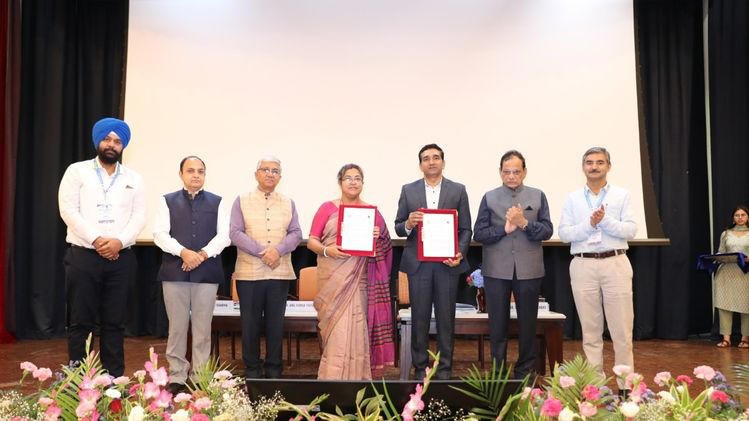
Tripura University has partnered with CSIR–CIMAP under the Aroma Mission to boost lemongrass cultivation. The MoU was signed on July 14 and aims to promote sustainable farming, improve rural incomes, and link scientific research with real-world applications. Through this move, the Aroma Mission Tripura University collaboration seeks to empower farmers and bring innovation directly to the fields.
Read More: Arunachal’s GDP Rises 166% in a Decade: CM Khandu
Aroma Mission Tripura University: Science Meets Soil
This MoU links the university with the Council of Scientific and Industrial Research–Central Institute of Medicinal and Aromatic Plants (CSIR–CIMAP). Their joint focus is on introducing high-yielding lemongrass varieties, training farmers, and setting up distillation units.
Vice-Chancellor Prof Ganga Prasad Prasain called the partnership a bridge between research and practice. “With this mission, science walks into farms. The outcome will benefit those who need it most—our farmers,” he said.
Why Lemongrass is the Focus
Lemongrass is a low-maintenance crop with high economic potential. It thrives in Tripura’s climate and is used in herbal products, cosmetics, and medicines.
Unlike many traditional crops, lemongrass needs fewer chemical inputs. It grows well even on marginal land, making it ideal for tribal and small-scale farmers.
This focus aligns with the larger vision of the Aroma Mission Tripura University—to create income opportunities through eco-friendly crops.
Training, Research, and Farmer Engagement
As part of the agreement, Tripura University will offer regular training to farmers. These workshops will cover topics like soil care, planting methods, harvesting, and oil extraction.
A dedicated team will track progress, troubleshoot field issues, and share updates with CSIR–CIMAP. Students from the university will also join these projects for practical learning.
This hands-on model ensures that research benefits both classrooms and communities.
Prioritizing Women and Tribal Communities
The initiative will target farmers from tribal areas and women-led self-help groups. These groups will receive planting materials, tools, and guided support for lemongrass farming.
Project coordinators emphasized the social impact. “This is not only about crops. It’s also about giving tribal women confidence and stable income,” said an official involved in the rollout.
Initially, over 1,000 farmers across Dhalai, Gomati, and South Tripura districts are expected to benefit.
National Context of the Aroma Mission
Launched by CSIR, the Aroma Mission aims to promote aromatic crops across India. It focuses on value addition, post-harvest technology, and market development.
With this new step, Tripura University becomes a key academic partner in the Northeast. Its participation strengthens the mission’s reach in underutilized yet potential-rich areas.
CSIR–CIMAP officials have stated that Northeast India holds untapped promise for aromatic plants.
Supporting Infrastructure and Future Goals
The university also plans to install a processing and oil distillation unit on campus. This facility will serve both as a training center and a production hub.
Faculty teams are preparing farmer-friendly manuals in local languages. In addition, the university will support student startups in herbal and aromatic product development.
As the Aroma Mission Tripura University effort expands, other crops like citronella and vetiver may also be introduced.
The MoU between Tripura University and CSIR–CIMAP under the Aroma Mission marks a new beginning for community-based farming innovation. By focusing on lemongrass cultivation, the university is turning research into opportunity and empowering those who live closest to the land.
With the Aroma Mission Tripura University model, sustainable agriculture and rural transformation are no longer distant goals—they are happening now, one field at a time.
Read More: Avoid Steel Foods: 5 Items You Should Never Store in Steel

