




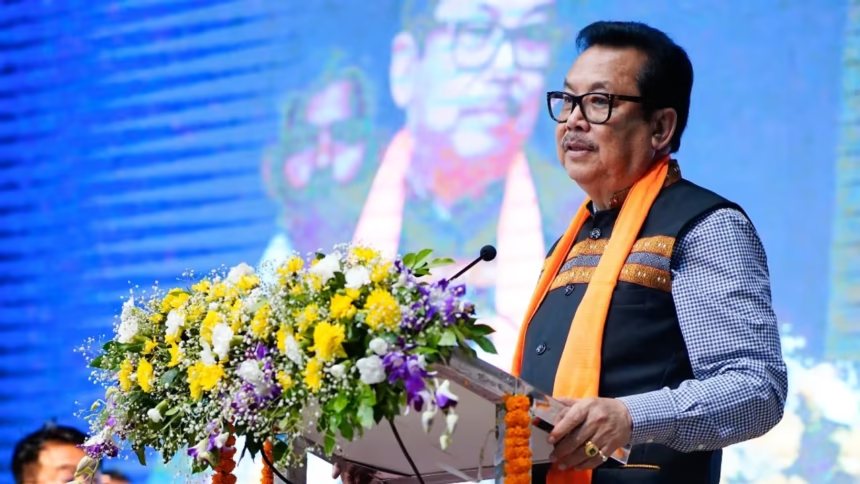
Arunachal Pradesh Deputy Chief Minister Chowna Mein has stated that the Northeast has emerged as India’s prime growth hub, highlighting rapid development across infrastructure, connectivity, and investment sectors. The remarks were made during an official engagement focused on regional progress and economic transformation. Moreover, he emphasized that coordinated efforts between the Centre and states have accelerated growth in the region. Officials noted that the statement reflects increasing economic activity and strategic importance of the Northeast.
Nirmala Sitharaman Inaugurates Northeast’s Largest Organic Spice Processing Plant in Ri-Bhoi
CPI(M) Accuses Identity Politics of Weakening Secular Fabric in Northeastern Hills
Chowna Mein Highlights Northeast’s Rapid Economic Transformation
Arunachal Pradesh Deputy Chief Minister Chowna Mein declares the Northeast has become India’s prime growth hub, citing significant improvements in infrastructure and development indicators. Consequently, he underlined that the region is witnessing a structural shift in economic activity.
He pointed out that improved road, rail, and air connectivity has played a major role in this transformation. Moreover, enhanced infrastructure has facilitated smoother movement of goods and services across states. Therefore, the Northeast is becoming increasingly integrated with national markets.
Mein further emphasized that sustained government investment has boosted development momentum. Furthermore, multiple flagship schemes have contributed to improvements in healthcare, education, and connectivity. As a result, the region is experiencing faster socio-economic progress.
Meanwhile, officials noted that private sector interest in the Northeast has also increased. Consequently, new opportunities in trade, tourism, and industry are emerging across states.
Infrastructure Growth Strengthens Regional Integration
The Deputy Chief Minister highlighted that infrastructure development has been central to making the Northeast a growth hub. Moreover, projects such as highways, bridges, and airports have improved regional accessibility. Therefore, connectivity remains a key driver of economic expansion.
Better transport networks have reduced travel time between states and major markets. Consequently, trade and commerce activities have seen steady improvement. Such developments are essential for long-term economic sustainability.
Furthermore, digital connectivity and power infrastructure have also expanded significantly. As a result, rural and urban areas are becoming more economically interconnected.
Meanwhile, government agencies continue to prioritize infrastructure expansion in remote and border regions. Similarly, efforts are being made to ensure balanced regional development.
Policy Support and Investment Drive Regional Growth
Arunachal Pradesh Deputy Chief Minister Chowna Mein declares the Northeast has become India’s prime growth hub, attributing growth to supportive government policies. Moreover, targeted initiatives have encouraged investment across sectors. Therefore, policy reforms have played a crucial role in regional development.
Various central and state government schemes have supported entrepreneurship and employment generation. Consequently, local industries are gaining stronger footholds in the regional economy. Such measures are helping diversify economic activity.
Furthermore, tourism and agriculture sectors have witnessed increased investment interest. As a result, livelihoods are improving across multiple communities.
Meanwhile, officials emphasized the importance of continued policy support. Similarly, long-term planning is necessary to sustain the current growth trajectory.
Northeast Positioned as Strategic Economic Corridor
The Deputy Chief Minister also noted that the Northeast is emerging as a strategic economic corridor linking India with Southeast Asia. Moreover, its geographical location provides significant trade advantages. Therefore, the region holds potential for international connectivity and commerce.
Improved border infrastructure and trade routes are strengthening cross-border opportunities. Consequently, the Northeast is becoming a gateway for regional trade expansion. Such positioning enhances both economic and strategic value.
Furthermore, initiatives under India’s Act East Policy have supported this transformation. As a result, the region is gaining greater importance in national planning frameworks.
Meanwhile, experts highlight that sustained investment will be crucial for long-term growth. Similarly, regional cooperation will further enhance economic integration.
Conclusion
Arunachal Pradesh Deputy Chief Minister Chowna Mein declares the Northeast has become India’s prime growth hub, reflecting the region’s rapid transformation in infrastructure and economic development. Moreover, his remarks underline the increasing importance of the Northeast in India’s overall growth story.
The region’s progress is driven by connectivity improvements, policy support, and investment inflows. Therefore, it continues to evolve as a key economic zone.
As Arunachal Pradesh Deputy Chief Minister Chowna Mein declares the Northeast has become India’s prime growth hub, the statement reinforces the region’s growing role in shaping India’s development future.
FAQs
1. What did Chowna Mein say about the Northeast?
He said the Northeast has become India’s prime growth hub.
2. What factors are driving growth in the region?
Infrastructure, investment, and government policies are key drivers.
3. Why is connectivity important for the Northeast?
It improves trade, mobility, and economic integration.
4. What sectors are growing in the region?
Tourism, agriculture, and infrastructure are expanding sectors.
5. What is the strategic importance of the Northeast?
It serves as a gateway for trade with Southeast Asia.