





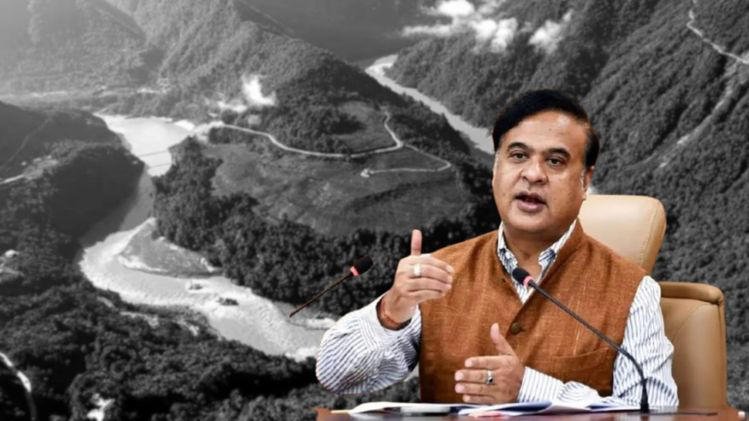
Assam Chief Minister Himanta Biswa Sarma dismissed concerns over China’s controversial dam project on the Yarlung Tsangpo, the upper stream of the Brahmaputra. The Assam CM on Brahmaputra dam reassured citizens that the state is not facing any immediate threat due to the river’s multiple sources once it enters India.
Read More: Kuki Naga peace appeal issued by NER-WHRO for harmony
No direct impact expected, says Assam CM
While speaking to reporters, Sarma explained that the Brahmaputra River receives water from many Indian tributaries, especially after entering Arunachal Pradesh. “We are not immediately worried. The river is fed by several streams like Dibang and Lohit, which enter from Arunachal and keep the water flow stable,” he stated.
The Assam CM on Brahmaputra dam highlighted that although the issue demands long-term attention, there’s no immediate reason for panic. He pointed out that expert teams from the Ministry of Jal Shakti and the Ministry of External Affairs are continuously monitoring the developments in Tibet where China is building the dam.
Transition words and simplified explanation
According to Sarma, China’s construction activity is not new and has been under observation for years. Nevertheless, the dam’s scale has attracted renewed interest due to its strategic location. The Yarlung Tsangpo flows through Tibet and becomes the Brahmaputra after entering Arunachal Pradesh.
Despite concerns from environmentalists and strategic analysts, Sarma reassured that India retains hydrological stability because of the river’s natural reinforcement downstream. “Even if China restricts the flow at the origin, our tributaries compensate significantly,” he explained.
India monitoring the project closely
The Indian government, especially the Ministry of External Affairs, has already raised concerns with China diplomatically. As per official sources, India has requested Beijing to share hydrological data regularly, especially during the monsoon months when the flood risk increases in Assam and other Northeast states.
The Assam CM on Brahmaputra dam reiterated that any major change in the water flow or sediment level would be closely observed. In case of any noticeable impact, India would take appropriate diplomatic or technical steps.
Strategic and environmental implications
Experts believe that while the dam might not create an immediate disaster, it could have long-term effects on sediment flow, water quality, and seasonal floods. Brahmaputra’s floodplain sustains agriculture and fisheries in Assam. Therefore, even small changes upstream can influence local ecology and farming cycles.
Sarma acknowledged this point but reiterated that India is taking all necessary precautions. He also mentioned that satellite surveillance and inter-agency collaboration have been scaled up in light of these developments.
Regional cooperation urged
During his briefing, the Assam CM also called for enhanced cooperation between Northeastern states. He emphasised the need to create a unified hydrological monitoring network that includes Arunachal Pradesh, Assam, and Meghalaya.
He proposed regular water sharing data and inter-state alerts in case of unusual river behaviour. This collaborative approach would ensure faster responses during emergencies, he said.
Confidence in resilience
Concluding his remarks, the Assam CM on Brahmaputra dam assured the people of Assam that the river system has historically proven resilient. “There’s no need for immediate alarm. We trust in science and strategy,” he added.
This response contrasts with growing concerns in some civil society quarters about China’s intentions behind the hydropower project. However, Sarma made it clear that India is prepared to deal with any scenario, diplomatically or through infrastructure upgrades.
Read More: Over 10,000 Meth Tablets Seized in Mizoram’s Champhai