





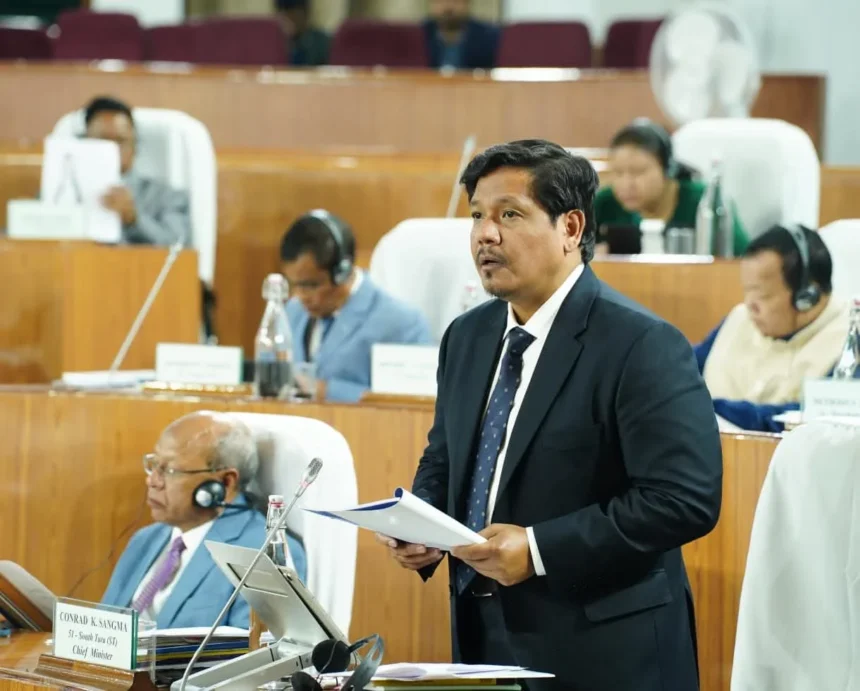
During the 2026 Budget Session of the Meghalaya Legislative Assembly, the Chief Minister addressed a proposal to carve out the Shillong Agglomerate from East Khasi Hills District and declare it a separate district.
The proposal was tabled by Bah Paul Lyngdoh, MLA from 18–West Shillong. He called for restructuring administrative boundaries to improve governance in the rapidly expanding State capital.
Read More: Meghalaya Debuts at BIOFACH 2026 Showcases Organic Products
Focus on Administrative Efficiency
Responding to the proposal, the Chief Minister acknowledged its importance. He said the idea deserves serious consideration because Shillong has witnessed rapid urban growth in recent years.
Moreover, he noted that a separate district could enhance administrative convenience. It could also ensure faster decision-making and better public service delivery. According to him, governance structures must adapt to changing demographic and urban realities.
Shillong, being the capital city, faces increasing pressure on infrastructure and civic services. Therefore, the government must evaluate long-term solutions carefully.
Understanding Shillong Urban Agglomeration
While explaining the concept, the Chief Minister referred to the Census of India 2011 definition of an Urban Agglomeration (UA). A UA includes a core statutory town and adjoining outgrowths or contiguous towns. Together, they form a continuous and functionally integrated urban area.
He stated that Shillong’s Urban Agglomeration consists of the Shillong Municipal Board, the Shillong Cantonment Board, and 10 census towns. Additionally, it includes 54 villages spread across East Khasi Hills and Ri-Bhoi District.
As a result, governance requires coordination across multiple administrative jurisdictions. This complexity strengthens the case for reviewing the present district structure.
Master Plan and Population Shift
The Chief Minister also referred to the Shillong Master Plan (2011–2041). This plan outlines long-term strategies for urban development, infrastructure expansion, and population management.
He pointed out that many residents have moved from the core municipal area to surrounding towns and villages. Consequently, urban growth now extends beyond traditional city limits.
Therefore, coordinated planning among government departments and traditional institutions becomes essential. Without integrated planning, infrastructure and service delivery may suffer.
Criteria for Creating a New District
The Chief Minister clarified that creating a new district involves several criteria. These include geographical area, population size, and distance from the district headquarters. Authorities also examine access to education and healthcare facilities.
In addition, economic conditions, public convenience, communication networks, and availability of funds are carefully assessed. A committee headed by the Chief Secretary evaluates such proposals. Senior officials from key departments are part of this review process.
Thus, the government follows a structured and transparent procedure before taking a final decision.
Government to Examine Proposal Carefully
The Chief Minister assured the Assembly that the government will scrutinize the proposal thoroughly. He stressed that any decision must strengthen governance and serve citizens effectively.
Furthermore, he appreciated Bah Paul Lyngdoh for initiating the discussion. He described the proposal as an opportunity for constructive debate on improving administrative efficiency in Shillong.
In conclusion, the government remains open to reviewing administrative reforms in response to urban growth. However, it will proceed after detailed examination and consultation. The move reflects Meghalaya’s broader commitment to responsive governance and citizen-centric development.