


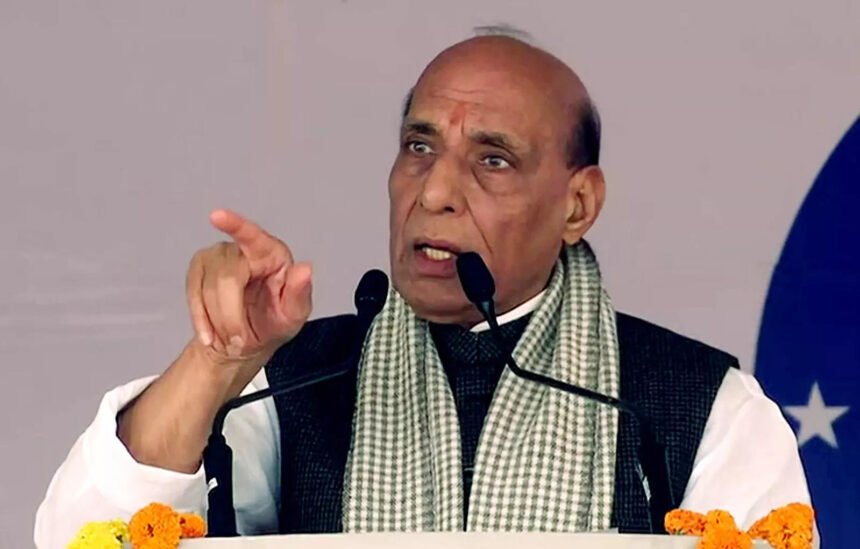
In a veiled response to Defence Minister Rajnath Singh’s recent remarks targeting DMK President and Chief Minister M.K. Stalin, the ruling Dravida Munnetra Kazhagam (DMK) party took a swipe at Singh and branded the Bharatiya Janata Party (BJP) as a “reactionary force.” The DMK’s Tamil daily, ‘Murasoli,’ published an editorial highlighting the Defence Minister’s comments and suggested that the very name Stalin instills fear in Singh.
Singh had criticized M.K. Stalin, likening him to the Russian dictator Joseph Stalin, accusing the Chief Minister of indulging in a similar form of dictatorship. Responding to this, the DMK’s newspaper cited a series of accomplishments attributed to Joseph Stalin during his time as the premier of the former Soviet Union from 1941 to 1953. The article listed achievements such as transforming the Soviet Union into an industrialized superpower, dismantling capitalism, opposing imperialism, safeguarding the ideals of Marxism-Leninism, and providing job security and social welfare to all citizens.
The DMK’s strong reaction comes in the midst of political tensions between the ruling party and the BJP, which has been making significant efforts to expand its presence in Tamil Nadu. The DMK, a Dravidian party with a strong regional foothold, has been critical of the BJP-led central government on various issues, including the handling of the COVID-19 pandemic and the implementation of policies that the DMK sees as detrimental to the interests of Tamil Nadu.
By highlighting Joseph Stalin’s accomplishments, the DMK’s ‘Murasoli’ editorial aimed to showcase the positive aspects associated with the name Stalin and counter the negative connotations raised by Rajnath Singh’s comments. It is evident that the DMK intends to present M.K. Stalin as a leader who shares some of the same qualities as Joseph Stalin, particularly in terms of his commitment to social welfare and economic progress.
The reference to the BJP as a “reactionary force” indicates the DMK’s perception of the party as one that opposes progressive policies and favors a more conservative approach. This reflects the ideological differences between the DMK, which is rooted in the principles of social justice and regional autonomy, and the BJP, which espouses a more centralizing and nationalistic agenda.
The DMK’s response underscores the growing political tensions in Tamil Nadu, as both the DMK and the BJP aim to consolidate their support bases ahead of upcoming elections. The DMK is seeking to maintain its stronghold in the state by emphasizing its accomplishments and projecting M.K. Stalin as a leader who can deliver on the promises of social and economic progress. On the other hand, the BJP is attempting to make inroads into Tamil Nadu by promoting its national agenda and appealing to segments of the population dissatisfied with the performance of regional parties.
As the political landscape in Tamil Nadu continues to evolve, it is likely that such exchanges between the DMK and the BJP will intensify. The DMK’s response to Rajnath Singh’s comments not only seeks to defend M.K. Stalin’s image but also serves as a reminder of the ideological differences between the two parties.