




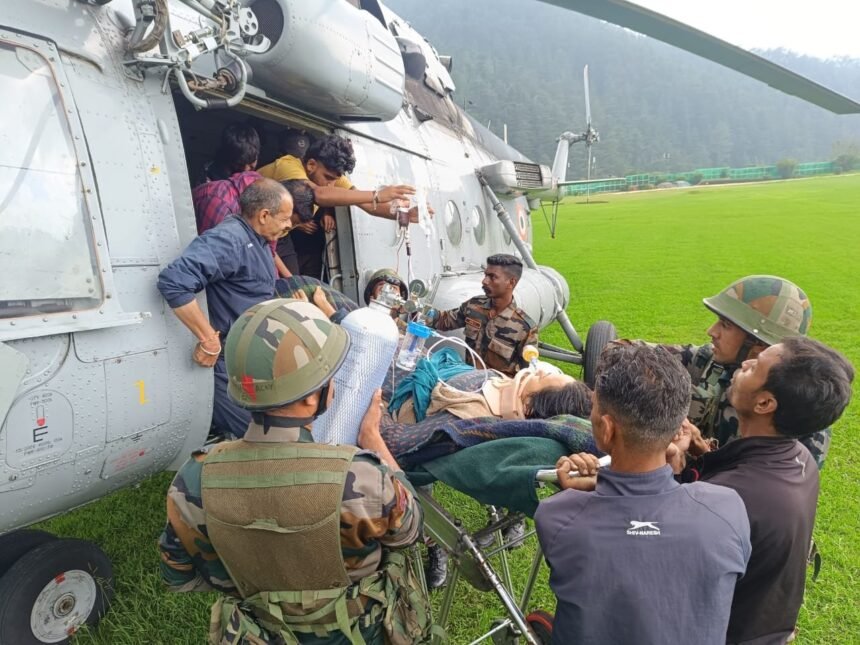
The Indian Air Force (IAF) has conducted a successful emergency casualty evacuation drill in the high-altitude region of Tawang, Arunachal Pradesh. The exercise focused on rapid response, airlifting injured personnel, and testing operational readiness in extreme terrain conditions. Moreover, officials stated that the drill is part of routine preparedness measures for difficult border regions. The operation highlights the armed forces’ capability to manage emergencies in high-altitude environments.
Sikkim Governor Flags Off the First Official Batch of Pilgrims for the Kailash Mansarovar Yatra
Severe Waterlogging Hits Low-Lying Residential Areas
High-Altitude Exercise Tests Rapid Evacuation Capabilities
Indian Air Force conducts successful emergency casualty evacuation drill in high-altitude Tawang to evaluate its response efficiency in remote mountainous terrain. Consequently, the exercise simulated real-life medical emergencies requiring urgent air evacuation.
The drill involved quick deployment of transport aircraft and trained medical teams. Moreover, injured personnel were stabilized before being airlifted to designated medical facilities. Therefore, the exercise demonstrated coordinated operational readiness.
Officials highlighted that Tawang’s terrain presents significant logistical challenges due to thin air and unpredictable weather. Furthermore, landing and take-off operations in such conditions require precision. As a result, specialized training is essential for effective missions.
Meanwhile, ground support teams assisted in coordinating evacuation procedures. Consequently, communication between air and ground units was closely monitored.
Focus on Medical Response and Survival in Extreme Conditions
Indian Air Force conducts successful emergency casualty evacuation drill in high-altitude Tawang with a strong emphasis on medical response readiness. Moreover, the drill tested the ability to provide immediate care in remote areas. Therefore, rapid stabilization of casualties was a key component.
Medical teams practiced emergency triage procedures before evacuation. Consequently, priority-based treatment was ensured for critical cases. Such protocols are vital in combat and disaster scenarios.
Furthermore, oxygen support and portable medical equipment were used during the drill. As a result, preparedness for high-altitude health complications was reinforced.
Meanwhile, simulated injury scenarios helped assess response accuracy. Similarly, coordination between medical and aviation units was evaluated.
Strengthening Operational Readiness in Border Regions
The Indian Air Force conducts successful emergency casualty evacuation drill in high-altitude Tawang as part of broader efforts to enhance operational readiness along sensitive border areas. Moreover, Tawang holds strategic importance due to its location. Therefore, regular drills are essential for preparedness.
The exercise tested logistical capabilities in challenging weather conditions. Consequently, aircrew performance under stress was closely observed. Such evaluations help improve mission efficiency.
Furthermore, forward air bases played a key role in supporting the drill. As a result, integrated operations between multiple units were demonstrated.
Meanwhile, continuous training exercises are being planned for similar high-altitude regions. Similarly, joint preparedness with other defence forces is being strengthened.
Enhancing Disaster and Emergency Response Capabilities
Beyond military readiness, the drill also reflects capabilities in disaster response situations. Moreover, high-altitude regions are prone to natural hazards and accidents. Therefore, rapid evacuation systems are crucial for civilian safety as well.
The exercise demonstrated how air evacuation can support humanitarian assistance. Consequently, it reinforces the role of the Indian Air Force in disaster relief operations. Such dual-use capabilities are vital in remote regions.
Furthermore, coordination with civil administration may be strengthened in future exercises. As a result, integrated emergency response systems could improve.
Meanwhile, lessons from the drill will be used for future operational planning. Similarly, training modules are expected to be updated.
Conclusion
Indian Air Force conducts successful emergency casualty evacuation drill in high-altitude Tawang, showcasing its preparedness for rapid response in extreme terrain. Moreover, the exercise highlights strong coordination between air and medical teams.
The drill reinforces the strategic importance of high-altitude operational readiness in border regions. Therefore, it enhances both defence preparedness and emergency response capabilities.
As Indian Air Force conducts successful emergency casualty evacuation drill in high-altitude Tawang, it underscores the importance of continuous training in challenging environments.
FAQs
1. Where was the drill conducted?
Tawang, Arunachal Pradesh.
2. Which force conducted the exercise?
The Indian Air Force.
3. What was the purpose of the drill?
Emergency casualty evacuation in high-altitude conditions.
4. Why is Tawang significant?
It is a strategic high-altitude border region.
5. What capabilities were tested?
Rapid air evacuation and medical response.