




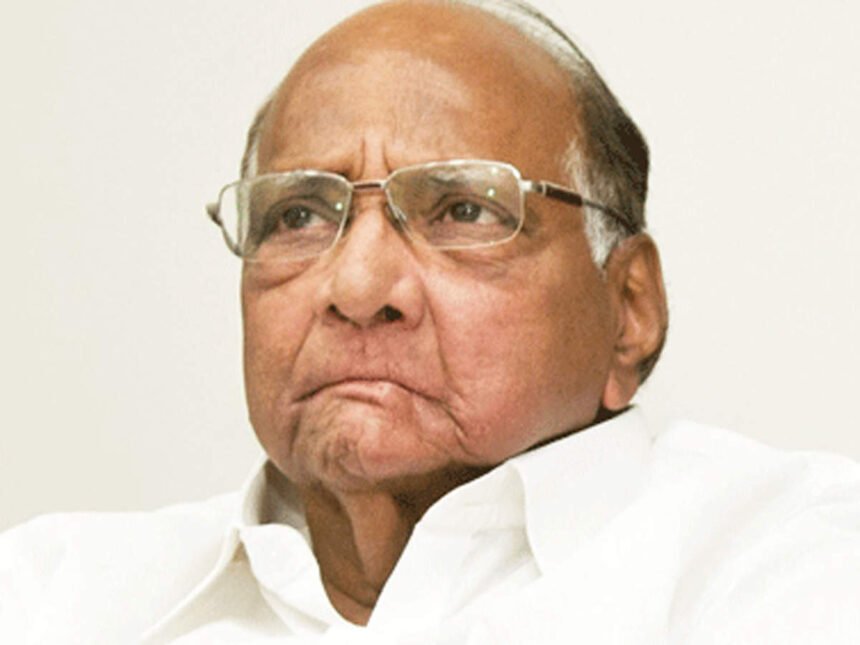
Maharashtra Chief Minister Eknath Shinde has responded to Nationalist Congress Party (NCP) president Sharad Pawar’s recent predictions on the upcoming elections, stating that Pawar’s past forecasts have proven to be inaccurate. Shinde emphasized that the 2014 and 2019 poll results defied Pawar’s expectations, and he believes that the next elections will follow suit.
In the aftermath of the Karnataka Assembly election results, where the Congress triumphed over the Bharatiya Janata Party (BJP) and reclaimed power, Sharad Pawar had asserted that these outcomes were indicative of the forthcoming scenario after the Lok Sabha elections in 2024. However, Chief Minister Shinde has firmly refuted Pawar’s claims and expressed skepticism about the existence of an “anti-BJP” wave.
During a press conference held in Aurangabad, Pawar maintained that there is currently a strong “anti-BJP” sentiment in the country and that people are yearning for change, pointing to the Karnataka Assembly poll results as evidence. However, Shinde has countered Pawar’s assertions, suggesting that history has shown Pawar’s predictions to be unreliable.
With the Lok Sabha elections scheduled for 2024 and the Maharashtra Assembly polls due in the latter part of next year, the political atmosphere is becoming increasingly charged. Both major parties, the BJP and the Congress-NCP alliance, are vying for dominance and seeking to sway public opinion in their favor.
Chief Minister Shinde’s dismissal of Pawar’s predictions underscores the intense rivalry between the two political camps. Shinde believes that Pawar’s past inaccuracies cast doubt on his ability to accurately gauge the mood of the electorate.
While the Karnataka Assembly election results did deliver a blow to the BJP and invigorated the opposition, it is premature to conclude that this signifies a nationwide “anti-BJP” wave. Elections are inherently complex, and outcomes are influenced by a myriad of factors, including regional dynamics, candidate selection, and voter sentiment.
Pawar’s claim of a prevailing “anti-BJP” sentiment should be taken with caution. The political landscape is known to be dynamic, with public opinion often shifting rapidly in response to unfolding events and evolving narratives. Additionally, regional variations in voter behavior and the presence of strong regional parties further complicate the electoral equation.
As the next elections draw closer, both the BJP and the opposition parties will intensify their campaigns, hoping to secure a mandate from the people. The Maharashtra Assembly polls, in particular, will be closely watched as they hold the potential to shape the political landscape of the state.
Chief Minister Shinde’s challenge to Sharad Pawar’s predictions and his dismissal of an “anti-BJP” wave reflect the highly competitive nature of Indian politics. While the Karnataka Assembly election results provided a boost to the opposition, it is premature to extrapolate this outcome to the national level. As the electoral battle approaches, both sides will continue to make their case to the voters, and only time will reveal the true mood of the electorate.