




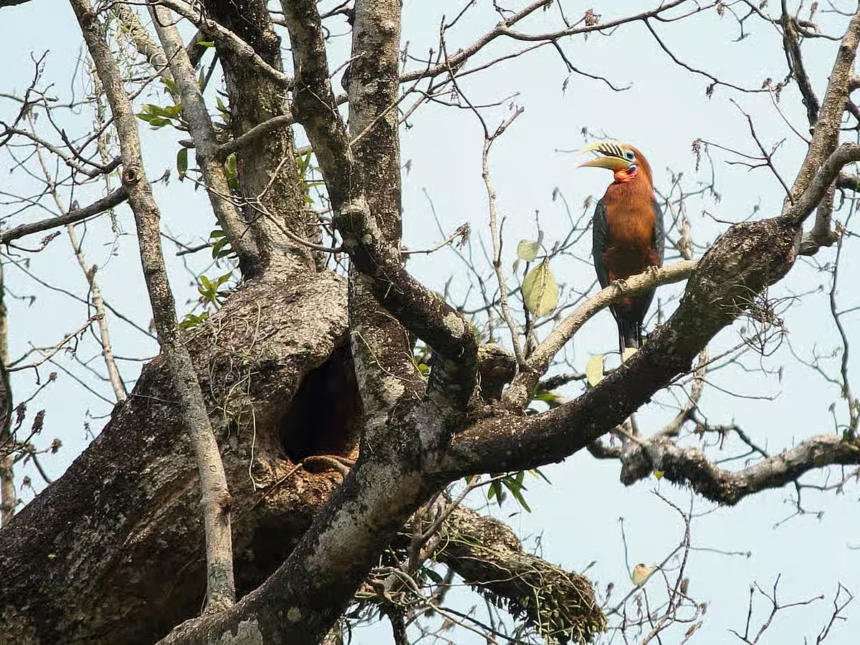
Nagaland’s hornbill preservation projects have received a financial boost from international wildlife conservation funds, strengthening ongoing efforts to protect the state’s iconic bird species and its natural habitat. The support is expected to enhance conservation activities, community participation, and ecological monitoring. Moreover, officials stated that the funding will help expand long-term biodiversity protection initiatives. The development marks a significant step in strengthening wildlife conservation in the region.
Manipur Integrity Coordination Committee Submits Comprehensive Memorandum
All Naga Students’ Association Manipur (ANSAM) Leads 4 km Rally Demanding Immediate Justice
International Funding Supports Hornbill Conservation Efforts
Nagaland hornbill preservation projects get financial boost from international wildlife conservation funds to support targeted conservation programmes. Consequently, expanded financial resources will be used to improve habitat protection measures.
The hornbill, a culturally significant bird in Nagaland, plays an important role in local traditions and ecological balance. Moreover, declining habitat quality has made conservation efforts increasingly important. Therefore, enhanced funding is expected to strengthen protection strategies.
Officials highlighted that international support will enable better field research and monitoring activities. Furthermore, conservation teams will be able to expand their coverage areas. As a result, data collection and wildlife tracking will improve.
Meanwhile, collaboration with global conservation organisations is being strengthened. Consequently, technical expertise is also being shared with local teams.
Strengthening Habitat Protection and Biodiversity Monitoring
Nagaland hornbill preservation projects get financial boost from international wildlife conservation funds to improve habitat conservation and biodiversity monitoring. Moreover, forest ecosystems where hornbills thrive are being prioritised for protection. Therefore, ecological balance is a key focus area.
The funding will support forest restoration initiatives and anti-poaching measures. Consequently, threats to hornbill populations are expected to reduce. Such interventions are crucial for long-term species survival.
Furthermore, advanced tracking and monitoring tools may be deployed. As a result, movement patterns and population trends can be studied more effectively.
Meanwhile, local forest communities are being engaged in conservation activities. Similarly, awareness programmes are being expanded.
Community Participation and Eco-Tourism Development
The Nagaland hornbill preservation projects get financial boost from international wildlife conservation funds while also promoting community involvement. Moreover, local communities play a crucial role in conservation success. Therefore, participatory approaches are being encouraged.
Awareness campaigns are being conducted to educate villagers about the ecological importance of hornbills. Consequently, community-led protection efforts are increasing. Such involvement strengthens conservation outcomes.
Furthermore, eco-tourism initiatives linked to hornbill habitats are being explored. As a result, conservation efforts may also generate sustainable livelihoods.
Meanwhile, cultural festivals promoting hornbill awareness continue to attract visitors. Similarly, conservation messaging is being integrated into tourism activities.
Strengthening Long-Term Conservation Strategy
The financial support aligns with broader long-term conservation strategies in Nagaland. Moreover, biodiversity preservation is a key environmental priority. Therefore, structured planning is being implemented.
Officials stated that sustained funding will help ensure continuity of conservation programmes. Consequently, short-term project gaps can be avoided. Such stability is essential for ecological protection.
Furthermore, partnerships between government bodies and international agencies are being strengthened. As a result, conservation outcomes are expected to improve.
Meanwhile, periodic evaluation of project impact will be conducted. Similarly, adaptive strategies may be introduced based on findings.
Conclusion
Nagaland hornbill preservation projects get financial boost from international wildlife conservation funds, marking an important milestone in wildlife protection efforts. Moreover, the funding strengthens habitat conservation, research, and community participation.
The initiative is expected to improve hornbill population protection and promote sustainable biodiversity management. Therefore, it contributes to long-term ecological stability.
As Nagaland hornbill preservation projects get financial boost from international wildlife conservation funds, it highlights the importance of global cooperation in wildlife conservation.
FAQs
1. What has been funded?
Hornbill preservation projects in Nagaland.
2. Who provided the funding?
International wildlife conservation funds.
3. What is the main goal?
To protect hornbill populations and habitats.
4. How will the funds be used?
For conservation, monitoring, and community engagement.
5. Why are hornbills important?
They are ecologically and culturally significant in Nagaland.