





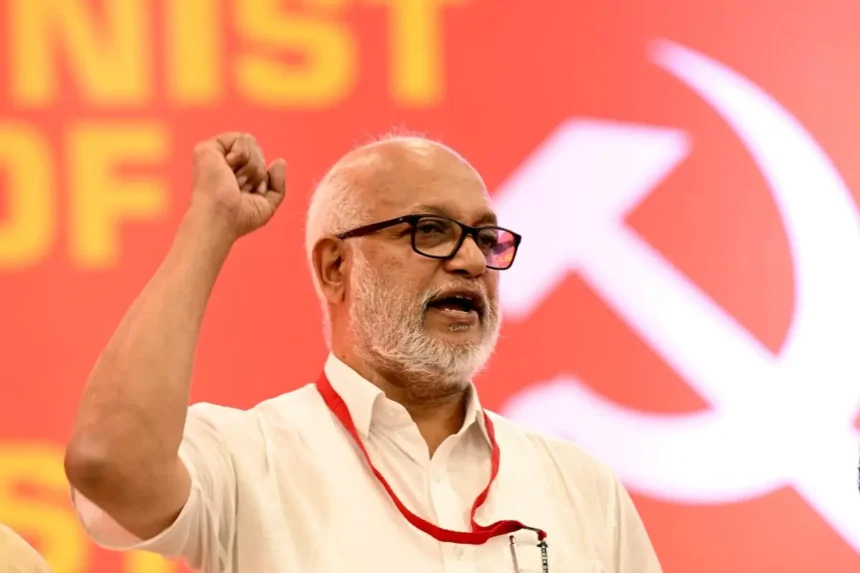
The national mass agitation announced by the Communist Party of India (Marxist) has brought renewed attention to the party’s political strategy ahead of the coming years. Moreover, CPI(M) General Secretary M.A. Baby predicted that the ruling Bharatiya Janata Party (BJP) would face a significant decline after the 2029 general elections. Consequently, he unveiled plans for large-scale public demonstrations and campaigns across India aimed at mobilizing people on various socio-economic and political issues. Meanwhile, political observers are closely watching the evolving strategies of opposition parties.
M.A. Baby Acknowledges Shortcomings in Left Front Strategy
National Mass Agitation Announced by CPI(M) Leadership
The national mass agitation announced by CPI(M) was revealed by General Secretary M.A. Baby during his remarks on the country’s political landscape. Moreover, he emphasized the importance of expanding public engagement through nationwide demonstrations and campaigns.
Political parties often organize public movements to communicate their positions and connect with citizens. Furthermore, mass mobilization has historically played an important role in democratic processes. As a result, the CPI(M) has outlined plans to intensify its outreach efforts.
According to M.A. Baby, the proposed demonstrations will be conducted on a large scale across different regions of the country. Additionally, the initiative aims to strengthen public participation in political discussions. Therefore, the announcement marks an important component of the party’s future strategy.
Meanwhile, opposition parties continue to assess their approaches ahead of upcoming electoral contests. Similarly, political developments are expected to influence campaign strategies. Hence, public mobilization remains a significant aspect of political activity.
Although political viewpoints differ, democratic systems provide space for peaceful expression and participation. Nevertheless, continued engagement remains essential.
M.A. Baby Predicts BJP Decline After 2029 General Elections
The national mass agitation announced by CPI(M) was accompanied by remarks from M.A. Baby regarding the future of the ruling BJP. Moreover, he predicted that the party would witness a considerable decline after the 2029 Lok Sabha elections.
Political leaders frequently present their assessments of electoral trends and future developments. Furthermore, such statements often reflect broader ideological and strategic perspectives. Consequently, predictions regarding electoral outcomes are common in political discourse.
M.A. Baby’s comments represent the CPI(M)’s outlook on the national political scenario. Additionally, they underscore the party’s intention to strengthen opposition politics. Therefore, his remarks have generated attention among political observers.
Meanwhile, political parties across the spectrum continue to formulate long-term strategies. Similarly, electoral dynamics are expected to evolve over time. Hence, discussions regarding future political scenarios are likely to continue.
Although predictions remain subject to changing circumstances, political debate remains an integral part of democracy. Nevertheless, voter preferences will ultimately determine electoral outcomes.
National Mass Agitation Announced Amid Opposition Mobilization Efforts
The national mass agitation announced by CPI(M) highlights the increasing focus on public campaigns and grassroots engagement. Moreover, opposition parties have been exploring various methods to expand their political reach.
Mass movements and public demonstrations are often used to draw attention to policy concerns and public issues. Furthermore, they provide political organizations with opportunities to interact directly with citizens. As a result, such initiatives remain a key feature of democratic politics.
The CPI(M)’s plans indicate an emphasis on strengthening organizational networks across the country. Additionally, public demonstrations are expected to form an important part of the party’s activities in the coming years. Therefore, political mobilization is likely to remain a major priority.
Meanwhile, parties continue to evaluate changing public sentiments and emerging challenges. Similarly, leaders are expected to focus on expanding their support base. Hence, political campaigning is likely to intensify gradually.
Although political competition remains dynamic, democratic participation continues to shape national discourse. Nevertheless, constructive engagement remains important.
Public Demonstrations Continue to Play a Role in Indian Politics
The national mass agitation announced by CPI(M) underscores the continuing significance of public demonstrations in India’s democratic framework. Moreover, political parties frequently rely on such movements to amplify their messages.
Public campaigns have historically contributed to political awareness and participation. Furthermore, they serve as platforms for expressing differing viewpoints. Consequently, mass movements remain an important aspect of democratic traditions.
The latest announcement reflects the CPI(M)’s commitment to expanding its presence through grassroots initiatives. Additionally, the strategy highlights the importance of organizational outreach. Therefore, public engagement continues to receive considerable attention.
Meanwhile, political developments across India are expected to influence future strategies adopted by various parties. Similarly, the run-up to future elections will likely witness increased campaigning. Hence, political mobilization is expected to remain active.
Although political perspectives vary, democratic institutions provide mechanisms for dialogue and participation. Nevertheless, peaceful engagement remains fundamental.
Conclusion
The national mass agitation announced by CPI(M) marks a significant development in the party’s political strategy under General Secretary M.A. Baby. Moreover, his prediction regarding a decline in the BJP’s fortunes after the 2029 general elections has added to the ongoing political debate. Consequently, the announcement of large-scale demonstrations across India reflects the party’s emphasis on grassroots mobilization and public participation.
The development also highlights the importance of democratic engagement and the role of political campaigns in shaping public discourse. Furthermore, opposition parties continue to explore strategies aimed at expanding their influence and strengthening organizational networks. As a result, public demonstrations are expected to remain an important feature of India’s political landscape.
Looking ahead, the national mass agitation announced by CPI(M) is likely to influence political narratives and campaign strategies in the years leading up to future elections. Additionally, continued public engagement and democratic participation will remain central to political activity. Therefore, grassroots mobilization is expected to play a prominent role in the evolving political landscape.
FAQs
1. Who announced the national mass agitation?
CPI(M) General Secretary M.A. Baby announced plans for nationwide public demonstrations and campaigns.
2. What prediction did M.A. Baby make?
Moreover, he predicted that the ruling BJP would experience a significant decline after the 2029 general elections.
3. What is the purpose of the proposed demonstrations?
The demonstrations are intended to mobilize public participation and strengthen political outreach. Consequently, they form part of the party’s broader strategy.
4. Why are public movements important in politics?
Public movements help political parties engage with citizens and highlight issues of concern. Furthermore, they contribute to democratic participation.
5. Why is the national mass agitation announced by CPI(M) significant?
The announcement is significant because it outlines the party’s future political strategy and reflects broader opposition mobilization efforts.

