







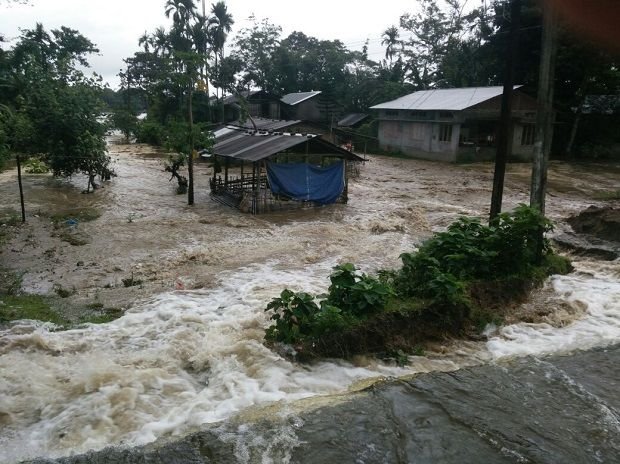
The Northeast India floods have claimed 48 lives across Assam, Manipur, and Arunachal Pradesh. Rising waters from torrential monsoon rains have swept away homes, isolated villages, and displaced over 800,000 people. Relief teams are racing against time to provide aid, even as new challenges emerge daily.
Assam Battles Worsening Floods in Brahmaputra Basin
Assam faces the gravest situation among the affected states. According to the Assam State Disaster Management Authority (ASDMA), more than 6.8 lakh people remain affected in 21 districts. Floodwaters from the Brahmaputra River and its tributaries have inundated low-lying areas, destroying homes, farmland, and infrastructure.
The state has reported 32 out of the 48 flood-related deaths. Government officials quickly mobilized the National Disaster Response Force (NDRF), who began evacuation and rescue operations. Simultaneously, state authorities opened over 300 relief camps to provide food, shelter, and medical care.
Despite the efforts, many regions remain cut off. Barpeta, Nalbari, and Dibrugarh districts have seen large-scale displacement. If you want to track ongoing relief work, visit the ASDMA website.
Manipur Struggles to Recover from Northeast India Floods
Meanwhile, in Manipur, more than 1.6 lakh people continue to suffer due to the floods. The Imphal Valley, in particular, remains submerged. Rising water levels have blocked roads, disrupted power supplies, and forced many residents to abandon their homes.
Authorities acted quickly. The Indian Army and local disaster teams used boats and helicopters to reach stranded residents. Although relief operations have reached several remote villages, access to clean water and sanitation still poses a threat. The Manipur Health Department has issued alerts to prevent outbreaks of disease.
For the latest information, check the official Manipur Government portal.
Arunachal Pradesh Faces Landslides and Flood Isolation
Arunachal Pradesh continues to deal with a dual disaster—landslides and flash floods. More than 33,000 people have been displaced. Several districts, including Lohit and West Siang, remain inaccessible due to damaged bridges and blocked roads.
The Border Roads Organisation (BRO) responded swiftly by clearing debris and restoring temporary connectivity. However, heavy rain continues to hamper the delivery of relief supplies. Local administration teams are using drones and helicopters to drop essentials like food and medicines.
The state’s coordination with central agencies has improved response efficiency. Updates are available at Arunachal Pradesh SDMA.
Why Northeast India Floods Are Becoming More Frequent
The increasing frequency and intensity of Northeast India floods can no longer be seen as isolated events. Meteorologists from the Indian Meteorological Department (IMD) have warned that changing climate patterns are making extreme rainfall events more common.
Experts also point out human-driven factors. Rapid deforestation, encroachment on wetlands, and poor floodplain planning have worsened the region’s vulnerability. As rainfall becomes erratic, rivers like the Brahmaputra overflow more violently, causing widespread destruction.
According to the Intergovernmental Panel on Climate Change (IPCC), Northeast India is among the most climate-sensitive zones in South Asia. These warnings suggest the urgent need for robust flood management strategies.
Government Responds to Northeast India Flood Crisis
Responding to the humanitarian crisis, Prime Minister Narendra Modi directed the National Disaster Management Authority (NDMA) to scale up rescue and relief efforts. A central team visited the region to assess the damage and ensure coordinated action across all states.
The government released emergency funds from the State Disaster Response Fund (SDRF) to accelerate rehabilitation. Over 500 relief camps are now operational. At the same time, non-governmental organizations and civil society groups have also stepped in to distribute food and medical supplies.
You can support these efforts by contributing to the PM CARES Fund or local relief campaigns.
Long-Term Recovery After the Northeast India Floods
While immediate rescue efforts continue, long-term recovery remains a daunting challenge. Thousands of families have lost their homes. In addition, damaged roads, broken power lines, and contaminated water sources will delay the return to normal life.
Authorities must now shift their focus toward rebuilding in a climate-resilient way. Urban planners and disaster management experts recommend constructing flood-proof homes and restoring natural waterways. Also, better early warning systems can reduce loss of life in future disasters.
Furthermore, environmental conservation must play a larger role in regional planning. Without preserving the Northeast’s natural buffers like forests and wetlands, any reconstruction effort will remain incomplete.
READ MORE: Northeast India Film Festival 2025: A New Era of Regional Cinema
Act Now: Northeast India Needs National Support
The impact of the Northeast India floods goes far beyond the immediate death toll. It is a crisis that demands national attention and long-term solutions. With 48 lives lost, millions affected, and infrastructure in ruins, now is the time to act.
You can help by donating to verified funds, spreading awareness, and pushing for policy reforms that prioritize environmental sustainability. Support local rescue teams by volunteering or contributing supplies through NGOs operating in Assam, Manipur, and Arunachal.
Together, we can support the people of Northeast India—not just in surviving this disaster, but in building a safer, more resilient future.

