




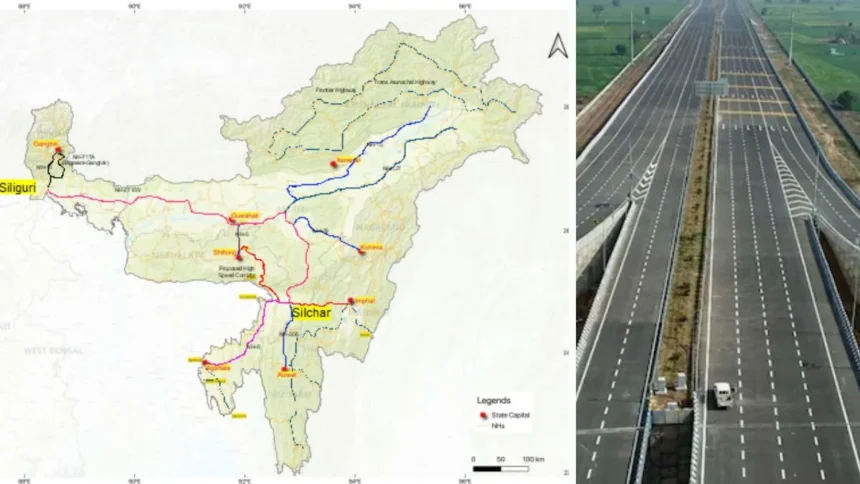
The Shillong–Silchar Greenfield Axis has been unveiled as a flagship ₹23,000-crore infrastructure project aimed at transforming connectivity between Meghalaya and Assam. Moreover, the 165-km Greenfield Corridor is expected to significantly reduce travel time to the Barak Valley while strengthening supply chains to Tripura, Mizoram, and Manipur. Consequently, the project is poised to enhance trade, logistics, and regional integration across the Northeast. Meanwhile, policymakers have highlighted the corridor as a major step toward accelerating economic growth and infrastructure development.
Guwahati–Shillong 1-Hour Travel Corridor: ₹8,500-Crore Greenfield Project
IAF Crash in Jorhat: AN-32 Aircraft Crashes at Airbase, Pilot Feared Dead and Co-Pilot Hospitalized
Shillong–Silchar Greenfield Axis Set to Transform Regional Connectivity
The Shillong–Silchar Greenfield Axis represents one of the largest infrastructure initiatives in the Northeast. Moreover, the ₹23,000-crore investment underscores the growing emphasis on modern transportation networks in the region.
Efficient road connectivity is essential for economic development. Furthermore, improved highways help reduce travel time and facilitate smoother movement of goods and passengers. As a result, the new corridor is expected to improve accessibility across multiple states.
The 165-km Greenfield project has been designed to provide a faster and more reliable route between Shillong and Silchar. Additionally, the project aims to reduce congestion and improve transport efficiency. Therefore, it is expected to become a key component of the Northeast’s infrastructure landscape.
Meanwhile, governments continue to prioritize connectivity projects under broader regional development strategies. Similarly, investments in transportation infrastructure are being aligned with national growth objectives. Hence, the Shillong–Silchar Greenfield Axis reflects a long-term vision for the region.
Although challenging terrain presents engineering hurdles, modern construction techniques are helping address these concerns. Nevertheless, timely execution remains critical.
₹23,000-Crore Corridor to Strengthen Supply Chains to Tripura, Mizoram, and Manipur
The Shillong–Silchar Greenfield Axis is expected to strengthen supply channels to Tripura, Mizoram, and Manipur. Moreover, enhanced road connectivity will improve logistical efficiency and support economic activities across the region.
Supply chain efficiency is crucial for ensuring smooth transportation of goods. Furthermore, better road infrastructure helps reduce transportation costs and delays. Consequently, businesses and consumers may benefit from improved market access.
The corridor is strategically important because it connects key regions in the Northeast. Additionally, faster transport networks can support industrial and commercial development. Therefore, the project is expected to have wide-ranging economic implications.
Meanwhile, policymakers are focusing on strengthening inter-state connectivity. Similarly, logistics infrastructure is receiving increased attention as part of development planning. Hence, the project complements broader efforts to improve regional integration.
Although infrastructure investments require substantial resources, their benefits often extend across multiple sectors. Nevertheless, effective coordination will remain essential.
Shillong–Silchar Greenfield Axis Expected to Boost Trade and Economic Growth
The Shillong–Silchar Greenfield Axis is expected to stimulate trade and economic activity throughout the Northeast. Moreover, improved connectivity can create opportunities for businesses and attract investments.
Reduced travel time contributes to more efficient movement of goods and services. Furthermore, enhanced accessibility supports industrial expansion and market connectivity. As a result, economic activities across the Barak Valley and neighboring states could receive a significant boost.
The project may also support sectors such as tourism and agriculture. Additionally, better transport infrastructure can help local producers access larger markets. Therefore, the corridor is likely to contribute to broader economic development.
Meanwhile, governments are emphasizing infrastructure-led growth as a key policy priority. Similarly, transport modernization is being integrated into regional development frameworks. Hence, the corridor aligns with long-term economic goals.
Although economic gains may emerge gradually, major infrastructure projects typically provide lasting benefits. Nevertheless, sustained maintenance and support will remain necessary.
Enhanced Access to the Barak Valley Supports Regional Integration
The Shillong–Silchar Greenfield Axis will significantly improve access to the Barak Valley and strengthen ties between states in the Northeast. Moreover, improved mobility can contribute to balanced development and closer regional cooperation.
Connectivity plays an important role in promoting social and economic integration. Furthermore, efficient transportation networks improve access to healthcare, education, and employment opportunities. Consequently, stronger infrastructure can enhance quality of life.
The project reflects ongoing efforts to address connectivity challenges in the Northeast. Additionally, better road networks support smoother interaction between communities and markets. Therefore, the corridor contributes to inclusive development.
Meanwhile, policymakers continue to emphasize sustainable and resilient infrastructure. Similarly, long-term development plans increasingly focus on strategic connectivity. Hence, the project supports the broader vision of regional transformation.
Although infrastructure expansion requires sustained investment, the long-term advantages are substantial. Nevertheless, successful implementation will determine its ultimate impact.
Conclusion
The Shillong–Silchar Greenfield Axis, with an investment of ₹23,000 crore, represents a landmark initiative in the Northeast’s infrastructure journey. Moreover, the 165-km corridor is expected to dramatically improve connectivity between Shillong and Silchar while supporting the Barak Valley and neighboring states. Consequently, the project has the potential to transform transportation and economic activity across the region.
The corridor also highlights the growing importance of strategic infrastructure in driving development. Furthermore, stronger supply chains to Tripura, Mizoram, and Manipur are expected to enhance trade and logistical efficiency. As a result, communities and businesses stand to benefit from improved accessibility and connectivity.
Looking ahead, the Shillong–Silchar Greenfield Axis could emerge as a key driver of regional growth and integration. Additionally, continued cooperation between the Centre and state governments will be vital for ensuring timely completion. Therefore, the project marks a significant milestone in strengthening the Northeast’s economic and transportation framework.
FAQs
1. What is the Shillong–Silchar Greenfield Axis?
The Shillong–Silchar Greenfield Axis is a 165-km highway corridor announced with an investment of ₹23,000 crore to improve connectivity between Shillong and Silchar.
2. Why is the Shillong–Silchar Greenfield Axis important?
Moreover, the corridor is important because it aims to reduce travel time, strengthen supply chains, and improve regional connectivity.
3. Which states are expected to benefit from the project?
Tripura, Mizoram, Manipur, Meghalaya, and Assam are expected to benefit. Furthermore, the Barak Valley region is likely to gain improved accessibility.
4. How will the project support economic growth?
Improved transport infrastructure can boost trade, reduce logistical costs, and encourage investment. Consequently, economic activity may expand across the region.
5. How does the Shillong–Silchar Greenfield Axis strengthen supply channels?
The corridor will facilitate smoother movement of goods and improve connectivity with Tripura, Mizoram, and Manipur. Moreover, it will enhance logistical efficiency.