





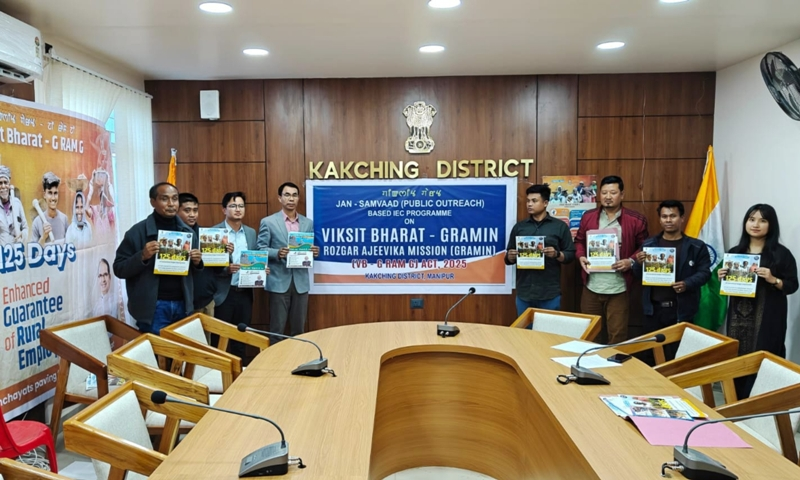
The Manipur government has launched a structured six-week Jan Samvaad-based Information, Education and Communication (IEC) campaign to spread awareness about the Viksit Bharat – Guarantee for Rozgar and Ajeevika Mission (Gramin) Act, 2025 (VB-G RAM G) across all districts of the state.
Additional Deputy Commissioner P. Shantikumar Singh announced the initiative during a Jan Samvaad programme held at the Conference Hall of the DC Office Complex in Kakching district. The campaign aims to inform rural households about their rights, entitlements and responsibilities under the new law.
Read More: Gauhati High Court Issues Notice to Himanta Biswa Sarma
New Law Replaces MGNREGA
Shantikumar stated that the Act came into force on December 21, 2025. It replaces the Mahatma Gandhi National Rural Employment Guarantee Act (MGNREGA), 2005.
Under the revised framework, authorities will align rural employment works with the national vision of Viksit Bharat@2047. Each Gram Panchayat will prepare a Viksit Gram Panchayat Plan to guide project selection and execution at the grassroots level.
125 Days of Guaranteed Employment
The new Act increases the annual employment guarantee from 100 days to 125 days of unskilled manual work per rural household. Officials will pay wages at prevailing rates within seven days of work completion. In special cases, authorities may extend the payment timeline up to 15 days.
Any adult member of a rural household willing to undertake unskilled work can register with the concerned Gram Panchayat and obtain a Gramin Rozgar Guarantee Card, commonly known as a Job Card.
After registration, households can apply for work either orally or in writing to the Gram Panchayat, Programme Officer or other designated authority.
Unemployment Allowance Provision
If authorities fail to provide employment within 15 days of application, the applicant becomes eligible for an unemployment allowance. The allowance equals one-fourth of the wage for the first 30 days. For any period beyond 30 days, the allowance rises to 50 per cent of the wage rate.
However, officials will not grant the allowance to individuals who refuse assigned work, complete 125 days of employment, or receive wages and allowances equivalent to the maximum entitlement.
The Act also prohibits the execution of works for 60 days during peak agricultural seasons, especially during sowing and harvesting, to prevent labour shortages in farming activities.
Focus on Water Security and Infrastructure
Shantikumar highlighted the thematic priorities under the Act. Authorities will give top priority to water security projects. These include the construction of canals, ponds, check dams, wells, plantations and rainwater harvesting systems.
In addition, the programme will support core infrastructure such as rural roads, culverts, crematoria, schools, hospitals, parking areas and waste management facilities. Works linked to schemes like Pradhan Mantri Awas Yojana – Gramin and Jal Jeevan Mission will also receive attention.
Livelihood and Climate Resilience Measures
The Act further promotes livelihood infrastructure development. Authorities can establish training centres, rural markets, grain storage facilities, compost units and agriculture- and fishery-related assets.
Recognising climate-related risks, the legislation incorporates mitigation measures for extreme weather events. These include the construction of flood and cyclone shelters, post-disaster rehabilitation works, forest fire prevention infrastructure and plantation drives.
Through the ongoing IEC campaign, the Manipur government aims to ensure that rural communities fully understand the provisions of the new law and actively participate in its implementation. Officials believe the initiative will strengthen livelihood security while supporting sustainable rural development across the state.
Also Read: Cyclist Killed in Tripper Vehicle Accident in Agartala