




A leading Pakistani newspaper has sharply criticised the government of Prime Minister Shehbaz Sharif after India and the United States clinched a major trade deal, saying Islamabad “never took serious efforts” to secure similar economic opportunities. The commentary reflects growing frustration within Pakistan over missed trade prospects and what critics describe as policy inertia.
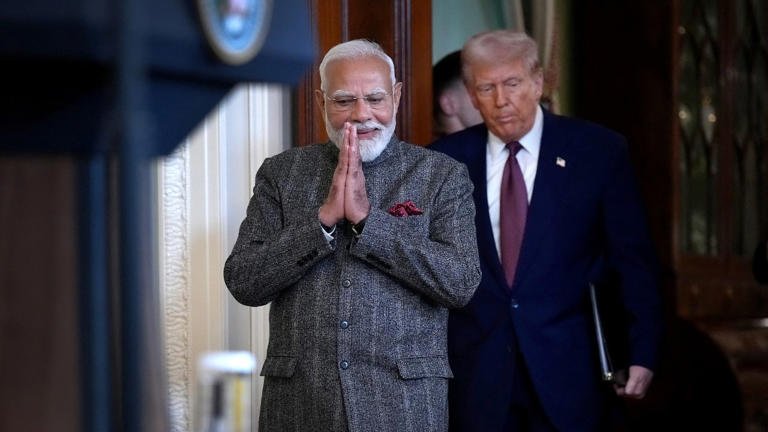
The editorial came soon after New Delhi and Washington announced progress on a bilateral trade agreement aimed at boosting market access, investment, and technology cooperation. While the deal has been welcomed in India as a sign of rising global economic clout, the reaction in Pakistan has exposed anxieties about the country’s economic direction and diplomatic priorities.
The Pakistani newspaper criticises Shehbaz Sharif government for failing to pursue proactive trade diplomacy at a time when global economic alignments are rapidly shifting.
Read More: Tripura CM Warns of Exposing ‘Unethical’ Conduct of TTAADC
Pakistani newspaper criticises Shehbaz Sharif government
In its editorial, the newspaper argued that Pakistan has repeatedly missed opportunities to deepen trade ties with major economies. It said that while India invested years in sustained engagement with the US, Pakistan lacked a clear strategy.
According to the editorial, Islamabad often reacts to global developments rather than shaping them. Therefore, the Pakistani newspaper criticises Shehbaz Sharif government for what it called a lack of seriousness and consistency in economic diplomacy.
The commentary said trade agreements require long-term planning, political stability, and policy clarity—areas where Pakistan has struggled.
India–US trade deal triggers introspection
The India–US trade deal has triggered introspection in Pakistan’s policy circles. The agreement is expected to enhance cooperation in sectors such as manufacturing, technology, energy, and defence-linked industries.
The newspaper noted that India’s expanding trade partnerships reflect sustained engagement with global powers. In contrast, Pakistan, it argued, remains stuck in short-term crisis management.
The Pakistani newspaper criticises Shehbaz Sharif government for failing to leverage Pakistan’s strategic location and market potential in a similar manner.
‘We never took serious efforts’
The editorial’s most striking line—“we never took serious efforts”—summed up its critique of Pakistan’s trade policy. It said successive governments talked about export growth and investment but failed to implement structural reforms.
According to the newspaper, Pakistan’s inconsistent policies and frequent leadership changes weakened investor confidence. As a result, potential partners hesitated to commit to long-term agreements.
The criticism suggests growing impatience within Pakistan’s intellectual and media circles.
Economic challenges facing Pakistan
Pakistan continues to face severe economic challenges, including low foreign exchange reserves, high inflation, and reliance on external bailouts. Critics argue that stronger trade partnerships could have eased these pressures.
The newspaper said the Shehbaz Sharif government inherited economic difficulties but has not moved decisively to change course. Instead, it accused the administration of relying heavily on short-term financial support.
The Pakistani newspaper criticises Shehbaz Sharif government for not prioritising trade-led growth as a sustainable solution.
Comparison with India’s approach
The editorial drew a direct comparison between India’s approach and Pakistan’s. It said India invested in long-term engagement with the US, aligning trade policy with strategic and economic goals.
By contrast, Pakistan’s outreach, the paper argued, often lacked continuity. Frequent policy reversals and political instability undermined credibility.
The comparison highlights how trade agreements reflect broader governance and policy stability.
Political implications for Shehbaz Sharif
The criticism carries political implications for Shehbaz Sharif’s government, which already faces pressure over economic performance. Opposition parties may use such commentary to question the government’s competence.
Analysts said when mainstream newspapers openly criticise the government, it signals deeper public dissatisfaction. The trade deal narrative could thus become a political talking point.
The Pakistani newspaper criticises Shehbaz Sharif government not only on policy grounds but also on leadership accountability.
Pakistan’s trade diplomacy under scrutiny
The editorial argued that Pakistan’s trade diplomacy remains reactive and fragmented. It said embassies and trade missions lack clear mandates and coordination.
Without a unified vision, the paper warned, Pakistan risks falling further behind regional competitors. Countries that adapt quickly to global trade shifts, it said, gain lasting advantages.
The India–US deal has therefore become a mirror reflecting Pakistan’s own policy gaps.
Calls for reform and strategic thinking
The newspaper urged the government to rethink its economic and trade strategy urgently. It called for structural reforms, political consensus, and consistent engagement with global partners.
Trade agreements, it said, cannot be achieved overnight. They require patience, negotiation capacity, and domestic reform—elements Pakistan must strengthen.
The Pakistani newspaper criticises Shehbaz Sharif government while also offering a roadmap for improvement.
Regional and global context
Globally, trade alliances are reshaping economic power. India’s growing role in such frameworks reflects its integration into global supply chains.
Pakistan, the editorial warned, risks marginalisation if it fails to adapt. Regional competitors are moving ahead, while Islamabad debates short-term fixes.
The criticism underscores the cost of delayed reform in a competitive global economy.
Government silence and possible response
As of now, the Shehbaz Sharif government has not publicly responded to the editorial. However, officials may attempt to highlight ongoing efforts to stabilise the economy and explore trade options.
Whether the criticism leads to policy recalibration remains uncertain. Observers said meaningful change would require political stability and sustained commitment.
The Pakistani newspaper criticises Shehbaz Sharif government at a moment when economic credibility remains fragile.
What lies ahead
The India–US trade deal is likely to continue influencing regional economic discourse. In Pakistan, it may intensify debates on trade, diplomacy, and reform.
Policy analysts said the government faces a choice between incremental adjustments and comprehensive reform. Public criticism from influential media may increase pressure.
The coming months could determine whether Pakistan repositions itself or continues on its current path.
Conclusion
The sharp editorial criticising the Shehbaz Sharif government after India and the US clinched a trade deal highlights growing unease within Pakistan about missed economic opportunities. By admitting that “we never took serious efforts,” the newspaper has voiced a broader national frustration.
As global trade dynamics evolve, the criticism serves as a warning that hesitation and policy inconsistency carry real costs. Whether the Shehbaz Sharif government responds with decisive reform will shape Pakistan’s economic trajectory in the years ahead.
Read More: Maoist Issue Not Linked to Development: Amit Shah in Chhattisgarh