





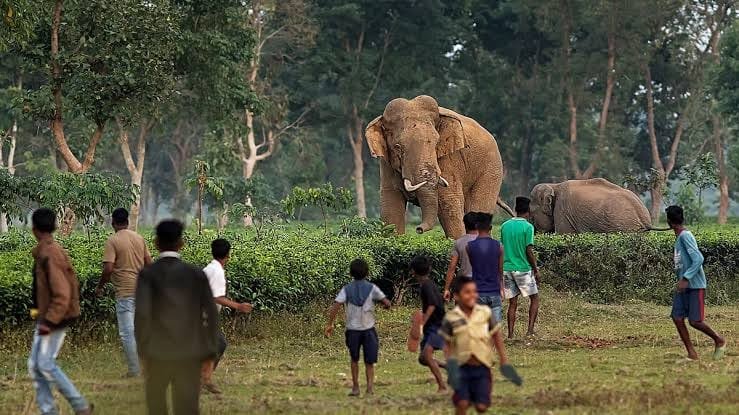
Human deaths caused by human-elephant conflict (HEC) in Assam’s Lakhipur have fallen significantly due to coordinated mitigation measures implemented by the Assam Forest Department and biodiversity conservation organization Aaranyak. Official data shows fatalities declined from 19 in 2022 to just two in 2025.
The installation of solar-powered fences, improved community alert systems, and active participation of local volunteers have played a key role in reducing encounters between people and wild elephants. Authorities have now called for continued cooperation among multiple government departments to sustain the positive trend.
Read More: Census 2027 Digital Enumeration Sparks Urban-to-Rural Registration – Hindustan Pioneer
Key Facts
- Location: Lakhipur Circle, Goalpara Division, Assam
- Issue: Human-Elephant Conflict (HEC)
- Human Deaths: Reduced from 19 (2022) to 2 (2025)
- Solar Fencing Installed: Approximately 47 kilometres
- Villages Protected: 18
- Households Benefited: Around 1,440
- Community Volunteers: 70 Elephant Conservation Network (ECN) volunteers and 40 Gaja Mitras
- Key Organizations: Assam Forest Department and Aaranyak
- Review Meeting: Next assessment scheduled for October 2026
Human-Elephant Conflict Deaths Decline in Lakhipur
Lakhipur in Assam’s Goalpara district has recorded a major reduction in human fatalities caused by human-elephant conflict following sustained conservation and community-based mitigation efforts.
According to official figures, deaths linked to human-elephant encounters declined from 19 in 2022 to only two in 2025. Forest officials attribute this improvement to long-term planning, better infrastructure, and stronger community participation.
The mitigation programme has been jointly implemented by the Goalpara Division of the Assam Forest Department and biodiversity conservation group Aaranyak, focusing on reducing direct interactions between humans and elephants.
Solar Fencing and Early Warning Systems Improve Safety
Range Officer Moupran Gayon said several preventive measures have helped minimize conflict in vulnerable villages.
Around 47 kilometres of solar-powered fencing have been installed across the Lakhipur Circle, providing protection to 18 villages and nearly 1,440 households. Solar street lights have also been installed in high-risk areas to improve nighttime visibility, while rechargeable torchlights have been distributed to volunteers assisting in elephant monitoring.
These measures have significantly reduced the chances of unexpected encounters between villagers and elephants.
Community Volunteers Play a Key Role
Local participation has become one of the strongest pillars of the conservation initiative.
Currently, nearly 70 Elephant Conservation Network (ECN) volunteers and 40 Gaja Mitras work alongside Forest Department personnel to monitor elephant movement and spread awareness among residents.
Whenever elephants are sighted near villages, volunteers immediately circulate alerts through WhatsApp groups, enabling local communities to take precautionary measures and avoid dangerous encounters.
Officials believe this rapid communication network has contributed substantially to lowering human casualties.
Multi-Department Cooperation Encouraged
A review meeting held on June 29 brought together officials from multiple government departments to discuss strategies for sustaining the declining trend in human deaths.
Circle Officer Sailen Dutta Das appreciated the collaborative efforts and urged departments including APDCL, Veterinary, Agriculture, Social Welfare, Education, Soil Conservation, Police, Health, DDMA, and Panchayat and Rural Development to continue supporting conflict mitigation initiatives.
He also announced that the next review meeting will take place in October 2026 to evaluate further progress.
Conservation Experts Stress Long-Term Coordination
During the meeting, Dr. Bibhuti Prasad Lahkar, Head of Aaranyak’s Elephant Research and Conservation Division, presented a detailed assessment on managing human-elephant conflict.
He highlighted the importance of coordinated action among government agencies, conservation organisations, and local communities to ensure long-term coexistence between people and elephants.
Representatives from various departments assured continued support for conservation efforts aimed at protecting both human lives and wildlife.
Questions & Answers
Q1: What happened in Lakhipur, Assam?
Human deaths caused by human-elephant conflict declined significantly from 19 in 2022 to just two in 2025.
Q2: What measures helped reduce human-elephant conflict?
Solar fencing, solar street lights, rechargeable torchlights, community awareness programmes, and early warning systems helped reduce encounters.
Q3: How much solar fencing has been installed?
Approximately 47 kilometres of solar-powered fencing have been installed.
Q4: How many villages have benefited?
The initiative has protected 18 villages and around 1,440 households.
Q5: Who is implementing the conservation programme?
The Goalpara Division of the Assam Forest Department is implementing the initiative in partnership with Aaranyak and local volunteers.
Q6: When is the next review meeting?
The next review meeting is scheduled for October 2026.
Location Context
Lakhipur, located in Assam’s Goalpara district, is one of the state’s important human-elephant conflict hotspots. The region lies within Northeast India, a biodiversity-rich landscape where expanding human settlements often overlap with elephant habitats. Conservation initiatives in Lakhipur are considered significant for promoting peaceful coexistence between communities and wildlife across the region.